
Last checked: August 2026 · Written by the player-led team at Badminton House
Quick Answer: Foam Rolling Recovery
Roll if it helps you feel more comfortable and move more freely. Do not expect it to repair an injury, guarantee a fresher next match, or replace the recovery basics.
Best use
Comfort and mobility: a brief, tolerable roll after play or before a dynamic warm-up when tightness is the problem.
Do not buy
A promise of injury prevention, tissue repair, or a guaranteed jump and speed rebound.
Foam rolling is worth five minutes only when it solves the problem you actually have. After a hard badminton session, it may help you feel less sore or temporarily regain comfortable range of motion. It is a poor trade if it becomes a long ritual that crowds out a meal, sleep, or a sensible change to training load.
Related reading: If you are weighing a hands-on option rather than self-care, read Thai massage for badminton recovery: what evidence shows.
What foam rolling can realistically do
The clearest case for foam rolling is a short-term change in how freely you can move and how sore you feel, not a dramatic recovery effect. Treat it like an optional comfort tool: useful when it makes the next movement session easier to start, unnecessary when it does not.
The best evidence signal is range of motion. A 2020 systematic review and meta-analysis found a large pooled effect for ROM across its included ROM studies, while also warning that it could not conclude direct athletic-performance benefit beyond that outcome. Read the details in the review's PubMed record.
That does not mean a roller has “fixed” a stiff muscle. A better practical reading is simpler: if a few gentle passes let you squat, lunge, or raise an arm more comfortably, use that window for the movement you planned. If it changes nothing, move on.
Use a simple before-and-after check instead of trying to judge the roller by feel alone. Pick one comfortable movement you expect to use, such as a bodyweight lunge or an overhead reach. Roll briefly, repeat the same movement, and keep the roller in your routine only if the change is useful to you that day. That is enough evidence for a comfort tool; there is no need to turn a small change into a claim about repairing tissue.
| Your goal | A sensible verdict |
|---|---|
| Feel less creaky before a dynamic warm-up | Reasonable to test briefly, then follow it with movement. |
| Feel more comfortable after repeated lunges and jumps | Reasonable if the pressure is tolerable and it helps you unwind. |
| Prevent an injury or repair a strain | Do not rely on it. It is not a diagnosis or treatment plan. |
After play: soreness signals are not performance proof
Post-match rolling may be worth trying for soreness and relaxation, but it has not earned a promise that you will jump higher, move faster, or be ready for a harder session tomorrow. A subjective improvement and a performance recovery are related questions, not the same result.
A separate meta-analysis described foam-rolling effects on performance and recovery as generally minor or partly negligible, while noting that flexibility and muscle-pain sensation can be the situations where effects matter. That is a good match for the player who wants a calmer, less stiff-feeling cool-down, not a recovery shortcut. See the full meta-analysis.
One recent post-match comparison in national wrestlers measured HRV, blood pressure, and countermovement jump after foam rolling, static stretching, or passive rest. It is interesting because it compares realistic cool-down choices, but it is acute research in wrestlers. An HRV change over a short window does not establish restored badminton performance, reduced injury risk, or a better tournament result. The study design is available in the published wrestler study.
This distinction matters most in a tournament or busy club week. Feeling looser after a roll can make a cool-down more pleasant. It does not tell you whether your next session is appropriately loaded. Decide that from the whole picture: how you feel during ordinary movement, what the session demands, and whether you can train without trying to work around pain.
For a badminton player, the decision is therefore modest: roll after play if you enjoy it and it helps you settle down. Keep the expectation modest too. Eat, drink, sleep, and manage the next session's load because those are not jobs a cylinder of foam can take over.
Before play, the same restraint applies. If rolling makes a comfortable warm-up easier to begin, use a brief pass and then do the dynamic movements you would normally use for badminton. Do not replace the warm-up with rolling, and do not keep adding pressure in pursuit of a guaranteed speed or jump benefit. The useful question is practical: does this leave you ready to move normally for the session ahead?
Treat the answer as personal and temporary. A roller can be useful on one day and irrelevant on another. Skipping it is a perfectly good choice when normal movement already feels comfortable, or when a shorter cool-down lets you get on with the rest of your recovery routine.
A five-minute badminton-focused sequence
Use this five-minute sequence as a light post-session check-in, not a discomfort test or treatment. Choose three of the first four areas, spending 45 seconds on each side, then finish with 30 seconds on the upper back. Breathe normally, and stop when the pressure exceeds your tolerance.
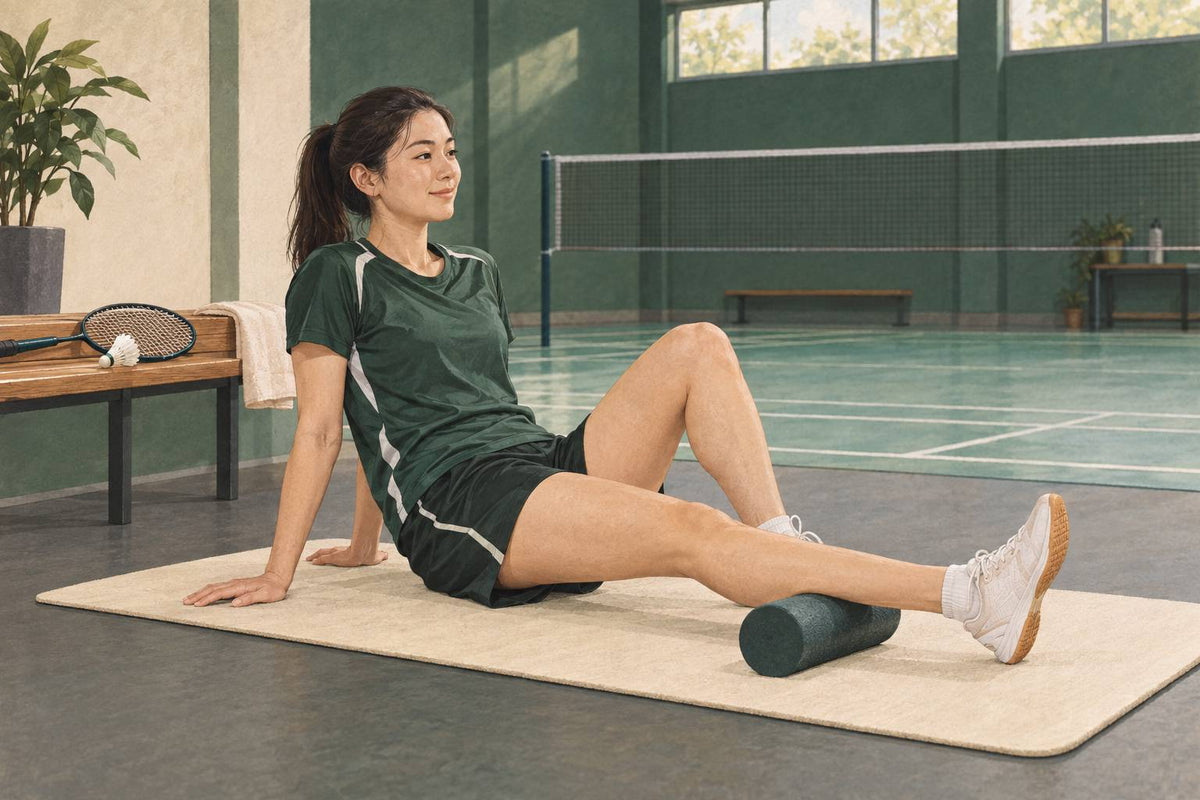
- Calves, 45 seconds each side: Sit with the roller under the fleshy part of the calf. Use your hands to control pressure and make slow passes through an area that feels ordinarily tight after play.
- Quads, 45 seconds each side: Lie face down and place the roller under the front of one thigh. Make small, easy passes over comfortable soft tissue rather than pressing directly on a joint.
- Glutes, 45 seconds each side: Sit on the roller and shift slightly toward one side. Use a hand or foot on the floor for control. This is an optional comfort stop, not a fix for hip pain.
- Lats, 45 seconds each side: Lie on your side with the roller below the armpit and make small, controlled passes along the side of the ribcage. Keep the pressure light and do not use it to force more shoulder range.
- Upper back, 30 seconds: Lie on your back with the roller across the upper back, hands supporting your head. Make small, comfortable movements and avoid any area that is painful or newly injured.
If five minutes is not practical, pick one area and then do a few pain-free bodyweight movements. The routine is intentionally short: it gives you a chance to assess whether you feel better without turning recovery into another demanding session.
You do not need to finish every stop for the routine to count. Choose the area that feels most relevant, use light pressure, then return to normal movement. If the roller makes you tense, hold your breath, or spend more time hunting for a “release” than moving comfortably, it is not serving the modest purpose this guide sets for it.
When to skip the roller and get help
Skip foam rolling when the issue feels like a new injury rather than ordinary post-session stiffness. A roller should never be a way to push through pain or to self-treat a symptom you are unsure about.
There are recognised contraindications and cautions because the pressure from a roller can be risky in some circumstances. The international Delphi consensus on foam-rolling cautions is a useful reminder to get individual advice before rolling when you have an acute injury concern or a relevant medical condition.
Keep pressure away from a newly injured or painful area. If symptoms persist, worsen, or change how you walk, lunge, or reach overhead, seek advice from a qualified clinician instead of adding more pressure.
The useful boundary is straightforward: ordinary, settling post-session tightness can be a reason to experiment gently; a problem that is new, worsening, or changing normal movement is a reason to stop experimenting. That is not a diagnosis. It is a way to keep a recovery habit from delaying a more appropriate assessment.
The practical verdict
- Use foam rolling for a small, immediate goal: comfort or easier movement.
- Keep it short, tolerable, and followed by normal movement.
- Do not use it to claim injury prevention or guaranteed performance recovery.
- Stop and seek qualified guidance when symptoms suggest more than routine training soreness.


Leave a comment
This site is protected by hCaptcha and the hCaptcha Privacy Policy and Terms of Service apply.