
Last reviewed: August 2026 · Written by the player-led team at Badminton House
Quick Answer: How to Be a Good Badminton Practice Partner
Agree the purpose of the drill, feed shuttles the worker can perform correctly, watch the quality of the rep, and trade roles on a plan you both accept. Your job is to make the next repetition useful, not to make it exhausting.
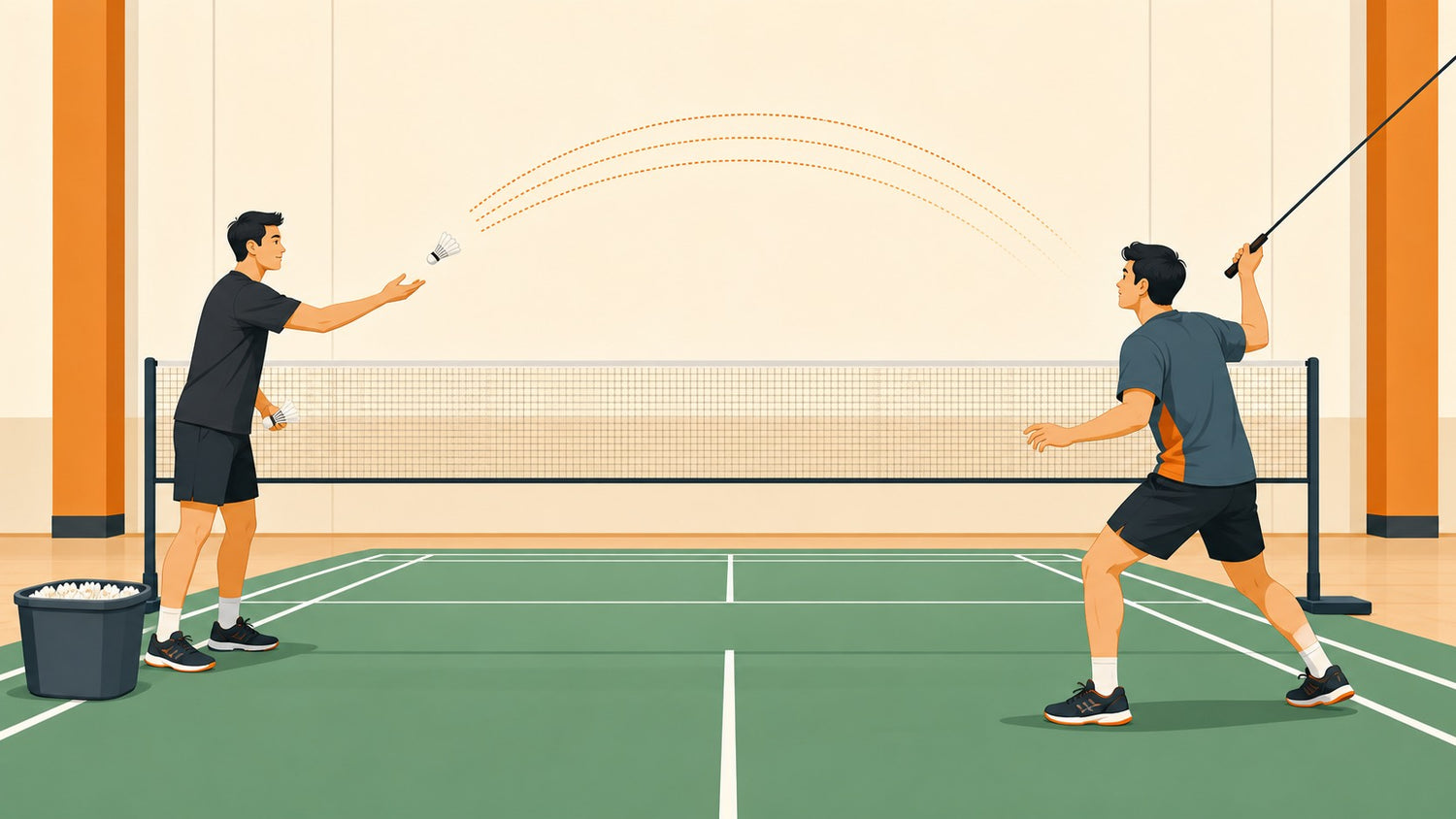
A useful practice partner does more than put shuttles over the net. They create repeatable chances for the other player to move, recover, and hit the shot the session is meant to train. That sounds modest, yet it changes whether a drill becomes deliberate practice or a scramble for whatever arrives next.
Partner feeding is a recognised badminton practice role. The BWF Level 1 coaching manual includes an exercise where one partner hand-feeds from the forecourt while the other practises a lift and lunge. BWF teacher education also calls accurate delivery at an appropriate pace an important feeding skill, because feed quality creates the conditions for good practice. See the BWF Level 1 coaching manual and the BWF Schools Badminton Teachers’ Manual.
Use this as a partnership rule: the working player owns the goal and the stop signal; the feeder owns repeatability and safety. Both players own the timer, the score, and the reset when the drill stops looking like the drill.
In This Guide
Agree the rep before the first shuttle
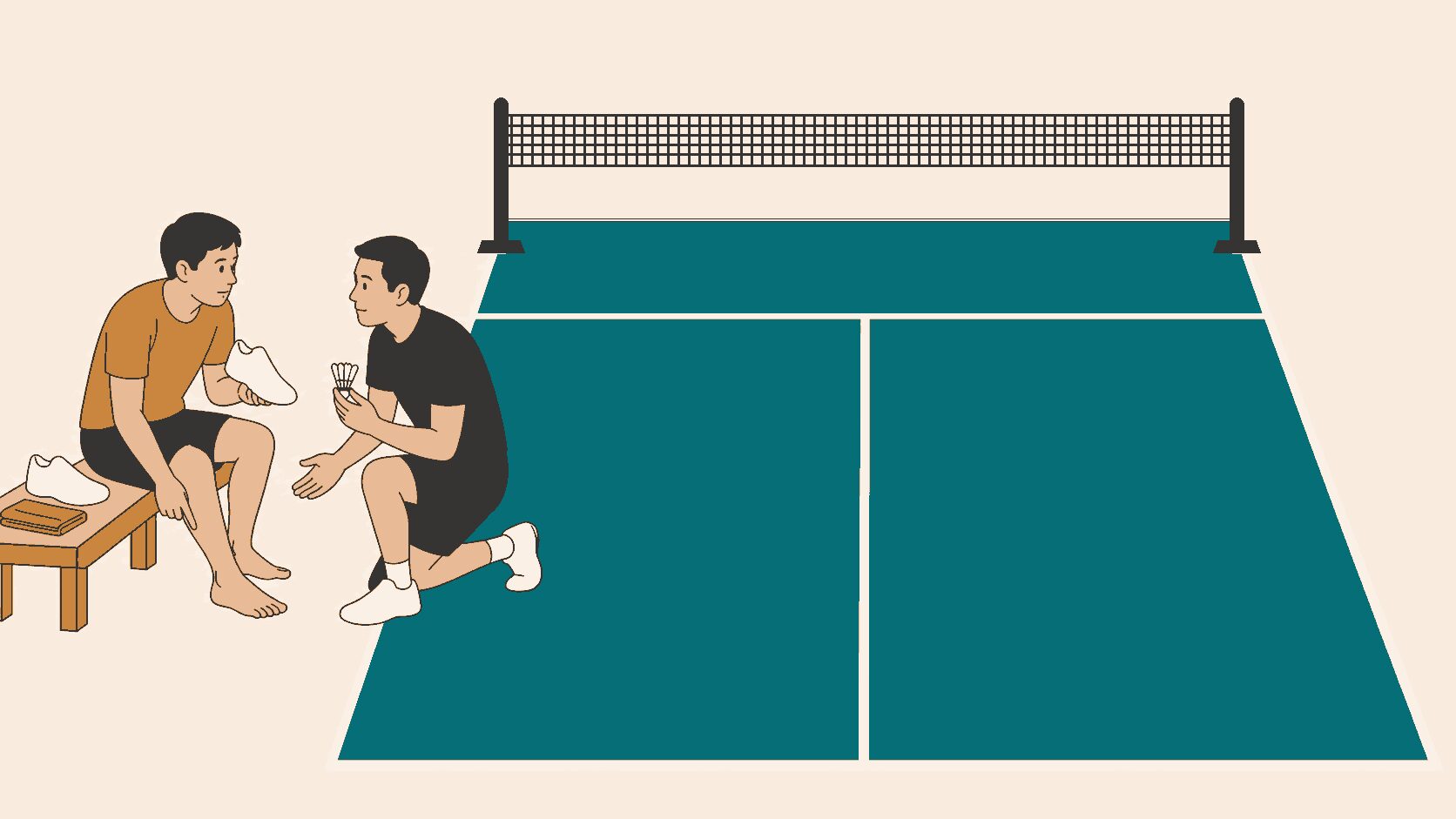
Good partner practice starts with one shared sentence: what shot or movement is being trained, where the feed goes, and what counts as a successful rep. That agreement prevents the feeder from improvising a different drill and lets both players tell when the task has become too hard, too easy, or simply unclear.
Try: “Feed my forehand rear corner; I will clear straight and recover to base. Count a good rep only when I reach the shuttle balanced.” That is enough detail for a short block. It gives the feeder a landing area, the worker a movement and shot, and both of you an observable standard.
Decide whether the drill is cooperative, competitive, or a bridge between the two. In a cooperative drill, the feeder repeats a usable pattern. In a competitive drill, the feeder is trying to expose whether the worker can still use the shot under pressure. The bridge is a simple score, such as five controlled clears before either player may change direction.
A one-sentence drill brief
“For the next block, feed [place/pattern]; I will [movement + shot]; success means [observable result].” This is Badminton House editorial guidance, not a formal coaching prescription. Its value is that either player can repeat it back before the first shuttle.
Feed for correct work, then raise the challenge
A good feed is repeatable enough for the worker to practise the intended movement and shot, while still asking them to move and recover honestly. Accuracy and appropriate pace are recognised feeding skills in BWF teacher education; a feeder should therefore judge success by the quality of the worker’s rep, not by how spectacular the feed looked.
Begin with a feed the worker can solve cleanly several times. If they are meant to practise a rear-court clear, keep the feed in the agreed rear corner and give enough time to arrive. Do not turn every third shuttle into a surprise net shot. Randomness has a place later, after the fixed pattern is working.
Use this simple escalation ladder as editorial guidance: first keep the direction and target fixed; then add a second possible direction; then let the feed vary within the agreed area. Change only one variable at a time. That way, when the worker loses quality, you know whether pace, range, direction, or decision-making caused it.
Your own skill level does not need to dominate the session. A stronger player can offer a controlled, honest feed. A newer player can be an excellent partner when they ask for a smaller pattern and concentrate on placing the shuttle. If you need a basic movement pattern to build from, use our badminton footwork basics guide before adding speed or random feeds.
“Could you feed me three steady rear-court shuttles, then one shorter one? I am working on recovering before I change direction.”
Give one useful cue, then let the rally happen
The best feedback is brief, observable, and delivered between repetitions rather than shouted during them. Badminton England advises simple, clear, concise instruction and clear, positive feedback. For a volunteer partner, one cue at a time is usually the most usable version of that guidance: name what you saw, name the next action, then feed again.
Say “you reached it, but your first step was late; start your split step before my contact,” rather than “move faster.” The first line gives a visible moment and a next attempt. If you are unsure what to say, ask a question instead: “Did that feed give you time to recover?” The worker may already know the problem.
Do not coach every shuttle. Let a block run long enough for the player to feel the pattern, then pause briefly. This is an editorial rule for partner practice, not a claim about an exact feedback frequency. It protects the drill from turning into a running commentary and gives the worker room to test the cue.
Consent matters here. Ask before giving technical advice, especially if the partner came to practise a specific drill rather than receive coaching. A simple “Want one observation after this set, or should I just feed?” makes the role clear. If the answer is “just feed,” be reliable and save the analysis for when they ask.
Match pace to recovery and reset early
Feed at the worker’s recovery pace, not at the fastest rhythm you can create. Watch whether they can reach the agreed area, play the intended shot, recover with control, and prepare for the next shuttle. If one of those pieces disappears repeatedly, slow the tempo, narrow the pattern, or pause and agree the next version.
Observation is part of good coaching practice, according to Badminton England, and it is just as useful when two club players train together. Watch the feet as well as the racket. Reaching late, stumbling through the recovery, or swinging when a partner is too close are reasons to reset the drill before somebody gets hurt or simply practises a poorer pattern. Badminton England’s coaching guidance also stresses clear demonstrations, concise instruction, positive feedback, and observation.
Be direct without making it personal: “That pace is making me rush the recovery. Can we slow it for the next ten, then build back up?” This gives the feeder a specific change and keeps the conversation about the drill. If a player says stop, a rally feels unsafe, or the court is crowded, stop the feed immediately. No rep is worth a collision.
A reset is not a failure. It is how you keep the next set honest. Collect shuttles, restate the one-sentence brief, and choose one adjustment: more space, a slower feed, a smaller range, or fewer shuttles before a break.
Make roles, scoring, and rotation fair
A practice partnership lasts when both players receive the work they came for. Decide the rotation before the first set, use comparable blocks when appropriate, and write down only what will improve the next session. Fairness does not mean identical drills; it means both players have a clear turn and purpose.
An 8–12 minute swap is a practical Badminton House editorial option, not an evidence-based dose. It is long enough to settle into a pattern and short enough that the feeder is not quietly sacrificed for half the court booking. Use a timer, a basket of shuttles, or a completed score as the handover trigger. Agree it before you start.
| Record | Keep it useful |
|---|---|
| Drill | “Rear-court clear: three fixed, one short.” |
| Success measure | “Balanced contact and recovery on 7 of 10.” |
| Next adjustment | “Add the second direction only after the fixed pattern holds.” |
Finish with one question each: “What should I keep doing as your partner next time?” and “What should we change?” That small debrief protects goodwill and turns the next court booking into a continuation, rather than another attempt to remember what went wrong.
A good practice partner is dependable, attentive, and easy to talk to. Feed the agreed shuttle. Match the pace. Give a cue only when it helps. Swap fairly. Those habits make you the person players want beside them when they are serious about getting better.

Leave a comment
This site is protected by hCaptcha and the hCaptcha Privacy Policy and Terms of Service apply.