

Last checked: August 2026 · Written by the player-led team at Badminton House
Quick answer
A feather shuttlecock starts as 16 matched feathers from one wing of a goose or duck, gets fixed into a leather-covered cork base by machine and hand together, then has to clear a weight and speed check before it ships. Every stage exists to solve the same problem: natural feathers are never perfectly uniform, so the build has to make them behave as if they were.
Start with Sorting Feathers Into a Matched Set of 16
Feather choice and sorting happen before any cork or thread is involved, and this step decides more of the finished flight than anything that happens later.
- Feathers are pulled from one wing only, never mixed left and right, and screened for curve, weight and shaft thickness.
- Each feather is set at a matched angle and fixed into the cork base, then bound firmly with thread.
- The cork base itself is either one solid piece or cork with a layer of polyurethane sandwiched inside, and the two age differently under smashes.
- A finished shuttle has to land inside a fixed weight and speed window, then pass a manufacturer's own grading before it reaches a tube.
Related reading: Duck vs Goose Feather Shuttlecock: Can Labels Predict Quality? — now that you know both species get sorted by wing and shaft thickness rather than by name, see whether the species label on the tube tells you anything else.
Sorting Feathers Into a Matched Set of 16
Every feather shuttle starts with 16 wing feathers from a goose or duck, always pulled from the same wing (never mixed left and right, since the two curve in mirrored directions and mixing them makes the shuttle fly untrue), then screened individually for curve, weight and shaft thickness before any feather reaches the cork base.
Manufacturers use large flight feathers taken from the wing of a goose or duck; badminton's construction rule does not require either species, so both appear across the market. Those feathers are also a byproduct of birds raised mainly for meat rather than for badminton, so the supply available for shuttlecocks tends to move with meat-farming economics: badminton felt this directly in 2024, when cheaper pork pulled demand away from other meats, duck farmers cut back production, and shuttlecock makers had a harder time sourcing feathers. reporting on the 2024 shuttlecock feather shortage
The 16 feathers set into one shuttle all come from the same wing, right or left, never mixed. A shuttlecock manufacturer's own production team states plainly that mixing wings changes the flight, because feathers from opposite wings curve in mirrored directions. manufacturer interview on feather sourcing Each candidate feather is then checked on its own: curve and weight get compared against the rest of the set, since either one can make the finished shuttle wobble, and shaft thickness across all 16 has to be even. That team's craftsmen say uneven shaft thickness is reason enough to reject a set even for a practice-grade tube.
Length comes last in sorting, not first. Badminton's Laws require all 16 feathers to measure a uniform 62 to 70 mm from tip to the top of the base, so a set that has already passed the curve, weight and shaft checks still gets trimmed to match before it goes anywhere near the cork.
Setting the Feathers Into the Cork Base
Once a matched set of 16 feathers clears sorting, each one is set at a slightly different angle, fixed into the cork base, and bound firmly with thread. One manufacturer's production line inserts feathers with a compressed-air process it calls feather thrusting, but the final balance check still comes down to a trained eye.
The 16 tips have to land on a circle 58 to 68 mm across, the part players call the skirt, and the construction rule requires the feathers to be fastened firmly with thread or another suitable material once they are seated. BWF Laws of Badminton, shuttle construction Getting a full, even skirt on every shuttle in a tube is why insertion is not a single step: that same production line sets each feather at a slightly different angle before fixing it into the cork with the compressed-air process, so the fan shape holds without gaps between feathers.
That angled, overlapping fan does more than look tidy. Because the 16 feathers overlap like shingles rather than sitting edge to edge, a properly built shuttlecock picks up a natural spin around its own axis as it flies, and as the receiving player sees it, that spin always turns clockwise. manufacturer craftsman interview Feathers are a natural material with real bird-to-bird variation, so no two behave exactly alike, which is the real reason hand judgment stays in the loop even where a machine does the physical insertion. That team put its own reasoning simply: because their shuttles are made from natural materials with their own behaviour, they check thousands of finished shuttles every day to hold manufacturing and flight consistent.

What the Cork Base Is Made Of
The base under those 16 feathers is a rounded piece of cork, 25 to 28 mm across, covered in a thin layer of leather. Manufacturers build that cork two ways: as one solid piece, or by sandwiching a layer of polyurethane between cork sections, and the two options hold up differently under repeated smashes.
The construction rule pins the base at 25 to 28 mm in diameter, rounded on the bottom, and every shuttle type, feathered or synthetic, is built to fly like the same reference construction: a cork base covered by a thin layer of leather. BWF Laws, shuttle base construction What sits under that leather covering is where construction choices diverge. Some corks are a single piece of natural cork. Others sandwich a layer of polyurethane between cork sections, a cheaper way to build a base at the same finished size. One manufacturer also states it sources the same grade of cork used for champagne bottles specifically because that grade holds shape better than the softer cork used for wine bottles.
The two base options hold up differently once a smash is involved. In one manufacturer's own durability test, a racket simulator smashed shuttles 40 times at 5 degrees Celsius: the polyurethane-sandwiched base came out misshapen because the polyurethane disintegrated, while the single-piece natural-cork base showed very little change in shape. manufacturer durability test That is a brand-run test rather than an independent study, so treat the exact numbers as one data point, but the result matches the plain mechanics of the two builds: a laminated joint inside the base gives repeated impact somewhere to fail that a single piece of cork does not have.
Finished-Shuttle Checks Before a Tube Ships
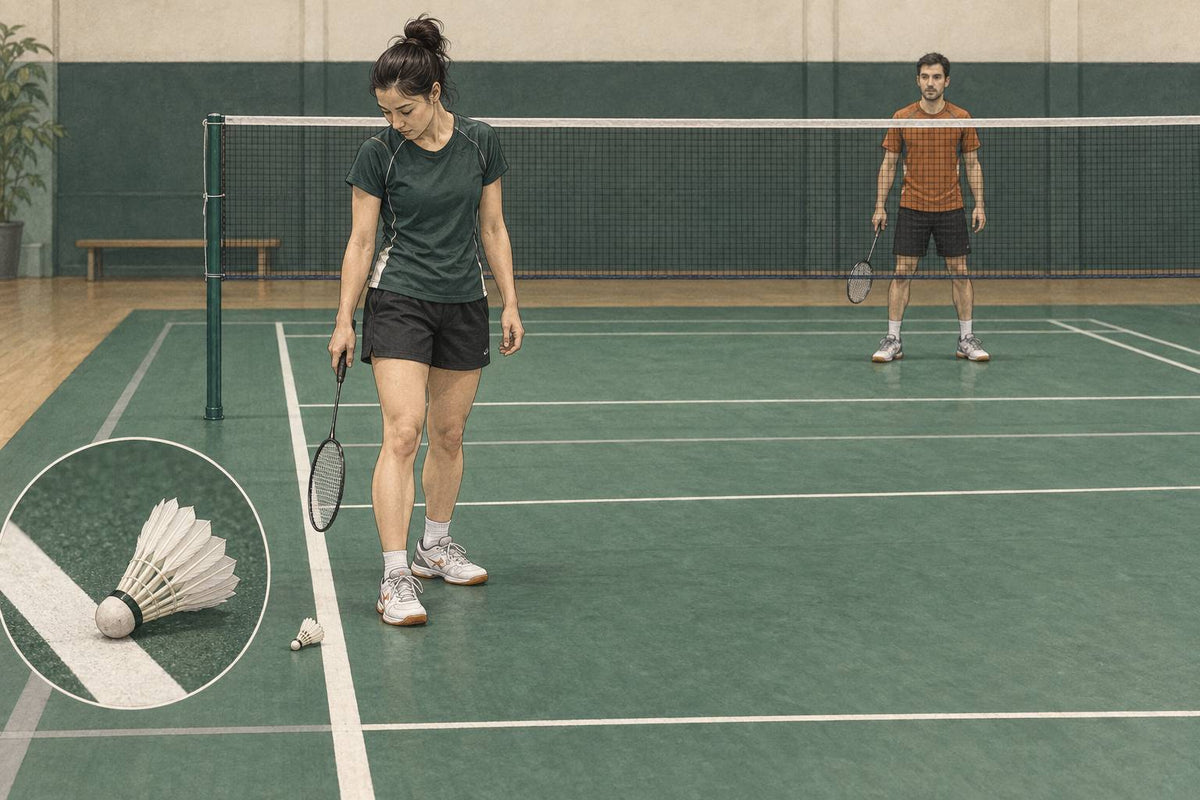
A finished feather shuttle must weigh 4.74 to 5.50 g, and clubs can test its speed with the same method the rule sets out: a full underhand stroke from the back boundary line, upward and parallel to the sidelines. A correct shuttle lands 530 to 990 mm short of the far boundary; manufacturers grade further from there.
The speed test is built to be simple: a full underhand stroke that contacts the shuttle above the back boundary line, hit upward and parallel to the sidelines, then a look at where it lands relative to the far back boundary. Landing more than 990 mm short of the far back boundary indicates a slow shuttle; landing less than 530 mm short indicates a fast one. BWF Laws, testing a shuttle for speed Anyone can run this on a normal court with a marked floor and an ordinary serve action, which is exactly why it is the standard test rather than a lab-only measurement.
Passing the weight and speed windows is a floor, not a finish line. One manufacturer's craftsmen describe inspecting roughly ten aspects of every finished shuttle, including how circular the feather spread is and the condition of each individual feather, and flight-testing every grade they sell, from tournament shuttles down to practice tubes. manufacturer inspection process Their stated reason is that natural feathers behave inconsistently from batch to batch, so consistency has to be checked in rather than assumed.
Breakage is the harder problem no amount of checking fully solves. Researchers building a new feather-testing method note that feather shuttlecocks used in official competition already have an unsustainably high replacement rate from ordinary racket strikes. peer-reviewed feather compression study That is the real payoff of everything upstream: matched wing feathers, even shaft thickness, a firm thread bind and a solid cork base each remove one way a shuttle can go out of true early, even though no amount of sorting stops a feather shaft from eventually snapping under a smash.

Leave a comment
This site is protected by hCaptcha and the hCaptcha Privacy Policy and Terms of Service apply.