
Last checked: August 2026 · Written by the player-led team at Badminton House
Quick answer
Keep feather shuttles in their capped tubes at stable room temperature, away from direct sun, heaters and parked cars. Follow the maker’s care instructions and inspect feather condition before play; do not assume one humidity percentage suits every product.
Related reading: Should You Steam Feather Shuttlecocks? covers the fix for feathers that have already dried out and gone brittle; this guide is about stopping that from happening in the first place.
Why Humidity and Heat Wreck Feather Shuttles
Feather shuttlecocks are a natural material: the feathers and the glue joint holding them into the cork base both react to moisture. Too much humidity keeps the glue from curing and leaves the feathers soft; too little humidity hardens the glue and dries the feather stems until they turn brittle and snap under a hard shot.
Shuttlecock manufacturers see this trade-off directly. Too much residual moisture during production keeps the glue from curing properly, leaving the feathers soft and the structure unstable. Dry a shuttle too fast, and the glue turns hard and brittle while the feather stems lose flexibility; aggressive high-heat drying can also dry the outer feather faster than the internal glue area, curing the joint unevenly (Anhui Delo Feather's drying and dehumidification notes).
Dry conditions can reduce feather resilience and make breakage more likely, as VICTOR’s shuttle-care guidance explains. This supports avoiding dry storage, but does not establish a universal storage-humidity target or a promised number of extra rallies.
How to Store Shuttles as an Individual Player
Keep tubes capped until needed, away from a bone-dry cupboard or a steamy bathroom. Check the product’s storage instructions and let tubes reach room temperature before using them.
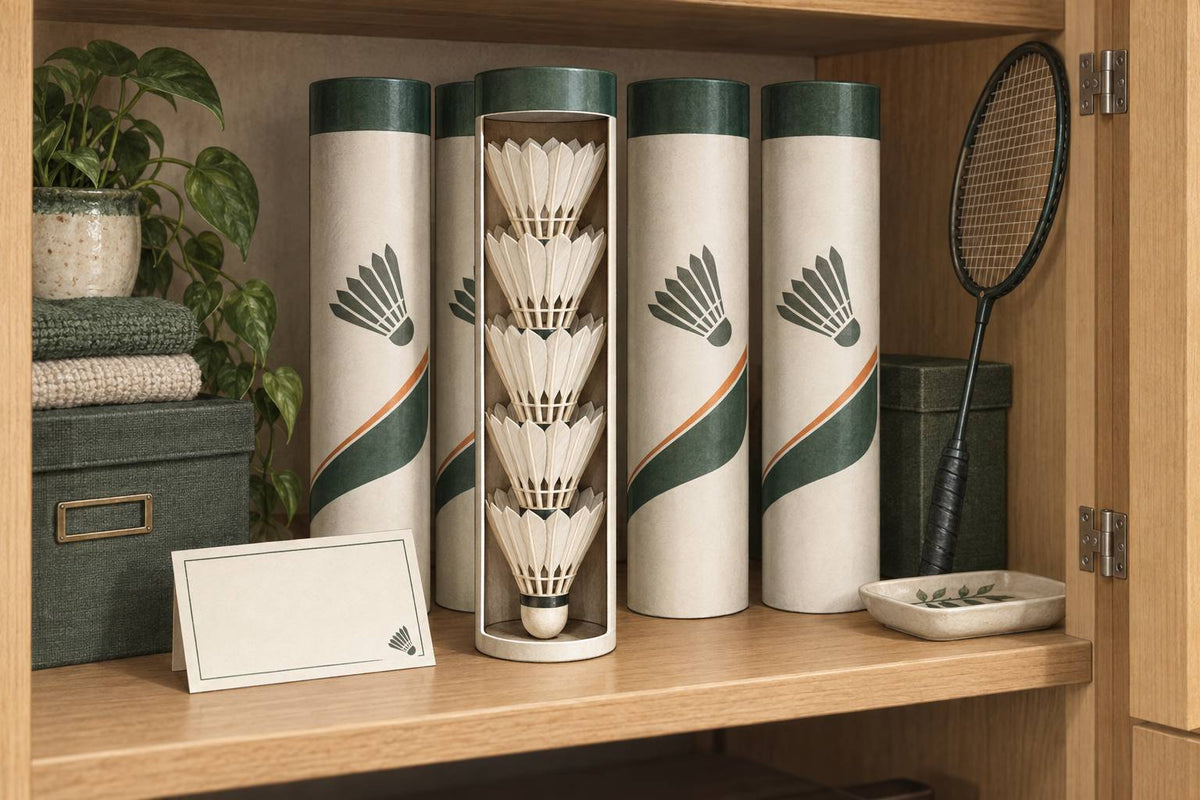
Use the original tube to protect the feathers. YONEX’s shuttle-care notes recommend vertical storage with cork heads downward and explain the tube lining’s role in moisture retention.
Before play, look for split or fraying quills and distorted skirts. Handle feathers gently and test the shuttle’s flight; a soft warm-up does not repair a broken feather or guarantee that a dried-out shuttle is ready.
A Club-Level Storage and Rotation Routine
Give club shuttles one stable storage location and separate unused stock from open practice tubes. A simple tube rotation can help track condition and use, but should not be treated as a proven way to restore tired feathers.
Store cases off the floor and away from radiators, vents and exterior doors. Label open tubes so staff can distinguish fresh stock from shuttles already used in practice. Between sessions, some coaches keep spare tubes cork-down in a cool bag rather than loose in a kit box (IntoBadminton’s shuttle-care notes).
Before doors open, inspect a sample from the case and test its flight. If it seems brittle, review the storage conditions and maker’s conditioning guidance before putting the whole case into play.
What Not to Do (and Why)
Avoid storing tubes next to a heater or leaving them in a parked car through temperature extremes. Protect the feathers from unnecessary heat and moisture changes; do not assume every storage problem is irreversible or repairable.
- On top of a radiator, near a heating vent, or in a hot attic. Choose a sheltered indoor cupboard instead of a place exposed to direct dry heat.
- In a car trunk, winter or summer. A parked car swings between extremes in both directions: baking and drying feathers on a hot day, then stiffening them in a hard freeze overnight. Storage guidance flags a vehicle as its own separate hazard.
- Anywhere it sits through a hard freeze. Extreme cold stiffens feathers and forces a slow warm-up before they can take a full-pace shot, so a case left overnight below freezing is not ready to play straight out of the bag.
Dry indoor heating is the quiet version of the same problem: a furnace running all winter keeps pulling moisture out of every open tube in the room, so a case that flew fine in October can be snapping shuttles by January unless someone tops up the humidity.
Store shuttles like this
- Keep tubes capped at steady room temperature and follow the manufacturer’s storage guidance.
- Inspect feather condition and test flight before full-pace play.
- Label open tubes and keep used practice shuttles separate from fresh stock.
- Never store shuttles on a radiator, near a heating vent, or in a car.


Leave a comment
This site is protected by hCaptcha and the hCaptcha Privacy Policy and Terms of Service apply.