
Last checked: August 2026 · Written by the Badminton House player-led team.
Quick answer: hybrid only makes sense when it tests one clear goal
Goal
Test one change: define the feel, control, or durability question before choosing two strings.
Limits
Use the exact racket model, maker's tension range, approved pattern, and product-specific guidance.
Compare
Record the full setup and judge it against a known full-bed baseline; no recipe guarantees a better result.
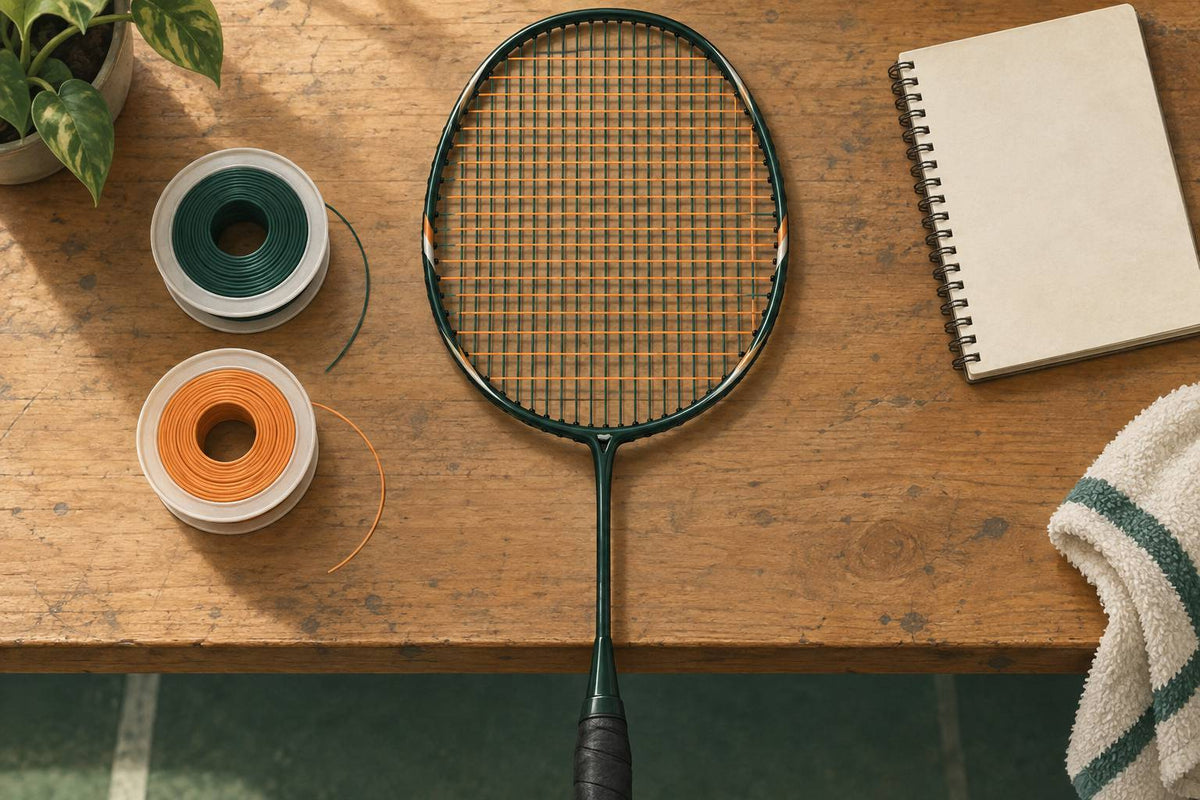
Hybrid badminton stringing means putting different string constructions in the mains and crosses of one racket. Players usually consider it when one string gives a useful feel or resilience and another offers a different response. The setup is an experiment with a purpose, not an automatic upgrade.
The important distinction is between what a product page specifies and what a player hopes to feel. A commercial hybrid can prove that two strings are designed to work together in one named product. It cannot prove that every thick-main, thin-cross combination will suit every racket or player.
What is hybrid badminton stringing?
Hybrid badminton stringing uses one string for the vertical mains and a different string for the horizontal crosses. The two materials share one string plane, so the final response depends on their interaction, the racket geometry, the pattern, the tensions, and where the shuttle strikes.
Yonex AEROBITE is a clear official example. Its specifications identify 0.67 mm mains and 0.61 mm crosses, with different construction details for the two directions. That establishes that a purpose-built badminton hybrid can assign distinct strings to the mains and crosses. It does not establish a universal gauge order or a guaranteed performance benefit. See the AEROBITE specifications for the product's exact construction.
A hybrid is practical because the stringing job can separate the mains and crosses into two sections. The exact knots, starting points, skipped holes, and tie-offs belong to the racket's approved pattern and the stringer's method. Do not assume that a product sold as a hybrid makes every two-string arrangement safe.
Keep the objective narrow. “I want a different response at the net” is testable. “I want the best of both strings” is not. A clear objective makes it easier to choose a baseline, compare the result, and decide whether the added complexity was worthwhile.

Which hybrid string recipe should you try?
Choose a hybrid recipe by the single change you want to test, then treat the result as product-specific. A thicker or more durable-feeling main with a thinner or more textured cross may alter the bed's response, but it does not guarantee longer life, sharper bite, more power, or greater comfort.
| Goal to test | Possible experiment | What to record |
|---|---|---|
| Protect the feel of a familiar main | Keep your usual main and change only the cross | Net control, launch angle, and whether the response remains familiar |
| Test a crisper or more textured contact | Use the chosen construction in only one direction | Slice, net-shot confidence, and mishit tolerance |
| Compare durability and feel | Use a familiar full bed as the baseline, then test one hybrid | Hours played, break location, changing feel, and visible wear |
These are trial categories, not universal prescriptions. A textured cross can feel different from a smooth cross, but the result depends on its coating, diameter, tension, racket, and impact pattern. A thicker main may change the bed's response, but it does not automatically make the complete job more durable.
Factory hybrids are also not interchangeable. Yonex markets AEROBITE around control and precision, while Ashaway describes Rogue Duo with separate RD68 and RD61 roles and its own tension guidance. These are manufacturer claims for named products, not independent proof that every hybrid delivers the same benefit. Rogue Duo's specifications show why its recommendation must stay product-specific.
If you cannot name the result you want to compare, use a known full bed instead. One consistent string, recorded tension, and repeatable play gives you a better baseline than changing two variables at once.
What limits apply to a hybrid job?
The racket maker's tension range and stringing pattern remain the controlling limits. A hybrid product page cannot override your racket's model-specific instructions, and another racket's routing, tension offset, or knot layout cannot be copied safely without checking the correct manual.
Yonex's ASTROX 70 page gives a model-specific 4U range of 18–26 lb and separate instructions for string starts, skipped holes, and tie-offs. That information belongs to the ASTROX 70. It is an example of why your stringer needs the exact model rather than only the brand name. Read the ASTROX 70 stringing advice as model documentation, not a universal hybrid template.
Do not assume a universal mains-to-crosses tension difference. Some product instructions use one relationship, while another hybrid can specify a different one. The Rogue Duo specifications, for example, give separate limits and recommend its crosses 5% below its mains. That recommendation belongs to that product.
A two-string setup also does not make four knots universally mandatory. The number and location of knots depend on the racket's pattern, the manufacturer's instructions, and the stringer's chosen method. Ask which method will be used and whether it follows the racket's published routing.
The string plane is mechanically coupled. Experimental and simulation research on badminton strings reported changes in elasticity, natural frequency, vibration, and impact response when material, diameter, tension, pattern, and impact location varied. That supports testing a hybrid as a complete racket rather than judging it from string labels alone.
How should you run a hybrid badminton stringing trial?
Make one hybrid trial interpretable by recording the baseline, changing one planned setup, and using clear stop conditions. Keep the racket, player, shuttle type, tension notation, and test period visible so a later decision is based on evidence rather than a first-session impression.
- Write the baseline. Record racket model, grip setup, current string, mains and crosses tension if known, string age, and the shots or situations you want to improve.
- Choose one goal. Pick control, response, durability comparison, or another specific outcome. Do not combine a new racket, new grip, new shuttle, and new hybrid if you want to learn what changed.
- Confirm compatibility. Give the stringer the exact racket model and ask for the maker's tension limit, pattern, starts, skips, tie-offs, and any product-specific hybrid instructions.
- Keep a short log. After each session, note hours played, the feel on your chosen shots, visible notching or fraying, and whether the racket still feels predictable.
- Stop when the setup is unsafe or unhelpful. Stop playing if the frame is damaged, the string bed behaves unpredictably, or the job exceeds the maker's instructions. Revert to the baseline when the hybrid adds complexity without a clear benefit.
Use one completed comparison line
A useful record is specific enough to repeat: “Racket: [exact model]. Baseline: [string], [mains/crosses tension], strung [date]. Hybrid: [string A] mains, [string B] crosses, [requested tensions], strung [date]. Goal: make tight net shots feel easier to control without losing predictable clears.”
| After each session | Example neutral note |
|---|---|
| Chosen shot | “Net replies felt predictable in 7 of 10 cooperative feeds.” |
| Trade-off | “Rear-court clears required more effort than the baseline today.” |
| Condition | “No frame issue; light notching visible at two centre intersections.” |
Do not compare adjectives alone. Pair “crisper” or “softer” with the shot, condition, and consequence you observed. After several ordinary sessions, choose one of three outcomes: keep the hybrid, run one controlled follow-up, or return to the baseline. A clear “no useful difference” is a successful test result.
Use a test period long enough to compare ordinary club sessions rather than only the first ten hits. The exact duration is your comparison choice, not a universal break-in rule. If a string breaks early, record where it broke and what you were doing instead of treating the failure as proof that every hybrid is unsuitable.
For the difference between mains and crosses, refer to our mains-versus-crosses tension guide, then bring the hybrid question to your stringer. This article does not replace the racket maker's pattern instructions.
What should you say to the stringer?
Give the request in one complete sentence: “Please use [string A] in the mains and [string B] in the crosses on my [exact racket model]. My goal is [one measurable change]. Please confirm the approved tension range, pattern, and method before starting.”
Ask whether both strings are available for the job and ask what the quoted price will be. Confirm the final notation in writing, including mains, crosses, units, string names, and the date. Clear records make the next comparison much easier.


Leave a comment
This site is protected by hCaptcha and the hCaptcha Privacy Policy and Terms of Service apply.