
Last checked: August 2026 · Written by the Badminton House player-led team.
Quick answer: should you ice after badminton?
Do not ice every sore joint automatically. For ordinary post-session stiffness, choose recovery habits you can repeat. A wrapped cold pack can provide short-term pain or swelling relief after an acute sprain or strain, but it does not prove that healing is faster.
The useful question is not simply whether ice is good or bad. It is whether you have routine soreness, a new localized injury or another match soon. A local cold pack, cold-water immersion and icing every tired area after club night are different interventions with different evidence.
Related reading: Our badminton recovery guide covers sleep, food, rest days and training load. For cold-water immersion rather than a local pack, see hot shower, cold shower or ice bath after badminton.
Is it routine soreness or a new injury?
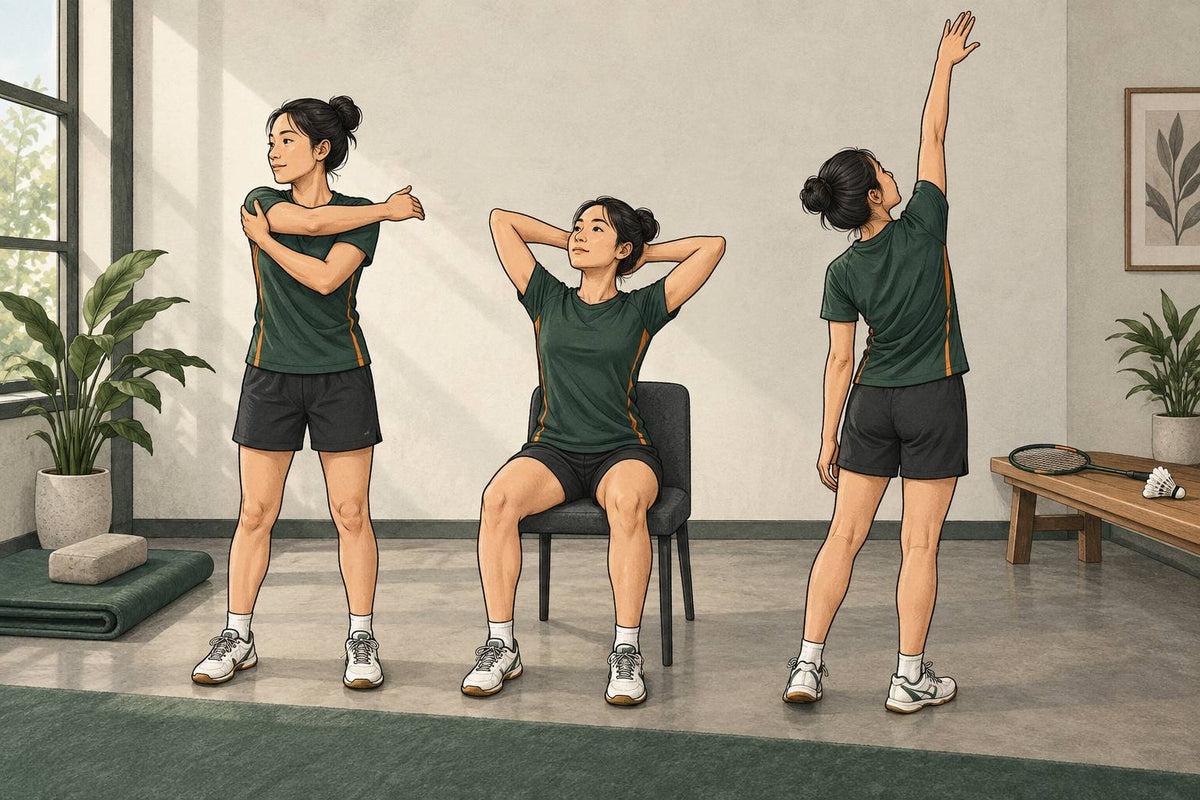
General stiffness after a demanding session is different from a sharp, localized event with immediate swelling, bruising, weakness or loss of function. If both calves feel evenly tired the next morning, there is no evidence-based requirement to cool them. Walk for a few minutes, move through a comfortable range, eat normally, drink to thirst and protect your sleep.
A discrete incident is different: you landed awkwardly, collided with another player, felt a sudden pull or developed swelling in one area. Stop the movement that hurts and decide whether you need assessment. Ice can be a comfort measure while you arrange care, but temporary numbness does not reveal how serious the injury is.
Do not use the next morning as a toughness test. If walking, weight bearing, joint motion or normal push-off is clearly reduced, the priority is understanding the injury, not repeating a recovery ritual.
What does the current evidence say about ice?
Modern guidance is more cautious than the old rest, ice, compression and elevation slogan. The PEACE and LOVE soft-tissue framework says high-quality evidence that ice improves soft-tissue injury outcomes is lacking and questions routine cooling as a healing intervention.
That does not mean cold has no use. The 2024 American Heart Association and American Red Cross first-aid guideline accepts cold as a short-term way to reduce pain and swelling after an acute sprain or strain. It also says cold has not been shown to improve function or shorten recovery. Relief and healing are separate claims.
Method and repetition matter too. A review of post-exercise cooling and heating found context-dependent acute effects and reported that repeated cooling after resistance training can impair some strength adaptations. That evidence concerns repeated post-exercise protocols; it does not prove that one short local pack harms every badminton player.
Cold-water immersion is another category. A systematic review of immersion after high-intensity exercise found some short-term improvements in soreness and perceived recovery. Those results cannot be transferred automatically to a small ice pack on one knee.
When is ice a reasonable choice?
Use local cold when short-term symptom control is useful after an acute sprain or strain or while you arrange assessment. The purpose is comfort and short-term symptom relief, not proof that the tissue is repairing faster.
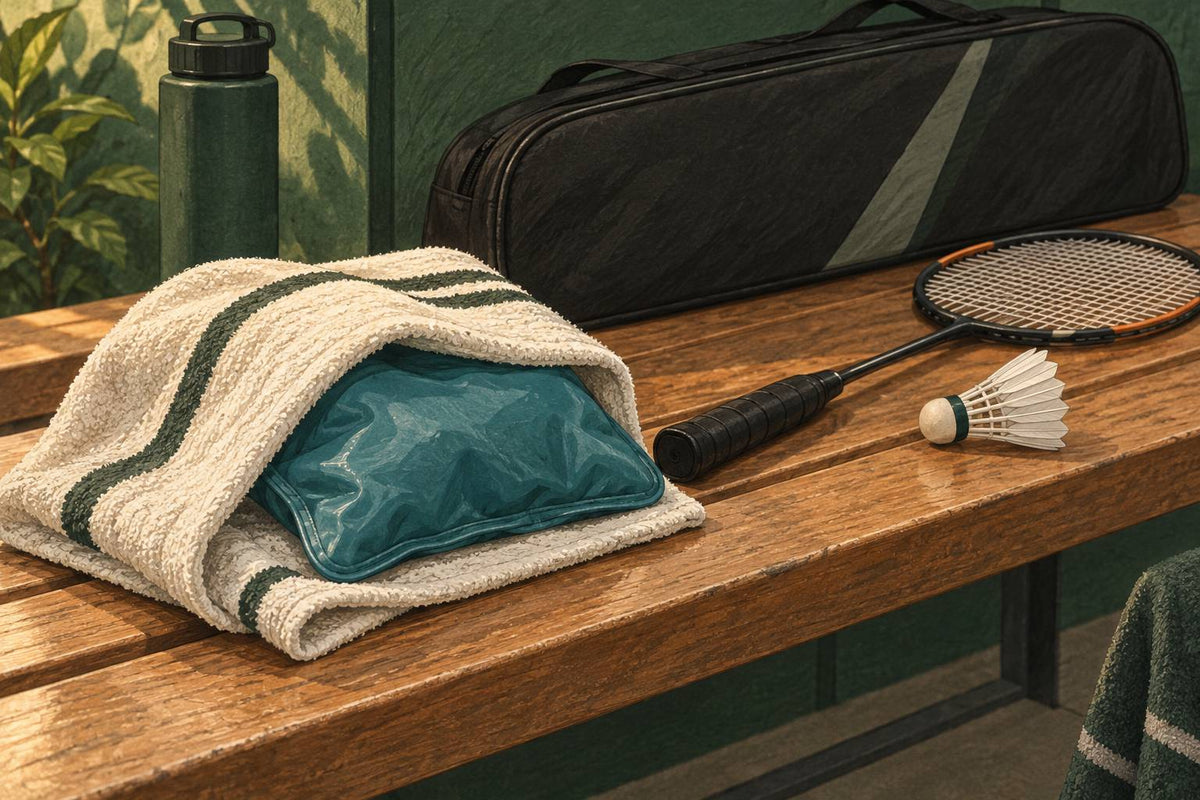
- Wrap the cold source: use a damp cloth or towel between it and the skin.
- Keep the application brief: the 2024 first-aid guideline limits an application to 20–30 minutes.
- Protect the skin: do not place the cold source directly on bare skin.
- Recheck function: relief does not make limping, marked weakness or lost joint motion safe.
Do not apply ice directly to bare skin. Limit each application to 20–30 minutes.
What should you do after a normal hard session?
After a normal session, choose the recovery habits that fit your normal routine and leave you ready for the next session. Cold is optional comfort, not a requirement.
| What happened? | Best first move | Role of cold |
|---|---|---|
| Even soreness after club night | Easy movement, food, sleep and load review | Optional comfort; no need to make it routine |
| New localized sprain or strain | Stop painful activity and consider assessment | May briefly reduce pain or swelling |
| Another match later the same day | Use a tested competition-day recovery plan | Immersion evidence is short-term and distinct from packs |
| Worsening pain, weakness, swelling or bruising | Arrange medical assessment | Do not use numbness as permission to play |
If you choose cold because it feels good, keep the choice optional. A routine becomes unhelpful when it delays eating, sleep, sensible load adjustment or assessment of a new injury.
When is ice not enough?
Seek prompt medical care for severe pain, a visible deformity, or a clear loss of movement or ability to bear weight. A cold pack can make an injured area feel quieter without making the underlying problem safer.
If you are unsure whether the problem is ordinary soreness or a structural injury, stop playing and ask a qualified clinician. Do not repeatedly ice, retest and return to the court until the pain breaks through again.
The practical rule
Use brief wrapped cold for comfort when it helps. Do not make it mandatory after normal play, and never let symptom relief replace injury assessment.

Leave a comment
This site is protected by hCaptcha and the hCaptcha Privacy Policy and Terms of Service apply.