
Last checked: August 2026 · Written by the Badminton House player-led team.
Quick answer: how do you check thoracic mobility for badminton?
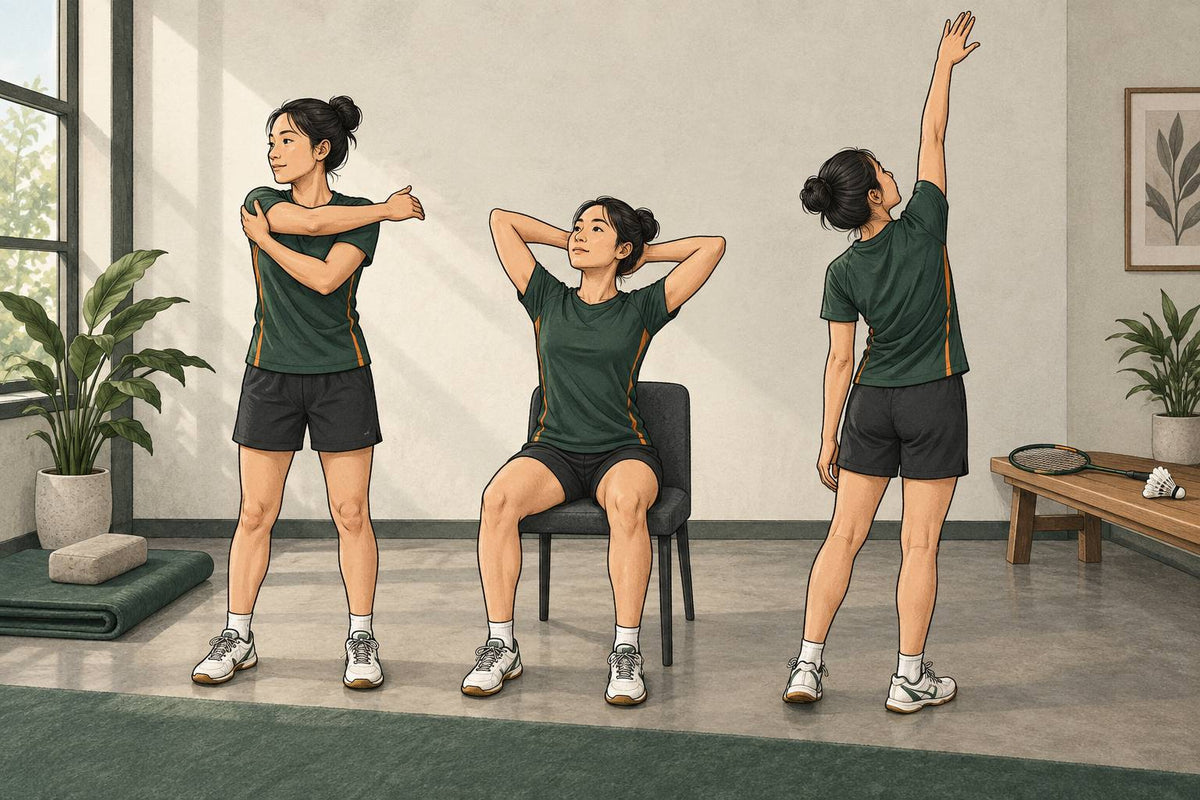
Compare side-lying rotation, seated rotation and upper-back extension at a wall. Look for smooth, pain-free movement without the pelvis, ribs or lower back taking over. These are coaching checks, not diagnostic cutoffs. Use the clearest limitation to choose one drill, then retest under the same conditions.
Rotation
Side-lying open book → supported open-book rotations.
Control
Seated comparison → seated reach rotations with the pelvis still.
Extension
Wall reach → wall-supported overhead reaches without rib flare.
Badminton overhead shots combine shoulder motion with trunk rotation, extension, strength and timing. If the mid-back contributes very little, a player may compensate elsewhere. That observation does not prove the upper back caused pain or a technical error. Test first, train gently and judge progress by smoother movement rather than forcing a larger range.
Safety boundary: stop for sharp pain, numbness, tingling, dizziness, unusual weakness or loss of coordination. Persistent shoulder, neck or back symptoms need individual assessment.
Why does thoracic mobility matter in badminton?
The thoracic spine is the middle and upper-back region connected to the ribs. Its ability to rotate and extend helps position the trunk and shoulder blade during overhead preparation. It is one contributor among many: shoulder range, strength, timing, hitting technique, training tolerance and footwork also shape the movement.
Research offers a reason to observe thoracic motion, but not a badminton diagnosis. In an observational study of 53 male baseball players with MRI findings of posterosuperior impingement, reduced upper-thoracic movement was associated with throwing pain. Baseball is another overhead sport, and an association cannot show that limited movement caused the pain.
The practical use is narrower: if your trunk hardly rotates while the lower back arches or the shoulder strains for range, practise the missing movement gently and see whether the overhead pattern becomes easier. If pain persists, assessment matters more than stretching harder.

Check 1: side-lying open-book rotation
This check compares left and right rotation while the bent legs limit pelvic movement. A useful result is smooth, comfortable motion with the knees stacked and no need to wrench the shoulder toward the floor. There is no universal pass angle.
- Lie on your side with hips and knees bent, knees stacked and arms straight in front.
- Keep the knees together while opening the top arm across your body.
- Pause when the pelvis wants to roll, the ribs flare or the shoulder becomes uncomfortable.
- Repeat on the other side and compare control, breathing and the point where compensation begins.
Matched drill: stay in the same position. Breathe out slowly as the top arm opens, pause for one comfortable breath and return under control. Support the top arm on a pillow if the shoulder hangs uncomfortably. Start with two sets of six slow repetitions per side.
A measurement study of side-lying thoraco-lumbar rotation found good repeatability between and within assessors, while also noting that clinical applicability needed further research. That supports a consistent setup and personal trend—not a magic normal number.
Check 2: seated rotation control
The seated check makes it easier to see whether the feet, knees or pelvis move before the trunk rotates. Compare sides rather than chasing a fixed angle. The useful question is whether you can stay tall and turn smoothly without leaning or shifting the lower body.
- Sit on a firm chair with hips and knees near 90 degrees and both feet flat.
- Cross your arms over your chest and keep your head comfortably aligned with the trunk.
- Rotate to one side without lifting a foot, sliding a knee or shifting the pelvis.
- Return to centre and compare the other side for range, control and comfort.
Matched drill: sit tall with the feet fixed. Reach one hand gently toward the outside of the opposite knee while the other hand rests across your chest. Rotate through the ribs, return without leaning and repeat for two sets of six each side.
A side-to-side difference is a training flag, not a diagnosis. Small asymmetries are common, and a badminton player may organize a forehand and backhand differently. Track whether the smaller side becomes smoother and whether the change transfers to easy shadow swings.
Check 3: wall extension and overhead reach
The wall check looks at upper-back extension and rib control during an overhead reach. A useful result is comfortable upward arm motion while the ribs and pelvis remain quiet. If the lower back arches or the ribs jump forward, reduce the range instead of forcing the hands higher.
- Stand with your upper back against a wall, feet slightly forward and knees relaxed.
- Let the lower ribs settle without flattening the entire spine aggressively.
- Bring the arms into a comfortable goal-post shape and slide them upward.
- Stop before the lower back arches, the ribs flare or the shoulders become painful.
Matched drill: repeat the wall reach only within the controlled range. Breathe out as the arms rise, pause briefly, then lower slowly. Use two sets of six. The wall is feedback, not a demand that wrists and elbows stay glued to it.
If the check changes immediately after easy movement, you may have found a useful warm-up option. If it does not change, do not increase force. The limitation may involve the shoulder, ribs, comfort, motor control or a normal body-shape difference rather than a stretchable thoracic restriction.
What can mobility work actually change?
Thoracic exercise can improve measured motion in some groups, but the research does not justify promising faster badminton shots or automatic shoulder protection. A 2026 randomized study of 42 professional male soccer players found improved bilateral thoracic rotation after six weeks of thoracic exercise performed three times weekly. That result supports trainability of the measure, not direct transfer to badminton performance.
A four-week randomized study in 36 adolescent volleyball players found improved hyperextension within the mobility group, but the added programme did not outperform regular training for strength, endurance or serve speed. This is an important limit: a mobility test can improve without the sport skill automatically improving.
| Reasonable expectation | Unsupported shortcut |
|---|---|
| Smoother or larger movement on the same check | A guaranteed faster smash |
| More options for overhead preparation | Proof that mobility caused or cured shoulder pain |
| A repeatable warm-up or accessory routine | A replacement for strength, technique, recovery or load progression |
How should you add the drills to badminton training?
Choose the one drill that matches the clearest observation. Use five to eight easy minutes after general activity or as a separate short session two to four times weekly. Before a match, use only comfortable dynamic repetitions; save exploratory range work for training or another day.
- Weeks 1–2: two sets of six controlled repetitions, then one easy overhead shadow sequence.
- Retest: use the same position, time of day and warm-up so the comparison means something.
- Transfer: add relaxed shadow swings or clears only when the new range remains controlled.
- Progress: improve control and breathing before adding resistance or more range.
For the joints below the trunk, our hip and ankle mobility guide uses the same test-train-retest idea. If your shoulder is already sore, start with our badminton shoulder-pain guide or the shoulder rotation total-arc screen.
The practical rule
Compare movement without chasing arbitrary numbers. Train the check that is clearly limited, retest consistently and convert any new range into easy badminton movement. Pain or neurological symptoms need assessment, not a harder stretch.

Leave a comment
This site is protected by hCaptcha and the hCaptcha Privacy Policy and Terms of Service apply.