
Last checked: August 2026 · Written by the Badminton House player-led team.
Quick answer: are compression socks worth wearing for badminton?
Compression socks have their strongest practical case for long travel and are a reasonable optional recovery experiment. They are not a proven badminton-performance booster. During play, use them only if the fit, warmth and court-shoe feel remain comfortable.
| Use case | Verdict | Reason |
|---|---|---|
| During play | Optional | No reliable badminton-performance case; comfort and fit decide. |
| After play | Reasonable experiment | Recovery evidence is more encouraging than performance evidence. |
| Long travel | Strongest case | Long-flight research supports less lower-leg swelling in suitable travellers. |
Compression socks are marketed as if a tighter calf automatically means faster movement, less fatigue and better tournament recovery. The evidence is more modest. Compression is a garment choice that may help some recovery and travel situations, but it cannot replace a well-fitting court shoe, sensible training load or medical assessment when swelling has an unexplained cause.
Related reading: Our badminton socks guide covers grip, cushioning, thickness and in-shoe fit. This article focuses on graduated compression.
What does compression mean on a sock?
Graduated compression is tightest near the ankle and progressively less tight farther up the leg. The pressure is reported in millimetres of mercury, written mmHg, normally at the ankle. Clinical guidance on graduated compression uses ankle pressure to define classes; it does not treat “snug,” “support” or “compression fit” as equivalent measurements.
A regular tall sports sock can feel tight without producing a measured gradient. A true graduated garment should state its pressure range and provide a sizing chart. Measure where the chart tells you—usually the ankle and widest calf—rather than choosing solely by shoe size.
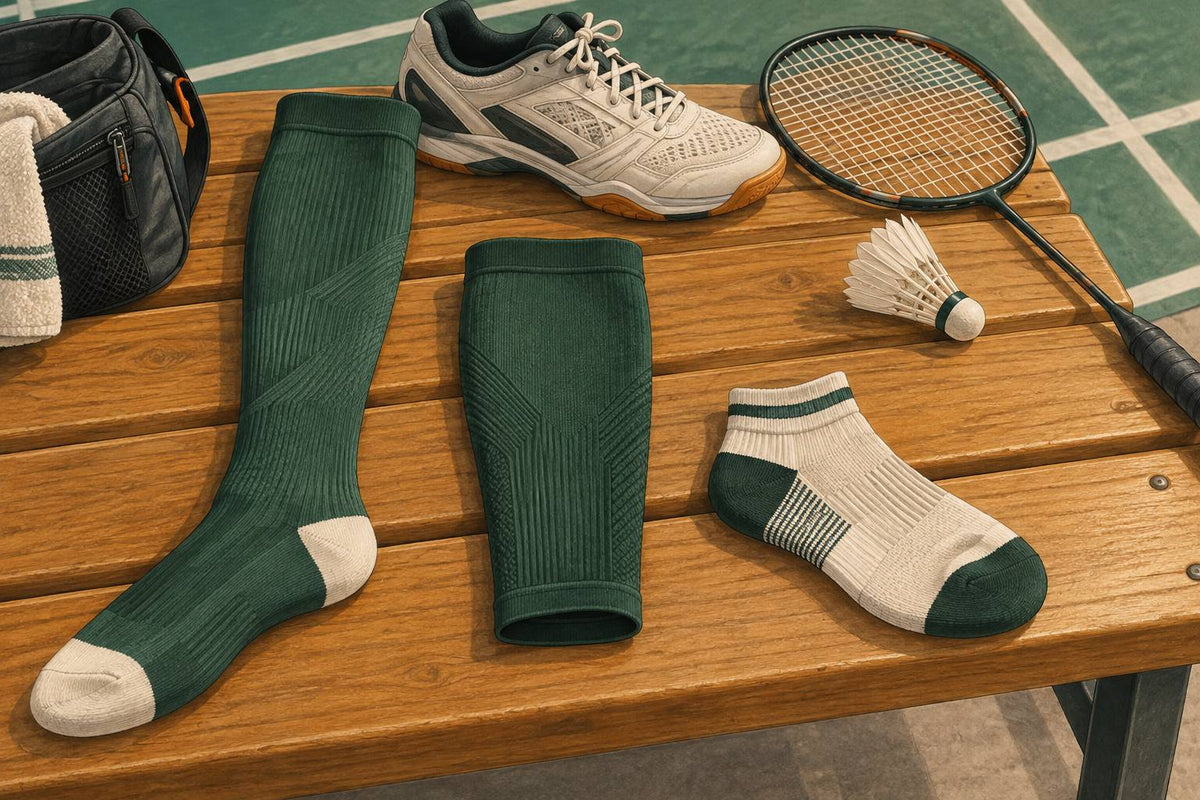
| Option | What it covers | Badminton trade-off |
|---|---|---|
| Full compression sock | Foot, ankle and lower leg | Complete gradient, but changes the layer inside the court shoe |
| Calf sleeve | Lower leg, not the foot | Keeps your usual sock, but is not the same garment studied in flight-sock trials |
| Ordinary sports sock | Foot and sometimes lower calf | May prioritize cushioning and shoe fit without a stated pressure gradient |
More pressure is not automatically better. The correct range depends on the purpose and, for medical use, personal health. This article does not prescribe a pressure class.
Should you wear compression socks during badminton?
During-play compression is optional rather than essential. The reviewed studies do not establish a dependable immediate performance gain, and they are not direct badminton trials. A garment may feel supportive without making footwork faster, jump height greater or injury less likely.
Court-shoe fit is the first practical test. A thicker foot section can reduce space around the forefoot or heel. A sleeve lets you keep your normal sock but may create a pressure line where the sleeve ends. Warmth and sweat management also differ by fabric and venue. None of these observations makes the garment good or bad for everyone; they make a practice test necessary.
- Use a normal practice first: never introduce the garment on the first morning of a tournament.
- Wear your usual shoes: lace them normally and check toe space, heel hold and pressure points.
- Play across the court: include lunges, split steps and changes of direction, not just a warm-up jog.
- Inspect afterward: look for persistent grooves, blisters, numbness, skin colour change or a folded band.
If the only evidence is that you like the sensation and the garment passes those checks, that can be enough for a personal comfort choice. It is not enough for a performance claim.
Are compression socks useful after play?
After play, compression is a reasonable experiment for players who enjoy the feeling and are not using it to hide a problem. A meta-analysis of 23 compression-garment studies reported small recovery benefits overall, with effects depending on the outcome and protocol. The evidence is more encouraging for later recovery measures than for immediate performance.
That finding needs two limits. First, the studies pooled different sports, exercise tasks, garment pressures and wearing times; they do not prove a badminton-specific effect. Second, feeling less sore does not prove that a muscle or tendon is ready for another maximal session.
Run a simple two-week comparison if you want an honest personal answer. Wear the garment after two similar hard sessions and skip it after two others. At the same time the next day, record calf comfort, stair walking and whether your planned easy warm-up feels normal. Do not change sleep, food and training on purpose just to favour one condition. Treat a small comfort improvement as exactly that—not a recovery guarantee.
Keep the basics in place: eat and drink normally, move gently between matches, sleep and reduce the next session if movement quality is poor. Our badminton recovery guide puts those priorities into one routine.
Are compression socks worthwhile for tournament travel?
Long seated travel is the clearest use case in this evidence set. The LONFLIT 4 randomized trial studied below-knee flight socks producing 14–17 mmHg at the ankle during 7–12-hour flights and reported reduced lower-leg swelling in suitable low-to-medium-risk travellers.
Do not turn that result into a universal blood-clot prevention promise. A single flight study does not decide what is safe for a person with previous clots, vascular disease, recent surgery, pregnancy or another individual risk factor. Follow personal medical advice where those issues apply.
For an otherwise suitable traveller, put the socks on before prolonged sitting, keep them smooth and walk when practical. Move your ankles while seated, avoid crossing a tight top band and remove the garment if circulation or sensation changes. On arrival, change into your tested badminton socks before playing if the compression pair alters shoe fit.
How should compression socks fit safely?
Put the garment on smoothly, without bunching, wrinkles or a folded top. It should feel evenly supportive rather than painfully tight. Recheck the toes and exposed skin after several minutes. Stop for numbness, tingling, unusual coldness, skin discolouration, rash, pressure pain or worsening swelling.
Ask a clinician or pharmacist before using graduated compression if you have known circulation or vascular disease, significant neuropathy, diabetes-related foot problems, fragile skin, unexplained one-sided swelling or a history that makes clot risk a concern. The international compression safety consensus identifies discomfort and skin irritation among the common minor problems and emphasizes contraindications and arterial circulation.
New one-sided calf swelling, heat, tenderness or unexplained pain needs prompt medical assessment. Do not cover it with tighter compression or play through it.
The Badminton House verdict
For play, use compression only when it remains comfortable inside your court shoe. For recovery, test it as an optional add-on. For long travel, a correctly fitted graduated sock has the strongest evidence-backed use. Persistent pain or swelling needs assessment, not more pressure.


Leave a comment
This site is protected by hCaptcha and the hCaptcha Privacy Policy and Terms of Service apply.