
Last checked: August 2026 · Written by the player-led team at Badminton House
Quick answer
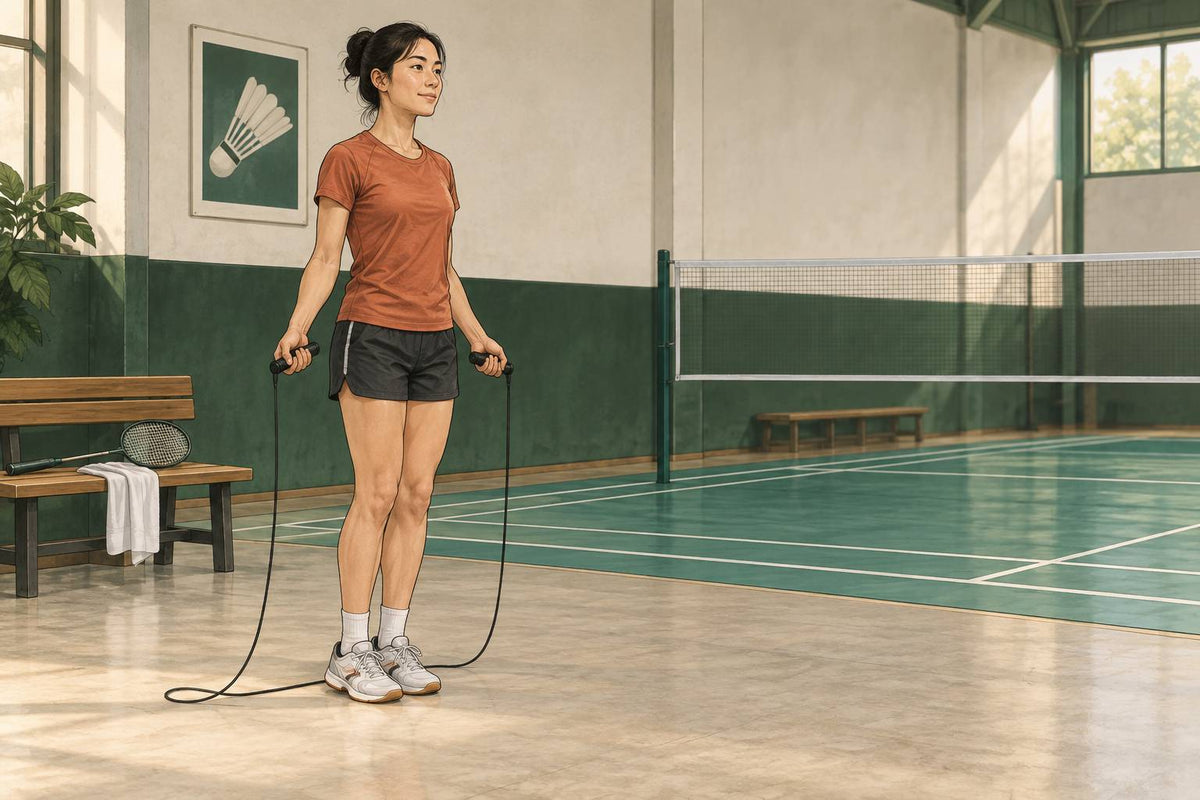
Run a 4-week jump rope progression, three short sessions a week: double-foot bounce, then split-step landings on the rope, then single-leg work, then high-knee fast-feet sets. Keep every set short and end it the moment your landings or timing break down, because the skill that transfers to the court is a quiet, controlled landing, not raw rope speed.
Start with The 4-week jump rope progression
Read the weekly table, run week 1 for a full week before moving on, and treat any calf or Achilles history as a reason to use the regression in the last section instead of skipping ahead.
Related reading: The Plyometric Progression Ladder for Badminton — how to place rope work alongside jump-smash and plyometric sessions in the same training week.
The 4-Week Jump Rope Progression for Footspeed
Skipping builds badminton footspeed fastest through a four-week ladder: two weeks of double-foot bounce and split-step landings build rhythm and soft landings, then two weeks of single-leg and high-knee fast-feet work raise the intensity your calves and Achilles tendons can handle, all in short, quality-first sets instead of long steady blocks.
This plan suits a player whose court access is shrinking for a stretch (winter gym scheduling, travel, or a temporary shortage of court time) and who still wants footspeed and landing quality to hold up when regular sessions resume. It does not replace on-court footwork drills or match play. A rope trains the vertical bounce and landing piece of footspeed only, not the lateral chase, the split step reading an opponent's racket face, or shot-specific recovery. Treat it as a maintenance and improvement tool for the piece of footspeed a rope can actually train, not a full substitute for court time.
Short sets are not an arbitrary choice. A single badminton rally is brief, averaging roughly 9 seconds in singles and 6 to 10 seconds in doubles, but the full cycle of a point, including the pause before the next serve, runs closer to 25 to 32 seconds in singles play according to a 2025 systematic review of badminton match-play data. Live rallies fill only about 29 to 34 percent of match time; the rest is short recovery. That stop-start pattern, not one long continuous effort, is what a rope session should copy, and it is why the sets below sit in the 20 to 40 second range with real rest between them rather than as one unbroken five-minute skip.
A notational study of junior badminton match play found the same intermittent shape at a younger level: rallies averaging 5.7 seconds, rest averaging 11.2 seconds between them, and only about 32 percent of total match time spent in live play. Training that never rests does not resemble either version of the sport, and neither does training that rests for five minutes at a time.
| Week | Sets | Work-to-rest | Variation | Weekly total (3 sessions) |
|---|---|---|---|---|
| 1 | 6 x 20s | 20s on, 40s off | Double-foot bounce, steady rhythm | About 6 minutes of rope work |
| 2 | 8 x 25s | 25s on, 35s off | Split-step landings on the rope | About 10 minutes |
| 3 | 8 x 30s | 30s on, 45s off | Single-leg alternating, switch legs each set | About 12 minutes |
| 4 | 6 x 30s | 30s on, 60s off | High-knee fast-feet, maximum quality contacts | About 9 minutes |
Notice that weekly rope time falls in week 4 even though the drill gets harder. That is deliberate. Fewer, better contacts at high intensity teach more than a longer set of tired, sloppy ones, and it matches the sequence used elsewhere on this site for jump training: move from two-leg landings to one-leg landings only once the easier version is controlled, never the other way round.
In practice, three short sessions a week beats one long one. Fit them around a badminton week that already has court time: put two rope sessions on days without hard jump training, and the third on a lighter court day. Each session is short by design, a few minutes of actual rope work plus a short warm-up, so it slots in before or after a normal training block instead of replacing one.
Technique Cues That Actually Transfer to the Court
The skill that carries over to the court is landing quietly on the mid-foot with a soft, slightly bent knee on every rep, not how fast the rope turns. That quiet landing is the same shock-absorbing position you need the instant before a split step, so it belongs in every set you skip.
Land on the middle of your foot, not your heel and not your toes, and let your ankle, knee, and hip soften on contact instead of locking out. A loud rope session, where every landing thuds and your shins take the impact, is not building a faster player; it is building sore shins. If you can hear yourself land clearly from across the court, slow the drill down and rebuild the softness before adding speed.
Each variation earns its place by rehearsing a specific court action. Double-foot bounce is the baseline rhythm, nothing more. Split-step landings on the rope (landing in a narrow, slightly staggered stance instead of a flat two-foot hop) directly rehearse the ready-position landing you make just before reacting to an opponent's shot. Single-leg work loads one side at a time, the same asymmetry your legs deal with every time you lunge and recover on one leg. High-knee fast-feet sets ask for quick, light ground contacts, which is the foot speed quality you actually want, not the rope moving faster.
Turn the rope from your wrists and forearms, not your shoulders. Big shoulder circles slow the rhythm down and throw your balance forward onto your toes, which undoes the mid-foot landing you are training. Keep your elbows close to your body, jump only as high as clears the rope, and keep your eyes up rather than watching your feet, the same head position you want when you are actually tracking a shuttle.
The stop rule for every set is the same regardless of week: end it the moment the rope starts catching your feet repeatedly. One catch is a mistake. Two or three catches in a row means your timing or your landing has broken down, usually from fatigue, and finishing the set anyway only grooves the sloppy version. Stop the set. Rest a little longer than planned if you need to, then start the next set clean.
Where Rope Work Fits in a Week That Already Has Jump Smashes
Rope work is heavy on the calf muscles and Achilles tendon, so treat it as its own loading day rather than pairing it with a jump-smash or plyometric session that taxes the same tissue. Give the tendon roughly 24 to 48 hours of recovery between sessions that load it heavily.
A 2026 peer-reviewed biomechanics study of world and junior national double-under champions found the movement is ankle-dominant, driven by explosive plantarflexion through what the researchers call the gastrocnemius-Achilles tendon complex. Repeated high-speed rope work places real, repetitive stress on that same tendon-muscle system, according to a peer-reviewed biomechanics study of elite jump-rope athletes. The same researchers caution developing athletes against imitating elite-level loads too early, recommending a gradual build in speed and control instead, which is the same principle behind spacing this plan's intensity increase across four weeks.
Both rope work and jump-smash training ask the calf and Achilles to absorb repeated impact, and stacking them removes the recovery window the tendon needs. A simple rule that avoids the conflict entirely: put rope work on a day with no other jump-heavy training, or at least several hours before a light session rather than immediately after a hard one.
A worked example makes the placement rule concrete. Say your week already includes two court sessions and one jump-smash-heavy plyometric session on Thursday. Put rope work on Monday, Wednesday, and Saturday instead, so the nearest rope session sits at least a full day from Thursday's jump-smash work in both directions. If Tuesday is a hard match-practice night, keep Monday's rope session at week 1 or week 2 volume rather than pushing to week 3 or 4, since the calves are already carrying some fatigue into Tuesday.
If you are weighing rope work as off-season conditioning during winter months when court time is scarce, the fitness return is real but modest. Per Harvard Health Publishing's activity calorie chart, a 70 kg (155 lb) adult burns roughly 281 kcal per 30 minutes skipping at a slow pace and about 421 kcal per 30 minutes at a fast pace, which scales to a rough 141 to 211 kcal in a 15-minute block at that bodyweight. A 4-week plan built around 6 to 12 minutes of actual rope time per week will not replace conditioning training. Its job is footspeed and landing quality, not calorie burn, so do not judge the plan by how tired the session leaves you. Add up the whole plan and the total conditioning volume stays small: the weekly totals in the table above come to roughly 37 minutes of actual rope time across all four weeks, which works out to somewhere around 345 to 520 kcal in total for a 155 lb adult, depending on pace, and more for a heavier bodyweight. That is a rounding error next to a single hour of match play, so treat any conditioning benefit as a bonus rather than the reason you are doing the plan.
For the rest of a jump-training week, including how many total jumps to plan for and when to place high-intensity plyometric work, see our plyometric progression ladder for badminton. Use that guide for the jump-smash and depth-jump side of the week, and slot rope work into the days it leaves free.
The Progression Test and a Calf or Achilles Regression
Test progress two ways: count unbroken high-knee contacts in 30 seconds each week, or track whether you can finish all four weekly sets without a missed rep. If you have a history of calf or Achilles pain, replace every set with 20 to 30 seconds of rope work followed by 2 to 3 minutes of rest.
The fast-feet contact count is the simplest test to repeat. Pick one week 4 session, count clean ground contacts in a 30-second high-knee set, and write the number down. Run the same test at the same point every week. A rising number with landings that stay quiet is real progress; a rising number with landings that get louder is speed bought with worse form, and it is not the trade you want. A worked example: a player might log 42 contacts in week 1, 46 in week 2, 51 in week 3, and 55 in week 4, with landings staying quiet throughout. That kind of steady, single-digit weekly gain is realistic. A jump from 42 to 70 in a single week usually means the count included sloppy, half-height bounces rather than full clean contacts, so recount using the same strict standard every time.
The unbroken-set test asks a different question: can you complete every set in a given week's protocol, at the prescribed work and rest, without a single caught rope? If you cannot get through week 2 clean, stay on week 2 rather than pushing into week 3 on a shaky base. The ladder only works in order; skipping ahead just moves the breakdown to a harder drill.
Anyone with a history of calf strain or Achilles tendinopathy should not run the standard progression. Use a conservative interval structure instead: 20 to 30 seconds of easy rope work, then 2 to 3 minutes of rest, repeated for as many rounds as stay pain-free. Keep this on its own day, at least 24 to 48 hours from any other jump-heavy session. If a set produces any Achilles soreness that lasts into the next day, stop the plan and get the tendon assessed before adding rope work back in.
Put the plan to work this week
- Start at week 1 even if double-foot bounce feels easy; the point is rhythm, not difficulty.
- Schedule rope days away from jump-smash or plyometric sessions, with at least 24 hours between them.
- Log your 30-second fast-feet contact count once a week at the same point in the session.
- If you have any calf or Achilles history, start with the regression, not week 1 of the standard plan.

Leave a comment
This site is protected by hCaptcha and the hCaptcha Privacy Policy and Terms of Service apply.