
Last checked: August 2026 · Written by the player-led team at Badminton House
Quick answer
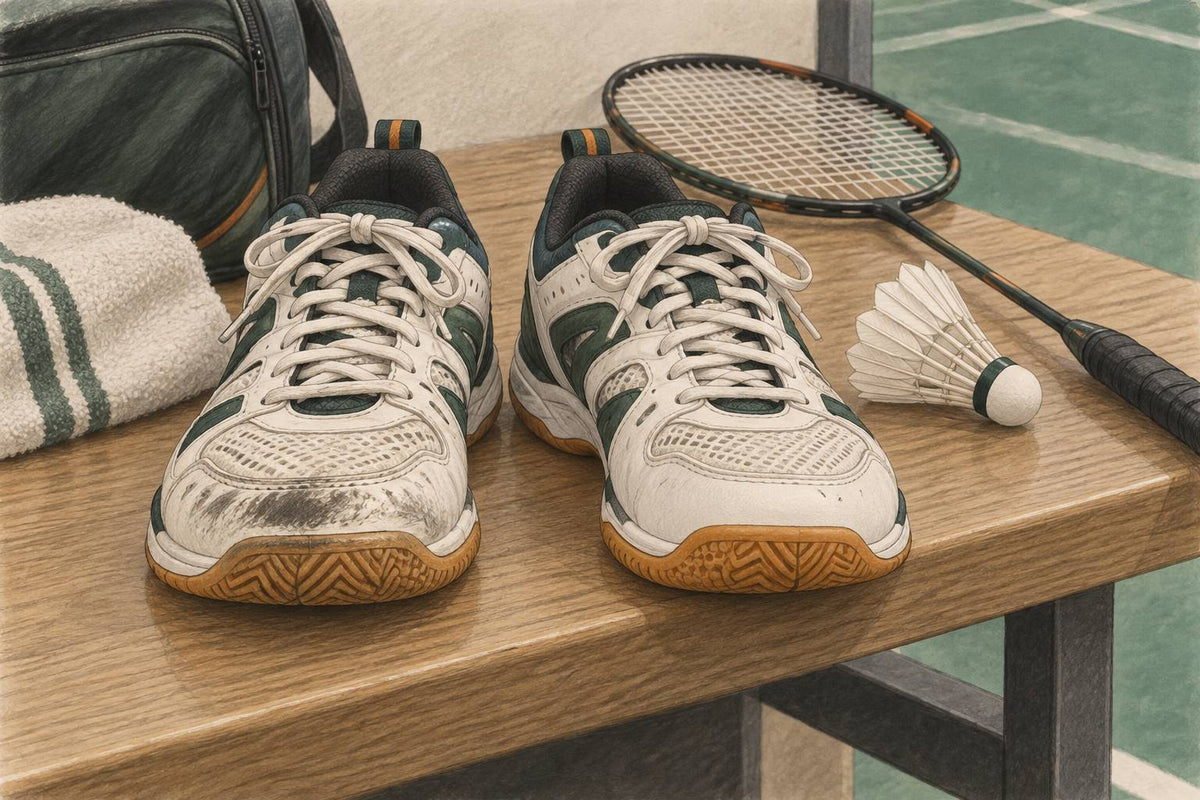
One shoe wearing out faster than the other may reflect a usual footwork signature, but asymmetry alone cannot rule out a problem. Badminton is played one-handed, so your racket-side leg and your other leg do different jobs on every rally. For most right-handed players, the left shoe shows toe and forefoot wear because that leg gets dragged along the floor as you recover from a lunge, while the right shoe absorbs more of the harder landing impact instead.
- Check exactly where the wear sits — toe, medial edge, lateral edge, or heel — before assuming a fault.
- Rotate between two pairs so the same foot is not absorbing an identical pattern every session.
- Retire a shoe on its own physical condition, not on how it compares with its partner.
Related reading: Badminton Footwork Braking for the lunge and landing mechanics behind this wear.
Is Uneven Shoe Wear Normal, or Is Your Pair Defective?
Uneven wear between your badminton shoes may reflect the legs having different roles; alone, it cannot rule out a biomechanical problem. Badminton is a one-handed sport, so your racket-side leg and other leg do different jobs. Research on badminton lunges confirms they absorb different loads rather than sharing the work evenly.
A cross-sectional survey of 326 recreational players found that badminton’s repeated forward lunges load the dominant, racket-side leg more heavily than the other leg, and when players ranked their worst shoe complaints, plantar pain on the non-dominant foot topped the list for both men and women, ahead of pain on the dominant side. See the full badminton footwear survey for the breakdown. That is exactly what you would expect if the two legs are doing different work, not proof that either shoe is faulty.
So which shoe wears out first depends on which job your feet are doing more of: absorbing the lunge, or dragging through the recovery. The next section maps specific wear locations to the specific movements that cause them.

Reading Your Wear Map: What Each Pattern Means
Where a shoe wears tells you what your foot was doing. For most right-handed players, toe and forefoot wear on the left shoe comes from the trailing leg dragging along the floor during lunge recovery, while medial or lateral edge wear signals how your foot rolls as you push off and change direction.
| Where you see wear | What is happening | What it means |
|---|---|---|
| Toe cap and forefoot, one shoe only | The trailing leg is dragged along the floor as you recover from a lunge | Pattern consistent with recovery from a lunge; check it further if pronounced or painful |
| Medial (inner) edge | Foot rolling inward as you push off | Check technique or fit if it is pronounced or painful |
| Lateral (outer) edge | Foot rolling outward during lateral pushes and direction changes | Check technique or fit if it is pronounced or painful |
| Both shoes, even wear, just fast | Accumulated hours, not asymmetry | Track hours played, not left versus right |
The toe-and-forefoot pattern has a specific, sourced cause. In the step-in lunge, one of badminton’s common lunge types, you do not push back to base off the trailing leg; instead that leg is pulled along the floor toward your racket leg to bring your body back upright. That drag happens on every recovery from that lunge shape, which is why it shows up as real, repeated wear rather than a one-off scuff. For left-handed players the whole pattern mirrors onto the other side: their dominant leg is the left leg; their right shoe therefore takes the trailing-leg drag, while their left shoe absorbs the harder landing impact.
Medial and lateral edge wear point somewhere else. In general footwear-wear science, heavy inner-edge wear tracks with the foot rolling inward at push-off, and heavy outer-edge wear tracks with it rolling outward. Either is worth a technique or fit check when it is severe or shows up with discomfort; a small amount on both shoes is simply how feet move.
What to Do About Uneven Wear
Three actions cover almost every case: rotate between two pairs so the same foot is not absorbing an identical stress pattern every session, judge each shoe’s condition on its own physical signs rather than comparing it with its partner, and only chase a footwork fix if the wear is severe or paired with pain.
Rotating between two pairs is worth doing even if you play often. It spreads use across more total soles instead of subjecting one pair to the same drag-and-landing pattern every session.
Retire a shoe on its own condition, not on a mirror test against its partner. Podiatric sports-medicine guidance puts comparable court sports on a roughly 45-to-60-hour clock, and flags two physical checks that matter more than the calendar: whether the midsole still sits flat on a level surface, and whether the heel counter still holds its shape when squeezed from side to side instead of folding over. A worn left shoe that still passes both checks does not need replacing just because its partner looks newer.
Only treat the wear itself as a problem when it is extreme relative to your hours played, or shows up alongside knee, ankle or arch discomfort. In that case the fix is technique, not gear: work on lunge and landing mechanics in our footwork braking guide, and check your recovery timing in our split step guide before assuming the shoe itself is the issue.


Leave a comment
This site is protected by hCaptcha and the hCaptcha Privacy Policy and Terms of Service apply.