
Last updated: July 2026 · Written by the team at Badminton House
Quick Answer: Playing Badminton in a Hot Gym
In a hot, humid gym, start easier than normal, use every break to sip, and stop if dizziness, nausea, cramping, or confusion appears.
Default
Best choice: reduce rally pace for the first games, plan longer breaks during casual sessions, and drink early — heat and humidity add up faster than normal fitness alone would suggest.
Hydration
For most sessions, small regular drinks beat chugging; water is usually enough under about an hour.
Stop
If symptoms escalate or thinking seems off, leave the heat and treat it as urgent.
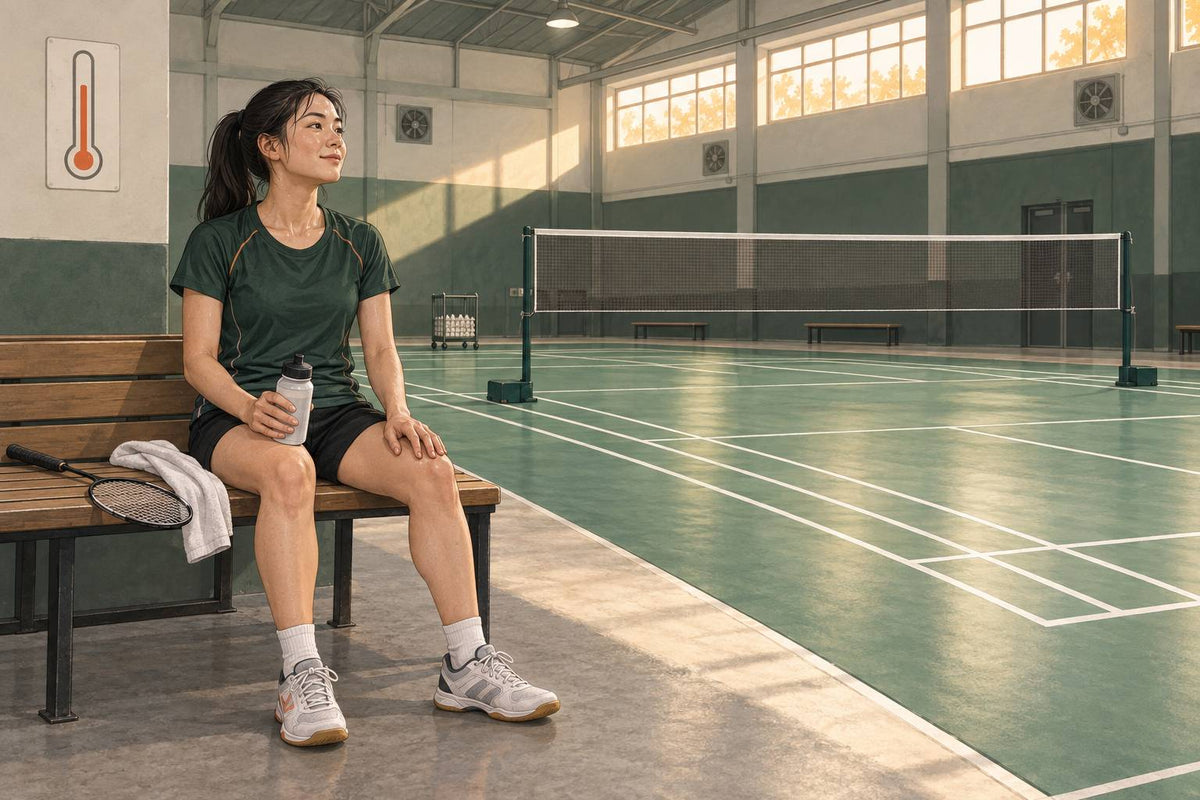
If your legs feel heavy by the second game in a hot gym, it is not just fitness. Badminton stacks short explosive rallies on short rests, and heat plus humidity raise the physical cost of every one of them (more on why below). The goal is not to “tough it out”; it is to adjust pace early, use the breaks you already have between points and games, and know which symptoms mean the session is over.
In This Guide
Why playing badminton in hot gym conditions feels harder

Playing badminton in a hot gym feels brutal because sweating is only useful when it evaporates. Sweat sitting on your skin, or dripping straight onto the floor, has not removed much heat. In humid air, evaporation slows because the air is already carrying moisture, so your body can lose fluid without getting the cooling payoff.
That matters in badminton because the sport is not a steady jog. It is repeated high-intensity bursts — lunges, jumps, recovery steps, and fast exchanges — separated by short pauses. Elite match-play data has measured sweat rates of about 1.0–1.14 L/h, which shows how quickly fluid loss can build even indoors.
Think of this as the hot-gym companion to our cold-gym badminton warm-up guide: temperature changes how your body should approach the same court.
Pace the session before heat catches up

In a hot gym, don’t wait until you feel cooked to slow down. Start your first game at a controlled tempo: fewer jump smashes, fewer all-out recovery sprints, and shorter casual games or practice blocks instead of turning every point into a fitness test; a clear or drop does not automatically shorten a rally.
In casual play, agree on rest periods and shorter games before starting. In a formal match, use the permitted intervals and the umpire’s directions; players cannot simply extend changeovers or delay the next serve. Stop play and seek help if heat-illness warning signs appear.
The best protection is gradual exposure. Heat acclimation can develop over roughly 1–2 weeks, so make early hot sessions shorter and less intense, then build up only if you are recovering normally. Acclimatization helps, but it does not make you immune: if warning signs appear, stop early.
Hydration and electrolytes: drink early, not endlessly

Do not wait until you feel thirsty midway through a hot gym session. A simple starting point is about 500 ml of fluid roughly 2 hours before exercise, which gives your body time to absorb what it needs and excrete the excess.
During play, use badminton’s natural breaks. Drink early and regularly: 200–300 ml every 15 minutes is a practical rule of thumb for a player sweating around 1 L per hour. For sessions under about 1 hour, plain water and carbohydrate-electrolyte drinks are generally similar; longer or very sweaty sessions may benefit more from electrolytes.
The main electrolytes lost in sweat are sodium and chloride. Replacing them can help retain fluid and stimulate thirst, but more fluid is not always better: excessive intake can dilute plasma sodium and raise hyponatremia risk. Afterward, replace fluid and electrolytes at roughly 1.5× the body weight lost during play.
Warning signs: when to stop immediately

Heat illness is not something to “push through” for one more rally. Early warning signs can include unusual fatigue, headache, dizziness, heavy sweating, nausea, painful cramps, a fast heart rate, or muscle cramps. Those can fit with heat exhaustion, but this is educational guidance, not a diagnosis.
Emergency red flags: confusion, disorientation, unusual sleepiness, inability to respond clearly, loss of consciousness, or a body temperature often above 104°F/40°C point toward possible heat stroke and need emergency care.
If symptoms appear, stop play, leave the hot environment, loosen tight clothing, and cool the body with misting or ice packs at the armpits and groin. Rehydrate if the player is alert and able to drink safely. Seek emergency care if symptoms worsen or include fainting, confusion, repeated vomiting, or severe weakness.
What to wear and how the shuttle may change


For hot gym sessions, choose lightweight, loose-fitting clothing that moves sweat away from your skin instead of trapping it. Avoid heavy cotton layers that stay soaked and cling during rallies. A spare shirt can also make the second half of a session feel less miserable, especially if you are playing multiple games back-to-back.
Simple setup reminder. If your kit is due for an update, check live availability in badminton apparel and keep the priority on breathable, easy-moving pieces.
Expect shuttle behaviour to vary with the gym conditions and the shuttle itself. Warmer air can reduce aerodynamic resistance, but humidity alone is not a reliable prediction of how a particular feather shuttle will fly. Test shuttle speed on court before play and check condition if length changes unexpectedly.
Which heat adjustment should you choose?
Use this as a courtside decision helper: solve the biggest risk first, then fine-tune hydration, shuttle speed, and gear comfort.
| Choose this | If this is happening |
|---|---|
| Pace down | You feel hot or unusually winded, but no warning signs. In casual play, shorten high-intensity work and plan more between-game rest. |
| Drink measured water | Session under about an hour — sip on every break (see hydration section above for exact targets). |
| Add electrolytes | Longer or very sweaty session — add sodium and chloride; don’t overdrink. |
| Stop now | Any early warning sign appears (see above) — leave the hot court and start cooling down. |
| Get help | Any emergency red flag appears (see above) — treat it as urgent and seek help. |
| Test shuttle | Clears drift long or die short — adjust for shuttle behaviour (see above) before blaming technique. |
Safety order: pace first, drink deliberately, stop for warning signs, then adjust gear and shuttle expectations.
Get 10% off your first order
Join the Badminton House list and we’ll email you a 10% welcome code — plus training guides, technique advice, and badminton updates.
By subscribing, you agree to receive Badminton House emails and can unsubscribe anytime.
Hot gyms are one of those conditions where smart players adjust before they feel desperate, especially when the air feels sticky before warm-up. We play badminton too, so if you are unsure what to wear, pack, or change for your next session, contact us and we’ll help you think it through.
Dress for the conditions. Update your kit before your next hot, humid session.
Check Live Apparel Availability


Leave a comment
This site is protected by hCaptcha and the hCaptcha Privacy Policy and Terms of Service apply.