
Last updated: July 2026 · Written by the team at Badminton House
Quick Answer: Taiwan Badminton Golden Plan
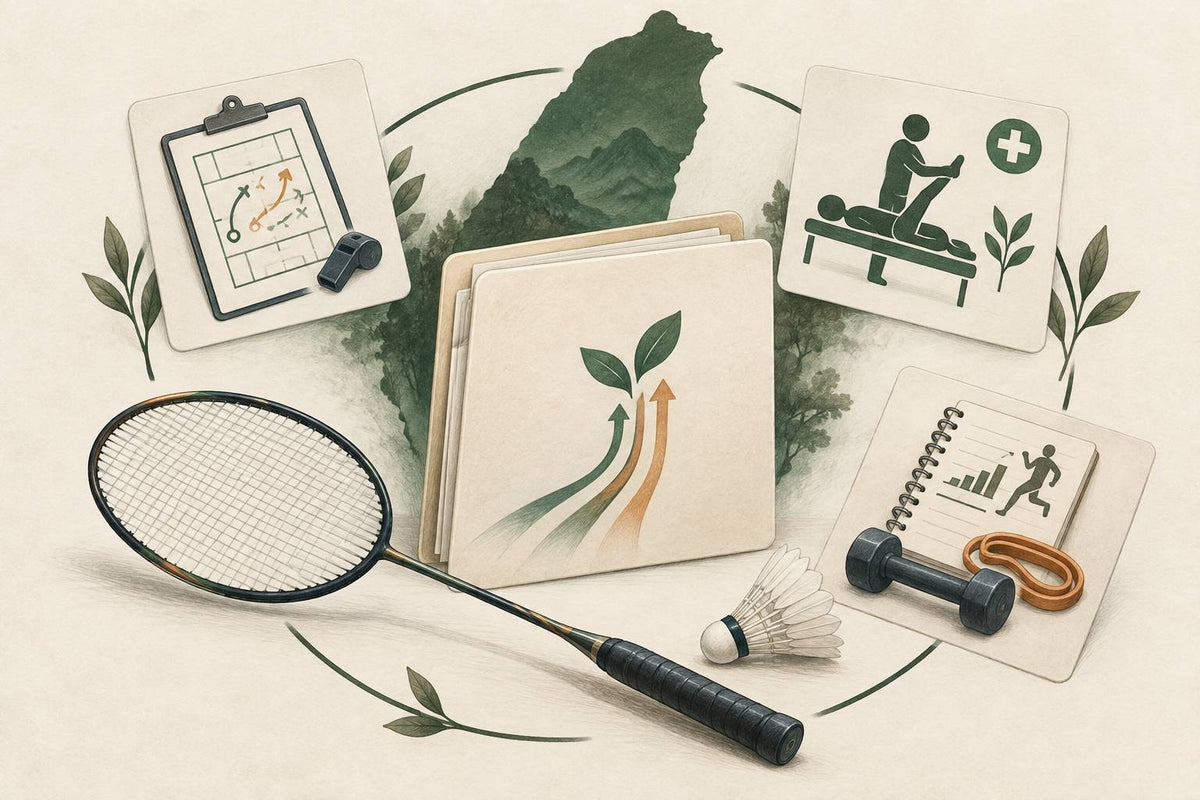
To understand Taiwan's Golden Plan, focus on it as a post-Rio 2016 elite-athlete system, not a single academy or one-player story.
Core
Best lens: launched immediately after Rio 2016, it selected Olympic-medal prospects and built customized teams of coaches, physiotherapists and trainers around them.
Evolution
The structure moved from Tokyo's three-grade model to Golden Plan 2.0's five grades, then Golden Plan 3.0's six categories.
Takeaway
For players, the lesson is targeted support: technical coaching, physical care, fitness testing and competition results all shaped the pathway.
Taiwan’s Golden Plan began after Rio 2016 as a medal-focused support framework. Its useful lesson is organizational: select athletes, track progress and provide specialist help. The achievements of Tai Tzu-ying, Chou Tien-chen, Lee Yang and Wang Chi-lin illustrate the era, but do not by themselves measure the programme’s effect.
This guide explains the Taiwan badminton Golden Plan in plain badminton terms: what changed, how the system was built, which players defined it, and what club players can borrow from the approach.
Train with intent, not imitation. If this story motivates your own setup, check live options in our badminton rackets collection.
In This Guide
What Taiwan's Golden Plan Changed After Rio 2016

Taiwan introduced the Golden Plan immediately after the 2016 Rio Olympic Games. Its purpose was narrow and ambitious: find athletes with realistic Olympic-medal potential, then surround each one with a tailored professional unit rather than leaving support to a generic national-team setup. For badminton players, that meant performance planning could include coaches, physiotherapists, and trainers matched to the athlete’s needs.
That distinction matters. The Golden Plan was not a single boarding-school academy pipeline like Malaysia’s Bukit Jalil model, which you can compare in Inside Malaysia's Boarding School for Badminton Champions. It was a government-funded elite-athlete reform aimed at the top end of the pathway: identifying medal contenders and giving them individualized support strong enough for Olympic preparation.
How the System Was Built: Grades, Selection, and the Kaohsiung Training Hub


The first Golden Plan for Tokyo used a three-grade training structure: identify Olympic-medal candidates, then wrap them in more individualized coaching, medical, physical-conditioning, and training support. After Taiwan’s Tokyo 2020 results, the Sports Administration and the National Sports Training Center launched Golden Plan 2.0 in January 2022, expanding that structure from three grades to five so more athletes could be prepared for Paris 2024 while LA 2028 prospects were developed earlier.
At the 2.0 rollout, the Paris 2024 group included 72 elite athletes, while the LA 2028 group included 78 athletes with medal potential. The plan was not a fixed roster: entry, withdrawal, and grade changes were handled through a rolling mechanism. Olympic results, international results, world ranking, fitness tests, and training status all informed selection and grading. The practical base for this elite setup was the National Sports Training Center in Kaohsiung, where Olympic athletes trained and where badminton sits within a broader high-performance hub.
The Badminton Stars of the Golden Plan Era


The Golden Plan era is easiest to see through Taiwan’s five badminton qualifiers for Tokyo: Tai Tzu-ying, Chou Tien-chen, Wang Tzu-wei, Lee Yang, and Wang Chi-lin. Tai was the defining singles figure: she first reached world No. 1 in December 2016, held the top ranking for a BWF women’s singles record 214 weeks, won Tokyo silver, and built a résumé that includes three All England Open titles, the 2018 Asian Games gold, three Asian Championships, and four Superseries Finals/World Tour Finals titles.
Her game also gave the era an identity: deceptive feints, sharp directional changes, and creative shot variation rather than simple power. Chou showed a different model, thriving after 2019 with physiotherapist Victoria Kao acting as mentor, critic, and courtside support. Wang Tzu-wei added men’s singles depth, while Lee Yang and Wang Chi-lin delivered the clearest doubles headline: Olympic men’s doubles gold at both Tokyo 2020 and Paris 2024, the first consecutive Olympic men’s doubles golds by the same pair.
Golden Plan 3.0 and What Players Can Learn From It

By 2025, Taiwan’s athlete pipeline had moved into Golden Plan 3.0. The program divided athletes into six categories, with categories I, II and III receiving training-fund tiers of NT$15 million, NT$10 million and NT$8 million respectively. Category VI was reserved for athletes aged 18 or younger, and funding continuation was reviewed every six months based on international-tournament performance.
The governance around the plan also changed: In September 2025, Taiwan created a new Ministry of Sports, with Lee Yang appointed to lead it, an Olympic badminton gold medalist and Golden Plan beneficiary who said he intended to review the plan’s problems and controversies. That matters because Taiwan’s badminton base is not small — participation is near 3 million, with about 60 official and regional tournaments each year.
For everyday players, the lesson is not to copy a national system; it is to make training measurable. Track results, review progress on a schedule, and adjust coaching, fitness, recovery, and equipment together with the same discipline the Golden Plan applied to its own athletes.
Which Golden Plan Lesson Should You Choose?
The Golden Plan is an elite government program, not a template most players can copy directly. The useful decision is which principle to borrow for your own training.
| Choose this focus | If this sounds like you | Golden Plan link |
|---|---|---|
| Personalized support | You need clearer feedback on coaching, recovery, and physical preparation. | The original plan built customized teams of coaches, physiotherapists, and trainers around medal-potential athletes. |
| Performance tracking | Your training feels busy, but you cannot prove what is improving. | Golden Plan 2.0 used competition results, world ranking, fitness tests, and training status for selection and grading. |
| Junior pathway patience | You are judging a young player’s progress too quickly. | Golden Plan 3.0 includes an under-18 category, with funding continuation reviewed every six months after international events. |
| Style identity | You win more through disguise, timing, and variation than raw hitting power. | Tai Tzu-ying’s era showed how deception, rapid direction changes, and creative shot choice can define an elite game. |
For most players, start with performance tracking: it turns every lesson, match, and fitness block into evidence instead of guesswork.
Get 10% off your first order
Join the Badminton House list and we’ll email you a 10% welcome code — plus training guides, technique advice, and badminton updates.
By subscribing, you agree to receive Badminton House emails and can unsubscribe anytime.
Systems like Taiwan’s Golden Plan are inspiring because they show how deliberate support can raise a player’s ceiling. We play badminton ourselves, so if you’re translating elite lessons into your own racket choice, training setup, or next upgrade, ask us for advice before you guess.
Build your setup with a racket that fits your level, swing speed, and goals — not just the pro’s highlight reel.
Shop Badminton RacketsCheck live availability and choose with player-first guidance.

Leave a comment
This site is protected by hCaptcha and the hCaptcha Privacy Policy and Terms of Service apply.