

Last checked: August 2026 · Written by the player-led team at Badminton House
Quick answer
One study found that fatigue reduced smash speed and accuracy, while repetitive multi-ball work had a different workload profile from singles play. That supports recording target landings and faults as observations, not claiming a proven way to preserve second-attack quality.
Start with Track target landings and faults
Use target landings and faults as a personal log of repeat-smash quality, not a universal fatigue cutoff. The cited study found reduced smash speed and accuracy with fatigue and a different workload profile for repetitive multi-ball work, but it does not prescribe a repetition total or second-attack solution.
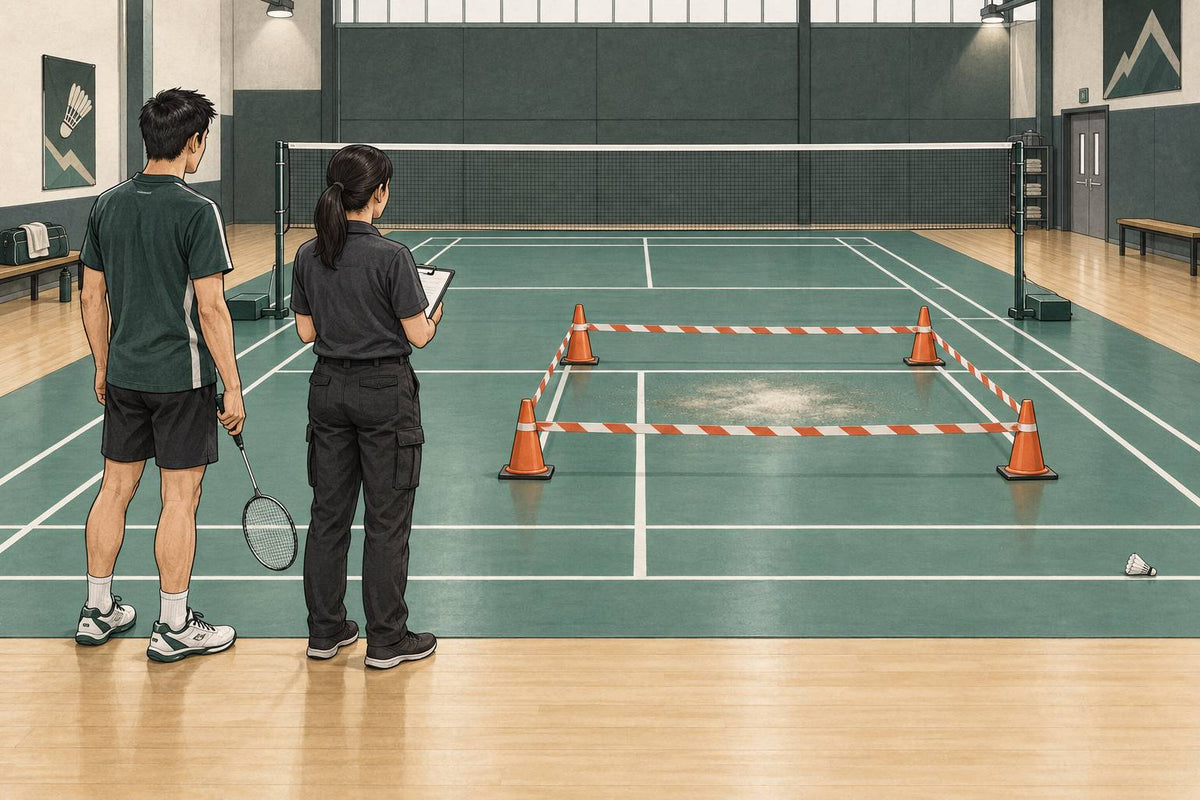
- Mark one safe target area and define a fault in plain language before the block.
- Log whether each chosen smash reached that area or became a fault, without assigning a scientific score.
- Compare early and later attempts only as a personal record of this session.
- When your own quality definition changes, simplify the task or stop the block; do not label that local choice a validated threshold.
Related reading: Badminton Training Load: Track Sessions With RPE — for putting a demanding smash block into a broader workload record.
Track target landings and faults
In a 2026 experiment of 24 national-level players, progressively induced mixed fatigue reduced forehand-smash speed and accuracy, with accuracy showing the larger decline under severe fatigue. The study reports baseline-to-severe fatigue changes in measured smash speed and accuracy. smash-fatigue study

The cited fatigue finding makes a simple log useful: target landings and faults can show whether the player’s chosen definition of quality is changing within the session. They are observations, not a substitute for laboratory speed or accuracy testing.
Keep repetitive practice distinct from match workload
Repetitive multi-ball smash practice does not impose the same workload profile as a singles game; one 14-player study found higher relative Player Load and greater anaerobic energy contribution in repetitive practice. The study compares game and repetitive-practice workloads. smash-workload study

Repetitive multi-ball work has a different workload profile from singles play, so a player should not assume that a repeat-smash block reproduces match demands. Keep the task, target, and recovery decision visible instead of selling one drill as a complete second-attack fix.
Use a personal stop decision, not a universal threshold
The cited studies measure smash speed, accuracy, Player Load, and anaerobic-energy contributions in their own tasks; a personal accuracy-and-fault log is therefore a coaching observation rather than a study-prescribed club protocol. The sources report measured task outcomes rather than a club-session prescription. smash-fatigue study and smash-workload study

A concrete local stop decision can be modest: if the player can no longer describe or meet the chosen target quality, reduce the pace, change the task, or end the block. That choice is personal coaching judgment, not a universal fatigue number.
Run a repeat-smash check with a clear next decision
- Before the first feed, choose one target area and one visible fault or quality marker for the local block. Keep the feeder, target, and observation stable long enough that an early attempt and a later attempt mean the same thing.
- Record a short early sample and a short later sample in the same language. The point is not to create a laboratory fatigue score; it is to notice whether the player and observer can still see the quality feature they agreed to watch.
- If the feed, target, pace, or quality definition changes, mark the next attempts as a new version. This avoids comparing unlike blocks and makes a later coaching conversation about a real task rather than a guessed repetition total.
- Write one local response in advance: simplify the feed, reduce the demand, pause, or end the task when the agreed observation is no longer clear. The response is a coaching choice for this session, not a universal stopping threshold.
A player can keep the record small enough to use at courtside: one target sketch, one fault marker, an early observation, a later observation, and the next local choice. It does not need speed readings, a published rep total, or an assumed recovery prescription. The value is comparison inside one deliberately defined task. If the block is changed, the new version begins a new line. That makes a later review honest: the pair can tell whether an adjustment followed a visible change in this drill rather than a vague sense that the player had done enough or should have continued.
A shared card also gives a feeder or coach a neutral way to suggest a change. They can point to the agreed observation and the current version rather than making the decision sound like a judgement about effort or toughness.
A simple log lets a player and coach make the next adjustment from a visible change in this practice block without claiming that it reproduces a match or establishes a general fatigue rule.
Use this distinction on court
Keep a repeat-smash block readable by separating the task definition, the outcome record, and the next decision. Before starting, write down the chosen target area, what counts as a fault for that block, the feed that will be used, and the planned point at which the pair will pause to look at the record. Those details make early and later attempts comparable within one local session. They do not turn the record into a laboratory measure of speed, Player Load, anaerobic contribution, or a fixed fatigue state. During the block, record only the outcomes the pair agreed to observe. A small tally of target landings and faults is enough if it is linked to the same feed and target throughout the comparison. If the feeder changes pace, the target changes, or the player changes stroke choice, mark that as a new version rather than mixing it into the first tally. That protects the useful local observation: the player can see whether the chosen task outcome is changing, without claiming that one number explains every part of the workload. Use the pause to choose a local action, not to discover a universal stop point. If the agreed quality is no longer visible to the player or observer, the pair can slow the feed, simplify the task, change the block, or end it. The cited studies show that fatigue and repetitive practice can produce measured differences in their own tasks, but their results do not supply an exact repetition total, rest period, or error threshold for a club session. A good log therefore makes the next coaching choice explicit while leaving the broader workload and match-transfer claims where the evidence stops clearly.
A single session record makes the next coaching decision easier to explain. Keep the feeder, target area, and fault definition stable for the version being observed, then mark whether the same agreed feature is still visible later in the block. If any of those fields changes, label the next attempt as a new version instead of comparing it as though nothing changed. This is a local practice record, not a laboratory fatigue score or a universal stopping threshold. Its value is that the player and coach can say exactly what changed before choosing to simplify, rest, or end the task.
Log one repeat-smash block
| Session field | One fixed example | New version field |
|---|---|---|
| Feeder | Same rear-court feed | Change only if a new version is declared |
| Target | One named landing area | Keep it unchanged for the comparison |
| Fault | The pre-agreed quality observation | Record when that definition changes |
- Mark one target landing area and define one fault before starting.
- Record the same two observations early and later in the block.
- Treat a change as a description of this task, not a laboratory fatigue score.
- Simplify or stop when the agreed quality observation no longer holds.
Questions the cited sources do not settle
- Exact sets, repetitions, rest periods, scoring, or a validated accuracy-decline stop rule.
- A promise of match endurance, injury prevention, or a safe protocol for every shoulder.


Leave a comment
This site is protected by hCaptcha and the hCaptcha Privacy Policy and Terms of Service apply.