
Last checked: August 2026 · Written by the player-led team at Badminton House
Quick answer
Dust and contamination are slip hazards, and damp or smooth court conditions are unsuitable for safe play. Sources support containing a local hazard but do not provide a universal cleaning product, drying time, or safe-to-resume test.
Start with Spot contamination before a rally
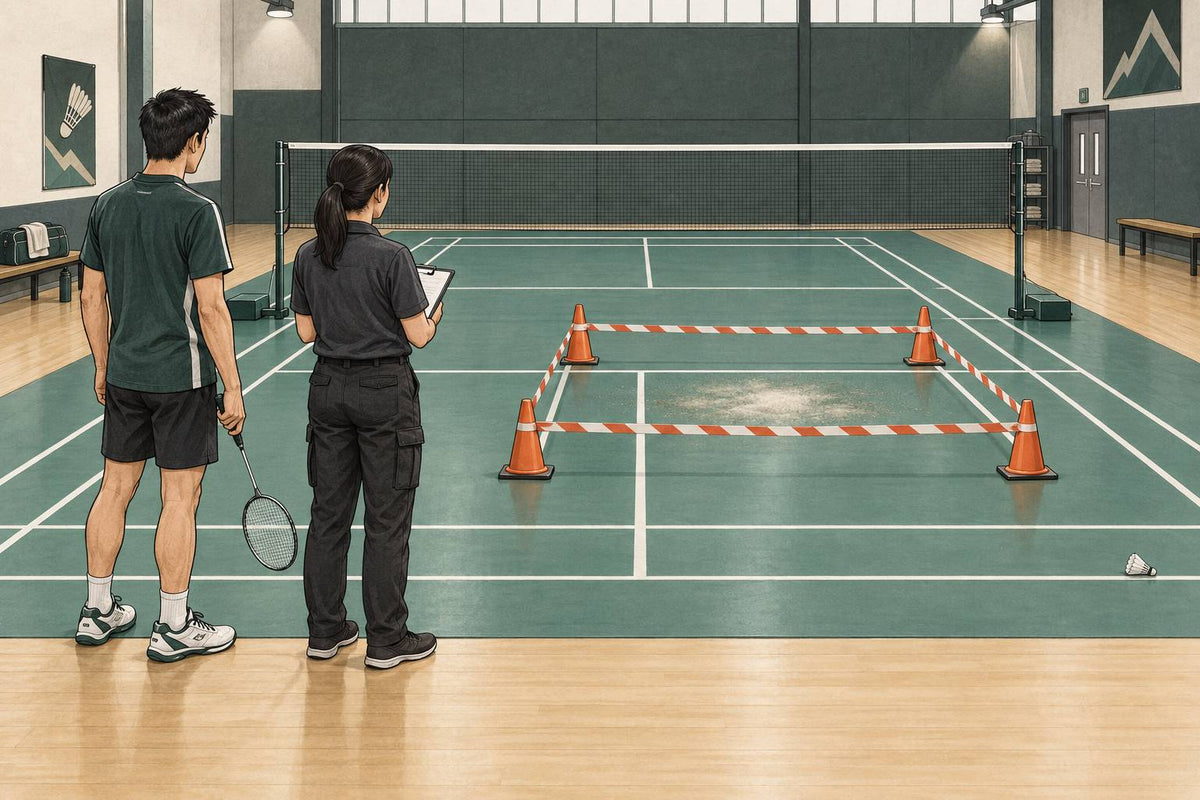
Treat a visible dusty, damp, or contaminated patch as a stop-and-report issue. Pause play, keep people out of the affected area, report the visible condition, and follow the venue’s documented cleaning and reopening process; do not use a quick player test as a readiness decision.
- Pause play around the affected area and point it out to the whole court group.
- Keep shoes, shuttles, bags, and players away from the patch so it is not spread elsewhere.
- Report where the issue is and what was seen, without choosing a cleaning product or drying time yourself.
- Follow the venue’s documented cleaning and reopening process before using the affected area again.
Related reading: Badminton Court Conditions: How Drafts, Ceilings, Lighting, and Floors Change Play — for other indoor conditions that can change play.
Spot contamination before a rally
Dust and contamination can create a slip hazard and should be addressed rather than normalised during play. HSE slip guidance identifies contamination as a cause of slips and calls for appropriate control. It does not establish more than the cited record supports. HSE slips guidance

The practical first move is containment, not diagnosis. Dust, dampness, or another visible contaminant can affect footing, yet a player cannot determine the cause or the right remediation from a glance. Mark the location verbally, pause the rally, and keep others from walking through it.
Keep the correction contained
HSE cleaning guidance says that damp smooth floors remain a slip risk and access should be controlled until the area is dry. The HSE page describes damp-floor risk and restricting access until drying is complete. Slips and Trips

A group agreement is useful for communication but is not a safety test. Use the venue’s documented process for inspection, cleaning, restricted access, and reopening rather than converting a player impression into a clearance decision.
Decide whether the court is ready to resume
The source supports keeping people away from a contaminated or damp court and following the venue’s cleaning and reopening process. It does not give players a universal product, drying time, traction test, or authority to certify a court ready for high-speed movement. HSE slips guidance and Slips and Trips

The cited material supports taking slippery or contaminated conditions seriously; it does not provide a universal product, drying time, player-run readiness test, or universal assignment of authority. Do not convert a brief improvement in feel into clearance for fast changes of direction.
Use this distinction on court
A useful court-side handoff is a description of the condition, not a proposed remedy. Keep the report to what the group can directly identify: the exact part of the court, what is visible there, whether anyone or equipment has passed through it, and whether play has already been paused. This gives the responsible person a clear starting point without asking players to diagnose the cause of a slippery patch or decide which product should be used. The group can also make containment easier by keeping the report local. One player can stay with the court group and explain that play is paused; another can alert the organiser or facility staff. Avoid turning the pause into a traction experiment, a race to wipe the area, or a decision made from a brief change in how the surface feels. Those actions can blur the boundary between noticing a hazard and clearing it. The same distinction helps after the facility responds. A court may look different after attention, but the player-side role remains simple: follow the direction of the person responsible for the venue and do not treat the group’s preference to continue as a safety conclusion. If several courts are in use, describe only the affected court and location rather than suggesting that every surface is compromised. This makes the report more useful and avoids spreading concern beyond the observed condition. For a regular club, a short local protocol can be posted without naming a universal cleaning method: stop around the patch, report the location and visible condition, keep traffic away from it, and wait for the facility or organiser’s decision. That sequence preserves the source-backed priority of addressing contamination while leaving cleaning, drying, inspection, and resumption decisions with the people who control the space.
Keep the player-side handoff separate from the venue-side decision. The useful part of a report is the observed location, condition, and pause in play; the useful part of the response is following the documented process that applies to that hall. That distinction prevents a well-meant player from turning a quick visual check into a declaration that the court is ready again. It also gives the next group a clearer record if the same area needs attention later.
Give the facility a usable report
- Name the court and the exact part of the surface.
- Describe what is visible and when play was paused.
- Keep players and equipment away from the patch while staff inspect it.
- Leave cleaning and reopening decisions with the facility or organiser.
Questions the cited sources do not settle
- A universal cleaning product, drying time, or guarantee that a dusty court can be made safe mid-session.
- Individual diagnosis of why a particular player slipped.
What to do next
Pause play, keep people out of the affected area, report the visible condition, and follow the venue’s documented cleaning and reopening process rather than using a player-run readiness test.


Leave a comment
This site is protected by hCaptcha and the hCaptcha Privacy Policy and Terms of Service apply.