
Last checked: August 2026 · Written by the player-led team at Badminton House
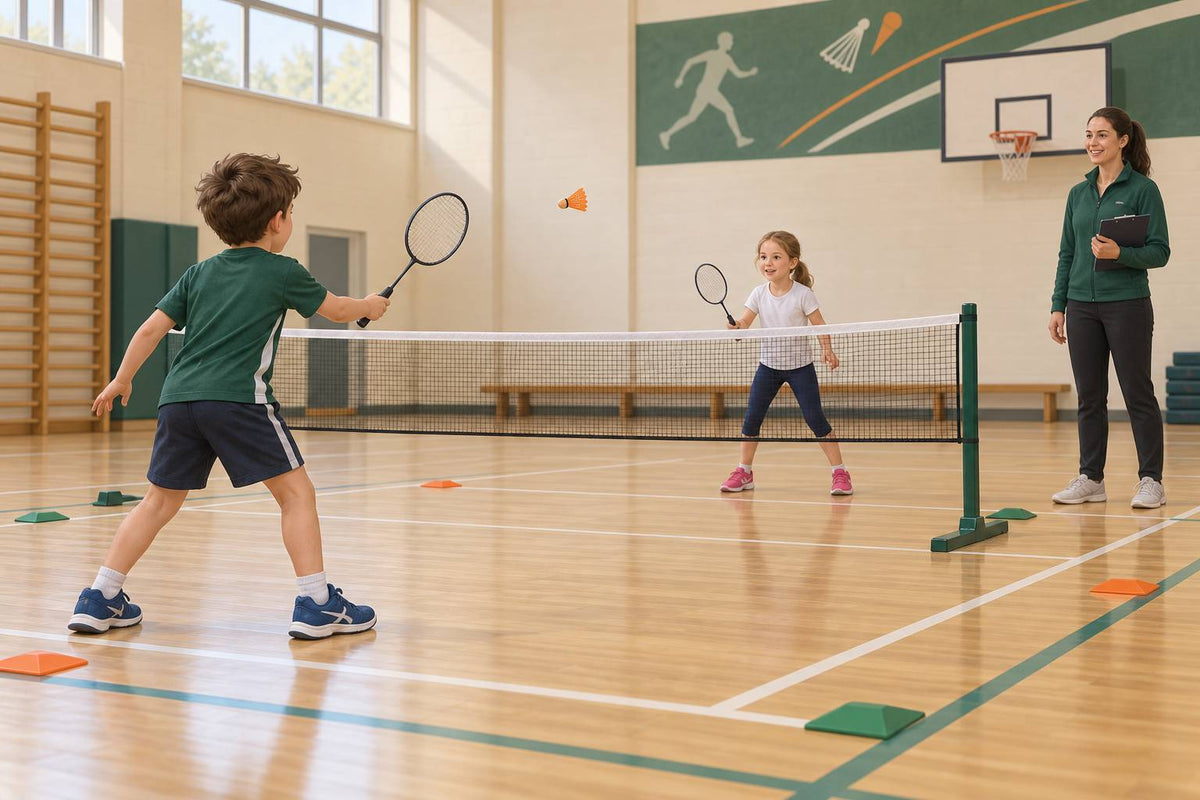
A full-size court and a regulation net stop most young children from ever starting a rally. Lower the net, shrink the playing area, shorten how they hold the racket, and slow the shuttle down, and the same group starts rallying within minutes. This guide covers the setup, three real group formats, and the scoring habits that keep everyone moving.
Related reading: once a child is rallying comfortably on a full court with a full-height net, front-court tactics become the next skill worth coaching: see our guide to doubles front-court net play.
How much should you scale the court down?
Shrink the playing area and lower the net rather than trying to fill a full court. Regulation net height is 1.524 m at the centre and 1.55 m at the edges, and BWF's own schools guidance for teaching young players says to reduce that height or take the net away entirely rather than make children reach a grown-up's net.
BWF Shuttle Time, the sport's own schools and beginner programme, states this directly: to assist pupils "it may be possible to reduce the height of the net or remove the net entirely," with a safety reminder attached whenever you do (per BWF Shuttle Time's equipment guidance). No specific lowered figure is prescribed, because the right height depends on the children in front of you: low enough that a five-year-old's swing clears it, high enough that a lift still has to travel over something. If you do not own a real badminton net, the same guidance says rope or tape works as a substitute, so a driveway hose reel or a length of string tied between two chairs is a legitimate stand-in for a first session.
Space matters more than court markings. Shuttle Time is built to run "inside and outside, in large and small spaces and with or without badminton courts," and the same programme keeps groups of 30-plus pupils active through team games rather than queueing them one court at a time (per BWF Shuttle Time's FAQ page). Practically, that means a half-width strip of one badminton court, a school gym floor with no lines at all, or a driveway with a rope net can all host a session. The area between the net and the short service line on a real court is only a narrow strip, and it is enough on its own for one of the formats below, so you do not need a full-length court to get children rallying.
Racket length and shuttle choice
Do not buy a shorter racket if you already have a standard one. Have the child choke up and grip near the racket's "T" joint instead, and switch from feather shuttles to coloured synthetic ones, or to balloons for the youngest beginners who cannot yet make consistent contact.
Shuttle Time's own equipment page frames the racket adjustment this way: "shortened badminton rackets can help pupils to better co-ordinate the hitting of an object," and the recommended method is "encouraging pupils to hold the racket near the 'T' piece of the racket," not swapping in a junior frame. For shuttles, the same source advises synthetic (plastic) shuttles over feather for school and group play, because they hold up to repeated mis-hits and come in colours, which helps "younger pupils or individuals with visual impairments" track the shuttle in flight. If contact is still a struggle, balloons stand in for shuttles in most drills: their larger size and slower fall give a child more time to react and more surface to hit.
A simple rule for a group with a wide age range: the youngest or newest players choke up further and use a balloon or a well-worn synthetic shuttle, while older or more coordinated children hold closer to a normal grip and use a fresh synthetic shuttle. You are matching equipment to the child, not picking one setup for the whole group.
Three group formats that keep every child playing
Run a cooperative rally count for pairs, a narrow continuous doubles game for four, and a rotating team format for six or more. Each one is published, tested badminton-club material, and each keeps children hitting shuttles instead of standing in line waiting for a turn on a full court.
| Format | Group size | How it works |
|---|---|---|
| Shot-count rally | Pairs | Both stand about 2.5 m from the net and count consecutive shots. A mistake resets the count to zero. |
| Narrow doubles | Four | Play is confined to the strip between the net and the short service line, hitting alternately. |
| Rotating team singles | Six or more | Three-a-side on a half court. One player hits, then leaves; the next teammate steps on for the following shot. |
The shot-count rally is a Badminton Wales coaching-sheet drill built on the Shuttle Time framework: pairs "work in pairs over a net, both players approx. 2.5 metres from the net," trying "to hit the maximum number of shots in the time allowed," starting at 30 seconds and building up, with the count returning to zero on any mistake (per Badminton Wales' Junior Games sheet). It rewards control over power, which suits children who are still learning to judge contact.
The narrow doubles game, described in the same resource as "table tennis style net doubles," confines two pairs to "the area between net and the service line," with players hitting alternately once the rally starts. Because the whole game happens inside that same narrow strip, it is the closest thing to a genuine short court: four children get a real doubles rally without needing anywhere close to a full-size playing area.
The rotating team format, sometimes called "Crocodile singles," runs three players against three on a half court. One player starts the rally, then steps off to the side; the next teammate comes on for the following shot, and the third comes on for the shot after that, cycling through the team while every player's points count toward the team total. It works for larger groups because nobody sits out for long between touches.

Scoring rules that stop the queue
Play to a short target score, let every child serve in turn, and skip disputed line calls in favour of a replay. These three habits keep games moving quickly enough that no child waits long between their own turns, which matters more for engagement at this age than strict rule enforcement.
A short target score, first to 5 or first to 7 rather than a full game to 21, means a group rotates through winners and new pairings every few minutes instead of playing one long match. Rotating the serve to every player in a group, rather than only the strongest hitter, gives quieter or less confident children a guaranteed turn to start a rally on their own terms. When a shuttle lands close to a line and children disagree, replaying the point costs less time and less frustration than adjudicating it, and it avoids turning a coaching session into a rules argument.
Every format above is written with a way to make it harder and a way to make it easier, which is the same design principle behind the scoring choices: Badminton Wales' coaching sheet pairs almost every game with a "Harder?" and "Easier?" note, and lowering or removing the net is consistently one of the standard easier options offered. Use the same logic on the fly. If a group's average rally is over in one or two shots, lower the net further, narrow the area, or switch to a balloon before changing anything else. If rallies are already going 10 shots or more, raise the net back up, widen the area, or move to a full-size setup and a feather shuttle.
Age is a rough guide, not a hard rule, for how much scaling a group needs. BWF's own Level 1 coach education manual splits youth motor development into a 6-9 age band, where generic coordination work like throwing, catching, jumping and changing direction takes priority, and a 9-13 phase, where sport-specific coordination and hitting technique become the focus. In practice, expect children in the 6-9 band to need the most scaling (lower net, narrower area, balloon or well-worn shuttle), while children in the 9-13 phase can usually handle a near-full net height and a synthetic shuttle sooner.
Set up a first session in four steps
- Lower the net, or replace it with a rope or taped line at a height the youngest child can clear with a swing.
- Hand out synthetic shuttles for most children and a balloon for anyone who cannot yet make consistent contact.
- Pick a format from the table above based on group size: pairs for shot-count, four for narrow doubles, six or more for rotating team singles.
- Play to a short target score, rotate who serves, and adjust net height or playing area up or down based on how long rallies actually last.


Leave a comment
This site is protected by hCaptcha and the hCaptcha Privacy Policy and Terms of Service apply.