

Last updated: August 2026 · Badminton House
Quick Answer: Doubles Front-Court Net Play
In a front-back attack, the front player takes every reply they can reach in front of them no higher than their own head, hits it down whenever the racket face can be above the tape, and leaves anything passing over their head to the rear partner.
Default
Best choice: racket head up in front of your chest, take flat and net replies early with a short tap or push, and send them down or at the closer defender’s racket-side hip so the next shot has to come up.
Leave
A shuttle you would have to reach up and behind you for belongs to your partner. Say “yours”, keep your racket in front of you and stay ready for the next reply instead of turning to watch.
Kill
If your racket face can be above the tape at contact, hit down with a finger squeeze and no backswing. If it cannot, play a tight net shot or a firm push and step in to threaten the next one.
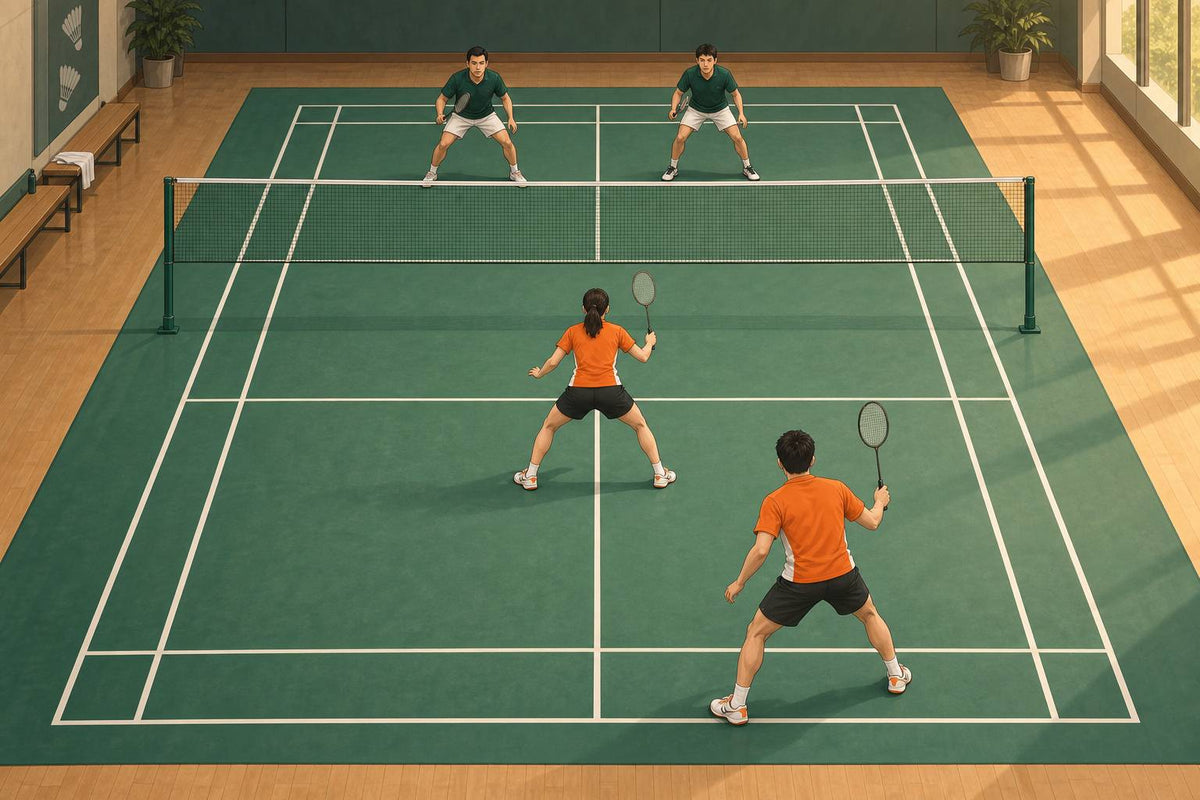
In a front-back attack the rear player makes the noise and the front player decides the point. Every reply that comes back low or flat passes you first, and you have a fraction of a second to settle three things: is it mine or my partner’s, can I hit it down, and where does it go.
This guide is about those decisions and the hands that carry them out. It is not about where to stand. For base depth, the half-step shadow toward your partner’s hitting side and reading the rear shot by its sound, use our companion guide to front player positioning in doubles. Here we assume your feet are already in the right place and ask what you do with the shuttle.
It is written for Canadian club players who play drop-in doubles with a different partner every game, which is why the middle of the article is a contract you can agree in ten seconds on the walk to the court.
In This Guide
What the Front Player Decides on Every Reply
The front player’s job is usually described as a list: control the net, intercept, pressure the opposing net player, finish weak replies. Lists do not help when the shuttle is already on its way. What helps is knowing that every reply asks the same three questions, in the same order.
- Mine or my partner’s? Decided by where your racket can meet the shuttle. In front of you and no higher than your head, it is yours. Over your head, it is your partner’s.
- Can I hit it down? Decided by where your racket face will be against the tape at contact. Above it, hit down. Level with it, hit flat. Below it, keep the shuttle tight.
- Where does it go? Decided by the defenders: the racket-side hip of the closer one, the gap between the two, or the open front corner after a cross-court block.
The order matters. Club players tend to ask the third question first, plan a lovely cross-court push, and get passed by a drive at the body they should simply have taken. Settle the first question before the rally starts, which is what the next section is for, and the second and third become habits.
The one rule that covers most rallies: if your racket face can be above the tape when you meet the shuttle, hit it down. Everything else in this guide is about the replies where it cannot.
Touch or Leave: The Contract With Your Rear Partner
Most front-court errors in club doubles are not technique errors. They are ownership errors: the front player turns and swipes at a lift that was on its way to the rear partner, or ducks a chest-high drive that was theirs, and both players end up standing still while the shuttle lands between them. The fix is a contract, agreed before the game, about which replies the front player touches and which they leave.

The contract is built on two things you can judge instantly: where the shuttle will pass you, and how high your racket would have to be to reach it.
| The reply | Whose it is | What you do | Call |
|---|---|---|---|
| Net reply or soft block landing in front of the short service line, either side | Front | Step in and take it at the highest point you can reach: tap down if you are above the tape, tight net shot if you are below it. | None. It is yours by default. |
| Flat drive or push at your body, between hip and shoulder height | Front | Take it with a short block or counter-drive off the racket face. Ducking hands it to your partner late and low. | “Mine” only if it is drifting wide of you. |
| Flat reply wide of you, further than one lunge | Rear | Do not chase it backwards. Hold your base; your partner has the angle and the time. | “Yours” |
| Anything passing above your head, whether a lift or a fast flat clear | Rear | Leave it without turning. Turning puts your racket in your partner’s swing path and takes your eyes off the defenders. | “Yours” |
| Cross-court block off your partner’s smash, dying in the far front corner | Front | Go. Your partner cannot reach a tight net block from the rear court; it is one lunge for you or a lost point. | None |
| Drive straight down the middle at hip height with both of you near it | Front | The front player takes it unless you have agreed otherwise; the rear player holds and covers the reply. | “Mine” |
Notice the height rule running through the table: anything you would have to reach up and back for belongs to the rear player. The front player’s ceiling is their own head. That gives the rear player a clear rule as well: everything above the front player’s head is theirs, so they never have to wait and see whether you will jump for it. If the middle keeps getting contested anyway, our guide to who takes the middle shot in doubles covers the handedness and formation cases.
The ten-second agreement for drop-in nights
On a Canadian club night you will play with a different partner every game, often someone you have never played with. There is no time to build chemistry, so say the contract out loud on the walk to the court: “I take everything I can reach below my head in front of the service line. Anything over my head is yours. I’ll call ‘yours’ if I’m leaving something.” A stranger can follow that. Nobody can follow “let’s just communicate”.
Two words are enough during play: “mine” when you are taking something your partner might also go for, “yours” when you are leaving something they might assume you will take. Say nothing for the obvious ones. Constant calling becomes noise by the third rally, and the one call that mattered gets lost in it.
Three Contact Heights, Three Shots
Once the shuttle is yours, contact height decides the shot. The measure is not how high the shuttle is off the floor; it is where your racket face will be relative to the tape when you hit. The tape sits 1.524 m (5 ft) above the floor at the centre of the net and 1.55 m (5 ft 1 in) at the posts, and you usually meet the shuttle somewhere near the short service line, 1.98 m (6 ft 6 in) back from the net. From there a shuttle that looked high as it crossed can be below the tape by the time your racket reaches it, so judge the contact point, not the shuttle’s peak.

| Racket face at contact | Shot | Target | What it forces |
|---|---|---|---|
| Above the tape | Net kill or steep tap down | The floor between the defenders, or the closer defender’s racket-side hip if they are square to you | The point, or a weak block up that you or your partner finish |
| Level with the tape | Flat drive or push, nothing lifted in it | The gap between the defenders, or the closer defender’s racket-side hip | A late, flat reply back through the same lane, for you to take again or your partner to hit down |
| Below the tape, balanced | Tight net shot, straight, then a half-step in | Just over the tape on the near side of the net | A lift, because the defender cannot hit down and can see your racket waiting |
| Below the tape, stretched | Firm push to the mid-court, straight, then recover | Behind the front defender, in front of the rear one | A reply hit from below hip height, which usually comes up |
The push in the last row is the shot club players forget. When you are late and low, a tight net shot from a stretched position tends to float, and a lift hands the attack away. A firm push into the space between the defenders keeps the shuttle below their shoulders and keeps your pair attacking. The racket-side hip is the target because it is the hardest place for a defender to swing from: the reply almost always comes up and usually comes back short.
Body target means hip or shoulder, never the head. There is no tactical gain from a kill or a drive aimed higher than the racket-side shoulder that justifies the risk to someone’s eyes. This applies with even more force at the net, where the defender has the least time to react.
Racket Up, Fingers Do the Work
The front-court stroke is a tap, not a swing. The racket head starts above your wrist, in front of your chest, and travels a short distance to the shuttle. The pace comes from squeezing the fingers at contact and a small forearm action, not from the shoulder, and the racket stops soon after it hits.

- Racket head above the wrist, wrist in front of the chest. If the head drops below your hand between shots, the next flat reply passes you while you are raising it.
- Loose between shots, tight at contact. Hold the grip lightly while you wait, squeeze as you hit, let go again. A grip that stays clenched cannot add the finger speed a kill needs.
- Backhand side: thumb behind the handle. Most interceptions at the front are backhand because the racket is held in front of the body; the thumb pushes the racket face into the shuttle.
- Stop the racket after contact. A long follow-through at the net drops the racket head for the next shot and, on a kill, carries the frame into the tape. Touching the net while the shuttle is in play is a fault: our guide to touching the net in badminton walks through the live-versus-dead shuttle cases.
| Habit | What it costs you | Cue |
|---|---|---|
| Backswing on the kill | Late contact below the tape, shuttle into the net, or frame into the tape | Racket already up; squeeze, do not swing |
| Racket head below the hand between shots | Flat drives pass before the racket is up | Head above wrist, wrist in front of chest |
| Grip clenched all rally | No finger speed at contact, pushes float | Loose, squeeze, loose |
| Whole body lunging at every shuttle | Late interceptions, no recovery for the next reply | Let the racket arrive first; the feet follow only when the reach is short |
For the finishing shot itself, including the lunge in and the recovery, read our net kill technique guide. For shuttles sitting right at tape height, where a full downward tap would go into the net, the brush net kill uses an across-the-shuttle path instead.
Prepare the Shot Your Partner Just Created
The reply you are about to face is decided by the shot your partner just hit, and you hear that shot before you see the reply. Use it to prepare the racket, not only the feet.
- Partner smashes: expect a block or a flat drive. Racket up at chest height, face slightly closed, ready to counter-drive or to tap a soft block. Do not creep in: the block that dies at the tape is rarer than the drive at your body, and creeping in is how you get passed.
- Partner drops: expect a net reply or a lift. Racket up higher, a half-step in, ready to tap down anything that sits up or to play a tight net shot on anything that does not.
- Partner lifts or clears: the attack is over and so is your front-court job. Your pair moves to side-by-side defence until someone earns the next lift.
How far you shade toward your partner’s hitting side, how to read the rear shot by its sound without turning around, and when to leave the front court are positioning questions, and the front player positioning guide answers them. What this section adds is the racket: the height and face angle you set while the shuttle is still on its way to the defenders.
A Three-Week Club-Night Progression
Most Canadian club nights give you a court to warm up on before the games start. Six minutes with one partner feeding is enough to run one step of this progression. Stay on a step until you pass it, then move on, and write the counts down; the counts are the point.
Week 1: decide out loud
The feeder stands at the far service line and hits 20 mixed feeds: soft net replies, flat drives at your body, and lifts over your head, in no fixed order. You start at the short service line with the racket up. Before you move, call “mine” or “yours”, then touch only the “mine” shuttles and let the others fly past. Count the correct decisions. Pass: 18 of 20 on two nights in a row.
Week 2: hit by height
The feeder plays 3 sets of 10: the first set arriving above the tape, the second flat at tape height, the third below it. Kill the first set down, drive or push the second flat, net or push the third. Count the shots that finish where the contact-height table says they should. Pass: 8 of 10 in every set.
Week 3: the live contract
Half court, you at the front and your partner behind, against a feeder who alternates blocks, drives and lifts. Your partner attacks for 10 rallies while you apply the contract and the height rule. Count two things: touches that should have been leaves, and leaves that should have been touches. Pass: no more than 2 ownership errors in 10 rallies.
Feed spots and feeder tempo for the first two weeks are laid out in our doubles net interception drill. The feeder matters more than the hitter in all of this, so swap roles every set. If you cannot get a court before games start, run week 1 inside the games instead: call every leave out loud for one match and ask your partner afterwards how many were wrong. It is slower, but it is the same drill.
Get new badminton guides by email
Join the Badminton House list for occasional emails with new guides, technique tips and news from our club in Moncton.
By subscribing, you agree to receive Badminton House emails and can unsubscribe anytime.
If your racket feels slow through the hand on interceptions, a lighter, head-light frame is usually the first thing to try; our badminton rackets collection is the place to compare. We play club doubles ourselves, so if you are not sure whether your front-court problem is the contract, the contact height or the racket, contact Badminton House and tell us how the rallies are breaking down.
Build a faster, steadier doubles setup for Canadian club nights.
Shop Badminton GearShips across Canada · 14-day returns · Canadian badminton specialty shop


Leave a comment
This site is protected by hCaptcha and the hCaptcha Privacy Policy and Terms of Service apply.