
Last checked: August 2026 · Written by the Badminton House player-led team.
Quick answer: does a slim shaft make a better racket?
A slim shaft is one construction detail, not a performance verdict. A smaller outside diameter can reduce part of the racket's frontal area, but it does not by itself tell you flex, torsional behaviour, swing speed, control or which player should use the racket. Read the complete build and the evidence behind each claim.
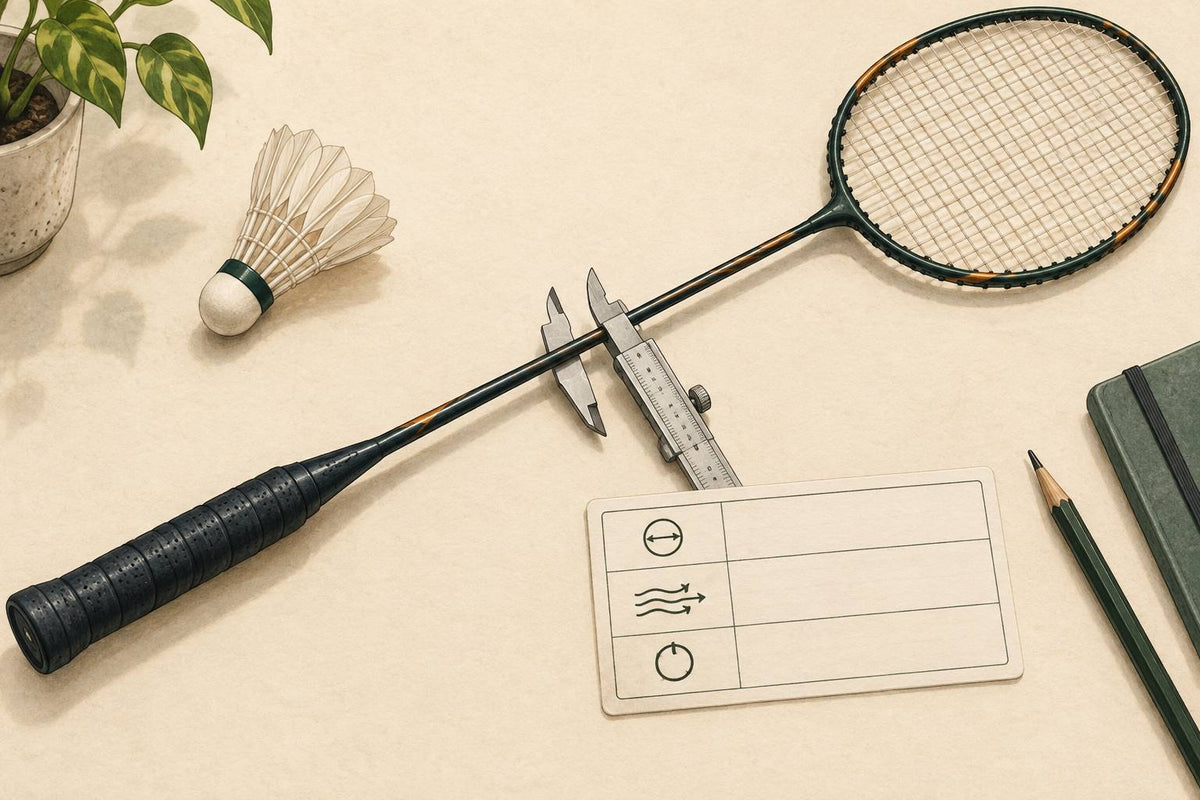
Diameter
A physical width: one part of frontal geometry, not a complete-racket rating.
Flex
A bending property influenced by the full shaft construction, not diameter alone.
Torsion
Twisting behaviour; the cited sources do not provide a universal consumer score.
“Slim shaft” often carries several implied promises: faster swing, firmer response, less twist or better control. Those are separate questions. A useful comparison separates diameter from bending, complete-racket behaviour under off-centre impact and the exact test behind a manufacturer's claim.
Badminton rackets are systems. Frame, strings, shaft, handle, balance and total mass all affect what is in your hand. A shaft label can describe a real design while remaining too narrow to choose between two complete rackets.
Understand what “slim shaft” means
Shaft diameter is the outside width of the section joining handle and head. If two shafts had the same shape and construction, the slimmer one would present less width to the air from some directions. That geometry does not reveal material, wall thickness, internal structure or reinforcement.
The Yonex 2026 badminton catalogue uses labels such as Slim Shaft, Ultra Slim Shaft and Super Slim Shaft within its own product descriptions. The catalogue does not supply an industry-wide millimetre standard for those names. Do not assume that a similarly named shaft from another brand has the same diameter.
Let a tier start a question rather than finish the comparison. Ask whether the maker publishes an actual diameter, whether it describes shape or material, and whether the term applies to the complete shaft or one technology. When no measurement is given, keep the label as written and compare other published specifications rather than inventing a conversion.
Comparison rule: a named shaft tier is manufacturer vocabulary. It can describe a design intention, but it does not prove that two models share a diameter or play the same way.
Keep diameter's drag contribution in proportion
A thinner shaft can reduce one part of the racket's frontal area. That gives aerodynamic language a mechanical basis, but it does not mean the shaft controls the whole racket's air resistance. Head, frame shape and strings also move through the air and occupy much more visible area.
A doctoral aerodynamic model of badminton rackets includes shaft diameter in frontal width while concluding that the frame and strings dominate modelled drag torque. Shaft geometry belongs in the picture, but a slim shaft cannot serve as a stand-alone measure of how quickly a complete racket moves.
Manufacturer results need the same boundary. In a 2020 ASTROX 100 announcement, Yonex reported an 11.8 percent air-resistance reduction for one named solid-core Hyper Slim Shaft design in its own test. That is evidence about that design and test. It is not a universal percentage for every slim shaft, frame or player.
The responsible reading is simple: a slim design may aim to reduce resistance, but the percentage stays with the tested model. Do not transfer it to another shaft because both have slim-sounding labels. For the broader specification, see our racket shaft diameter and length guide.
Separate diameter, flex and torsion
Diameter describes width. Flex describes bending under load. Torsional behaviour describes twisting around the shaft's length. They can interact in an engineered racket, but none is a substitute for the others. A thin-looking shaft is not automatically flexible, and a stiff label does not establish how much a complete racket twists.
| Property | What it describes | What it cannot establish alone |
|---|---|---|
| Diameter | Outside width and one part of frontal geometry. | Universal drag, flex or torsion. |
| Flex | How the shaft bends in the described construction. | A standardized cross-brand measure or player prescription. |
| Torsion | Twisting behaviour in a defined complete-racket setup. | A consumer score unless a stated test measures it. |
This matters when a product page combines words such as slim, stiff and torque control. The terms may describe several parts of one design, but the reader should not turn them into a numerical result that was never published. Cross-brand flex labels are already imperfect comparisons; adding a diameter label does not standardize them.
Treat the complete frame as the object of comparison. Note the exact model, weight class, balance description, flex description, stringing range and published construction details. That keeps shaft width from being asked to answer every equipment question at once.

Do not turn a mishit into a torsion test
Mishits are where marketing language becomes tempting. A player feels a racket rotate or vibrate after off-centre contact and may conclude that the shaft has a particular torsion score. The available cited study does not support that shortcut.
A finite-element badminton-racket impact study found that off-centre impact altered simulated force direction while contact-force magnitude remained comparable in its complete-racket model. It did not isolate shaft torsion, validate a hand-held consumer test or show that one mishit predicts control, comfort, injury risk or player suitability.
Do not deliberately mishit as a torsion test. Contact location, strings, frame, grip, swing path and racket condition all enter the result. A single hit cannot separate them. When comparing rackets in person, describe the response as a personal observation of that exact setup, not proof of a general torsional ranking.
Our racket torsional stability guide explains the difference between a bounded structural model and a consumer-facing stability claim in more detail.
Compare a slim-shaft model without overclaiming
A slim-shaft label is useful when it creates more specific questions about the whole racket. It is least useful as a ranking. Compare published information in this order:
- Exact model: record model and weight class because one technology label can appear on several constructions.
- Published geometry: use a millimetre diameter only when the maker gives one; otherwise retain the label without converting it.
- Mass and balance: compare these complete-racket specifications alongside the shaft.
- Flex as its own field: use the maker's description while remembering it is proprietary.
- Evidence boundary: separate a named-model manufacturer result, an independent model and your court observation.
This process does not create a universal winner. It produces a defensible comparison: what the maker calls the shaft, what it measured or tested, what independent work can establish about aerodynamics or impact, and what remains unknown.
The useful takeaway
A slim shaft can be meaningful, but it is not a universal speed, flex or torsion score. Compare the whole racket, keep model-specific claims attached to their tests, and do not turn limited impact evidence into a player recommendation.



Leave a comment
This site is protected by hCaptcha and the hCaptcha Privacy Policy and Terms of Service apply.