
Last checked: August 2026 · Written by the player-led team at Badminton House
Quick answer
The BWF Laws do not prescribe a torsional-stability score. The cited finite-element work models string-interval and frame-shape effects on out-of-plane string-plane stiffness, not a complete-racket torsion rating, buying hierarchy, comfort, or injury prediction.
Start with what no official torsion score means
Separate a modelled string-plane property from a consumer-facing racket verdict. The BWF Laws do not prescribe a torsional-stability score, and the cited model examines string interval and frame shape effects on out-of-plane string-plane stiffness—not a complete-racket buying hierarchy.
- Keep manufacturer wording, the BWF Laws, and the cited modelling result in separate notes.
- If comparing two frames, treat the record as a local comparison note—not a BWF rule or the study’s protocol—and state the exact models, strings, and conditions you chose to hold steady.
- Describe any result as your own comparison rather than an official stability score or injury prediction.
- Ask a manufacturer or qualified stringer about a model-specific question instead of inferring comfort or safety from the model alone.
Related reading: Box Frame vs Aero Frame Badminton Rackets — for another frame-design question.
What no official torsion score means
BWF Laws do not set a torsional-stability threshold or ranking for badminton rackets. Law 4 instead defines the racket’s permitted construction—its handle, stringed area, head, shaft and, if present, throat—and maximum overall dimensions. Those compliance provisions do not create a torsion score, test protocol, or buying hierarchy. BWF Laws of Badminton

What the model actually tested
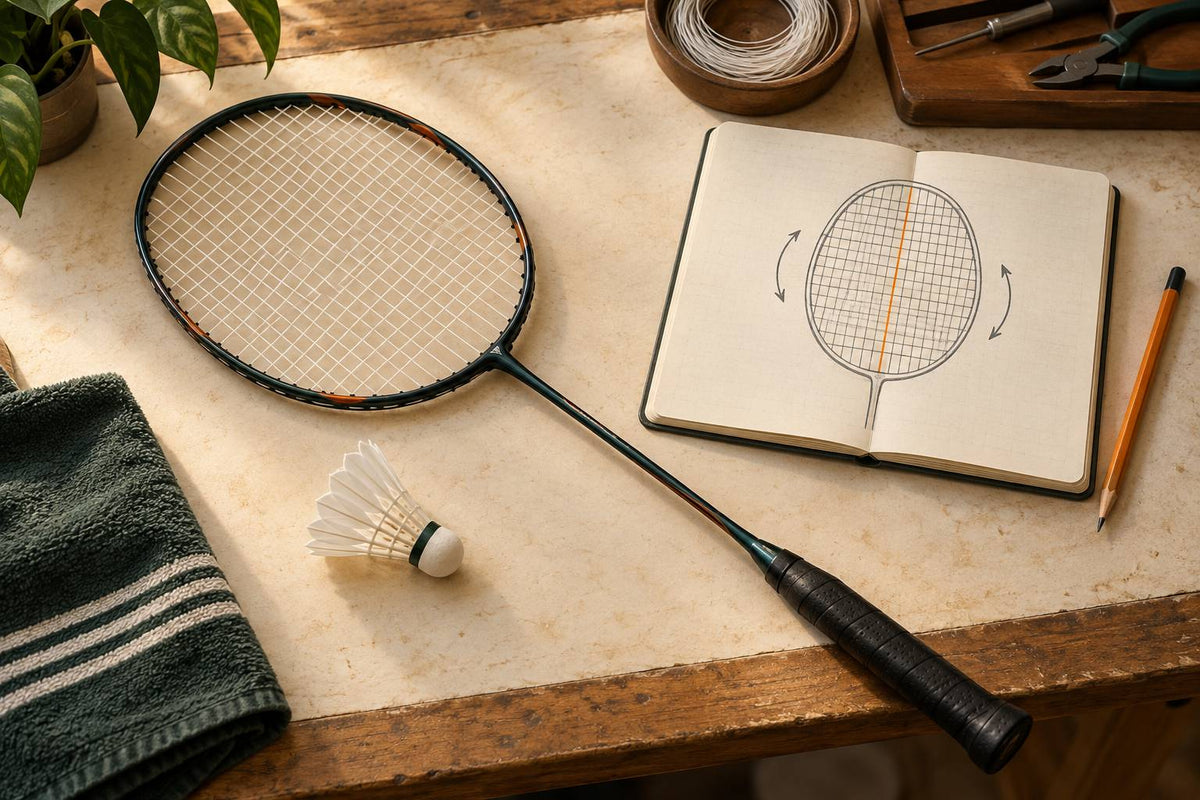
A finite-element study modelled three badminton racquets with different frame shapes and string intervals. In that model, wider string spacing increased out-of-plane string-plane stiffness, while the stiffness distribution changed with frame shape; it did not test a consumer-facing torsional-stability rating for a complete racket. string-plane stiffness study

What it cannot tell a buyer
The retrieved study does not establish a consumer-facing torsional-stability rating, a marketing hierarchy, comfort claim, or injury implication for a complete racket. It models string planes, so any claim about a complete racket’s player outcome needs direct evidence for that outcome. string-plane stiffness study

Local comparison note—not a BWF rule or study protocol: keep the conclusion proportional: BWF has no prescribed score, and the cited model is not a consumer test. Record an exact model, condition, string setup, and personal observation before asking a manufacturer or qualified stringer a model-specific question.
Frame a model-specific equipment question
- Begin with the complete setup in hand: exact racket model, condition, string, and stringing context. This stops a broad stability phrase from drifting away from the equipment a player is actually asking about.
- Use separate fields for three different kinds of information: a manufacturer description, a research-model result, and a player’s own court observation. Do not merge the fields just because each uses a word such as stiffness, stability, or feel.
- For an on-court observation, describe one situation and what the player noticed without translating it into a numerical score. A controlled personal comparison can guide a later question, but it remains an observation of that setup rather than a rating for a whole product class.
- Write the next person who can answer the remaining question. A model-information question goes to the maker; a stringing or condition question goes to a qualified stringer. If no source settles the question, retain it as open instead of inventing a consumer hierarchy.
Record the exact racket and string setup, identify whether the evidence is a manufacturer description, a model finding or a personal court note, and write the question that remains. A change of model, strings or condition starts a new comparison.
For a side-by-side question, keep the comparison modest: record the two exact frames, anything intentionally held constant, and the one description each source actually supplies. If the court observation is different on another day or after a stringing change, record that as a separate observation rather than a contradiction that needs a universal explanation. The record remains useful even when it ends with an unanswered model-specific question, because it identifies precisely what a further source, maker, or stringer would need to address.
Questions the cited sources do not settle
- A universal torsional-stability score or player recommendation.
- That a marketing label predicts control, comfort, or injury risk.
Player-first advice for your next indoor session


Leave a comment
This site is protected by hCaptcha and the hCaptcha Privacy Policy and Terms of Service apply.