
Last updated: July 2026 · Written by the team at Badminton House
Quick Answer: Shaft Diameter and Racket Length
Start near 6.6 mm and 665–675 mm unless you specifically want faster handling or more leverage.
Balanced
Best default: A typical shaft diameter and standard length avoid pushing either specification to an extreme.
Speed
Choose a slimmer shaft near 6.0 mm and standard length when quick swings matter most.
Leverage
Choose a longer frame for reach and tip speed, accepting extra swingweight and slower handling.
Two rackets can share the same weight, balance and “stiff” label yet feel noticeably different in a fast drive exchange. The overlooked reasons are often shaft diameter and how the racket’s overall length is divided between handle and shaft. A slimmer shaft can reduce air resistance, but diameter alone does not determine stiffness; wall thickness, materials and cross-section also matter. Extra length can increase reach and tip speed, yet any added swingweight can make defence and net interceptions slower. This guide shows how to read those numbers without treating “ultra slim” or “longer” as automatic upgrades.
Comparing a spec sheet that omits millimetres? Send us the listing and your playing priorities through our contact page, and we’ll help interpret what is actually published.
In This Guide
What Badminton Racket Shaft Diameter Means
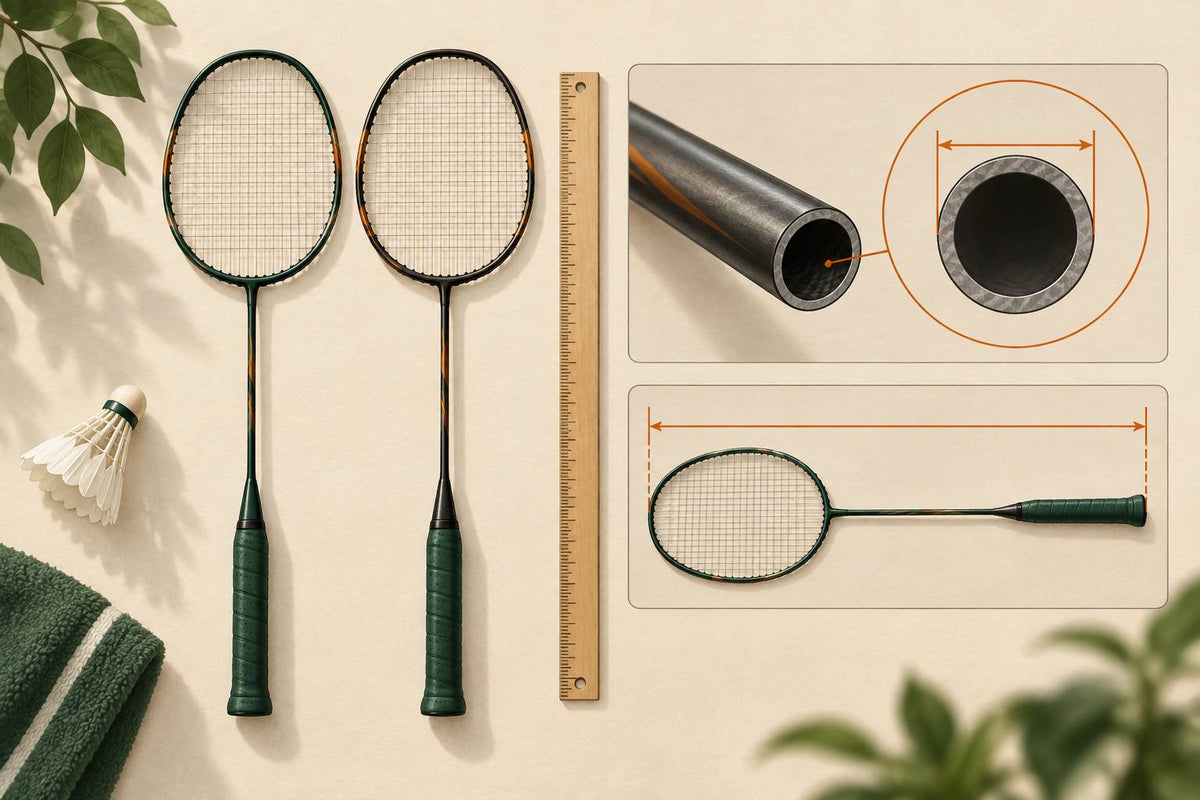
Badminton racket shaft diameter is the shaft’s outside width, normally measured across its circular cross-section and stated in millimetres. Typical shafts sit around 6.6 mm. Slimmer designs approach 6.0 mm, while one racket manufacturer describes the broader range used in most rackets as approximately 6.4–7.2 mm.
This measurement is a design specification, not a dimension prescribed by the Laws of Badminton. BWF Law 4 defines the shaft functionally as the part connecting the handle to the head, but gives no required diameter, thickness or shaft length. The complete racket frame is regulated instead, including a maximum overall length of 680 mm and width of 230 mm.
Spec sheets are not consistent about reporting diameter. Some manufacturers provide a number such as 6.8 mm, while others use named technologies or tiers such as Slim Shaft, Super Slim Shaft and Ultra Slim Shaft. Treat those labels as manufacturer-specific descriptions rather than automatic millimetre equivalents.
How Shaft Diameter Changes Speed and Flex Feel
A slimmer shaft presents less frontal area to the air, supporting a faster-through-the-air feel. As attributed examples, one racket-shaft manufacturer reported 5.2% lower swing wind resistance for a 6.1 mm design, while Yonex reported an 11.8% air-resistance reduction for its graphite-cored ASTROX 100 shaft. These are design-specific manufacturer claims, not universal gains for every thin shaft.
Diameter is not a stiffness rating. Bending resistance also depends on cross-section geometry, materials and wall thickness. For a circular tube, the second moment of area depends on the fourth power of its inner and outer radii, so a small diameter change can strongly affect bending resistance. A slimmer shaft therefore generally feels more flexible at the same published flex rating, but reinforcement can preserve stiffness. See the shaft flex guide for that distinction.
Speed-oriented players may appreciate quicker preparation and follow-through. Players wanting a firmer, more precise response should not choose by thinness alone.
Racket Length: Tip Speed Versus Manoeuvrability
Overall length is measured from the bottom of the handle to the top of the racket head. Most badminton rackets fall between 665 and 675 mm. That typical range should not be confused with the BWF legal maximum: a racket frame may not exceed 680 mm in overall length.
A longer design can provide more reach, leverage and tip speed, helping a well-timed player contact the shuttle higher. The trade-off is that added length usually raises swingweight, so the racket takes more effort to accelerate and recover. That cost is most noticeable during fast flat defence and attacking net exchanges, where compact movements and quick racket-face changes matter.
Choose the longer end when your timing is reliable and you value leverage or a higher contact point. If reaction speed, defensive recovery and front-court manoeuvrability are the priorities, the more forgiving standard-length end of the range is usually the safer starting point.
How to Read Diameter and Length on a Spec Sheet


Use this quick inspection checklist before comparing rackets:
- Shaft diameter: Look for a measurement in millimetres or a named tier such as “Slim,” “Super Slim,” or “Ultra Slim.” Named tiers are manufacturer-specific, so do not assume they correspond to the same diameter across brands.
- Racket length: Look for either the absolute overall length or an offset such as “5 mm longer.” An offset is relative to that manufacturer’s own standard, not a universal baseline.
Identical published weight, balance and flex still do not guarantee identical feel. Overall length does not reveal how that length is divided between shaft and handle, while flex labels are not standardized across brands. Shaft cross-section, wall thickness, cap geometry, handle construction and vibration behaviour can all change bending, twisting and feedback. Published balance also cannot replace swingweight when judging how quickly a racket moves.
Which Shaft Diameter and Length Should You Choose?
Treat diameter and length as filters, not guarantees. Construction, mass distribution and swingweight can make two apparently similar rackets play differently.
| Choice | Choose it if… |
|---|---|
| Slimmer shaft | You prioritize lower air resistance and a faster, generally more flexible feel. |
| Standard shaft | You prefer the more conservative starting point and do not want slimness to drive the decision. |
| Longer racket | You have reliable timing and value reach and tip-speed potential over compact handling. |
| Standard length | You prioritize quick defence, flat exchanges and net reactions. |
When undecided, compare swingweight and test recovery speed; extra length only helps if you can accelerate and reposition the frame comfortably.
Get 10% off your first order
Join the Badminton House list and we’ll email you a 10% welcome code — plus training guides, technique advice, and badminton updates.
By subscribing, you agree to receive Badminton House emails and can unsubscribe anytime.
Diameter and length are useful filters, but they cannot predict feel on their own. We play badminton and know how strongly shaft construction, balance, and swingweight interact in the hand. If two spec sheets leave you unsure, contact us for practical advice based on your game.
Compare the details before you choose.
Browse Rackets & Check Spec SheetsCheck live availability and compare published specifications.


Leave a comment
This site is protected by hCaptcha and the hCaptcha Privacy Policy and Terms of Service apply.