
Last checked: August 2026 · Written by the player-led team at Badminton House
Quick answer
A court usually turns slick mid-session for one of four reasons: sweat, condensation, dry dust, or a freshly recoated finish. Each leaves a different tell and a different fix, and none of them are solved by sliding harder into your lunge. Pause play as soon as you notice a slick area, report it and keep the court clear until the surface is clean, dry and safe.
Related reading: How to Clean Slippery Badminton Shoe Soles Safely — for when the floor is fine and the problem is what has built up on your own soles.
Diagnose What Actually Made the Floor Slick
Four things turn a badminton floor slick mid-session: sweat, condensation, dust, or a freshly finished surface. Each leaves a distinct tell, so look before you guess. Getting the cause right decides whether you grab a towel, call over staff, or simply wait for a coat of finish to cure.
Sweat shows up as a specific wet patch, usually under the back-court smash zone or right around the service line where a server plants and pushes off. It is easy to spot because it is localized and it reappears in the same few spots every rally.
Condensation looks different: a dull, even sheen across a wider stretch of floor rather than one wet footprint, often near exterior walls, glass, or air-conditioning vents, and it feels cool and slightly clammy to a bare hand. Humidity and condensation are recognized environmental causes of slippery floors, alongside contamination from dust or spills (UK Health and Safety Executive slip guidance), and it shows up most on humid days.
Dust is dry contamination: a grey haze or grit you can see and feel underfoot, usually tracked in from outside or shed by a rarely-swept multi-use hall floor. Health and safety guidance treats dry, dusty floor contamination as its own established slip hazard, separate from wet or fluid contamination (HSE guidance).
Floor finish is the one players miss. A hall that has just been recoated or waxed feels slick everywhere, evenly, with no dust and no obvious moisture, because the new finish has not fully cured. Sports-floor manufacturer guidance is explicit that a newly finished floor needs to stay clear of foot traffic until the finish cures, which typically takes several days (Maple Flooring Manufacturers Association). If the floor was recently finished, ask staff whether it has been cleared for use.
Fix What a Player and a Venue Can Each Do
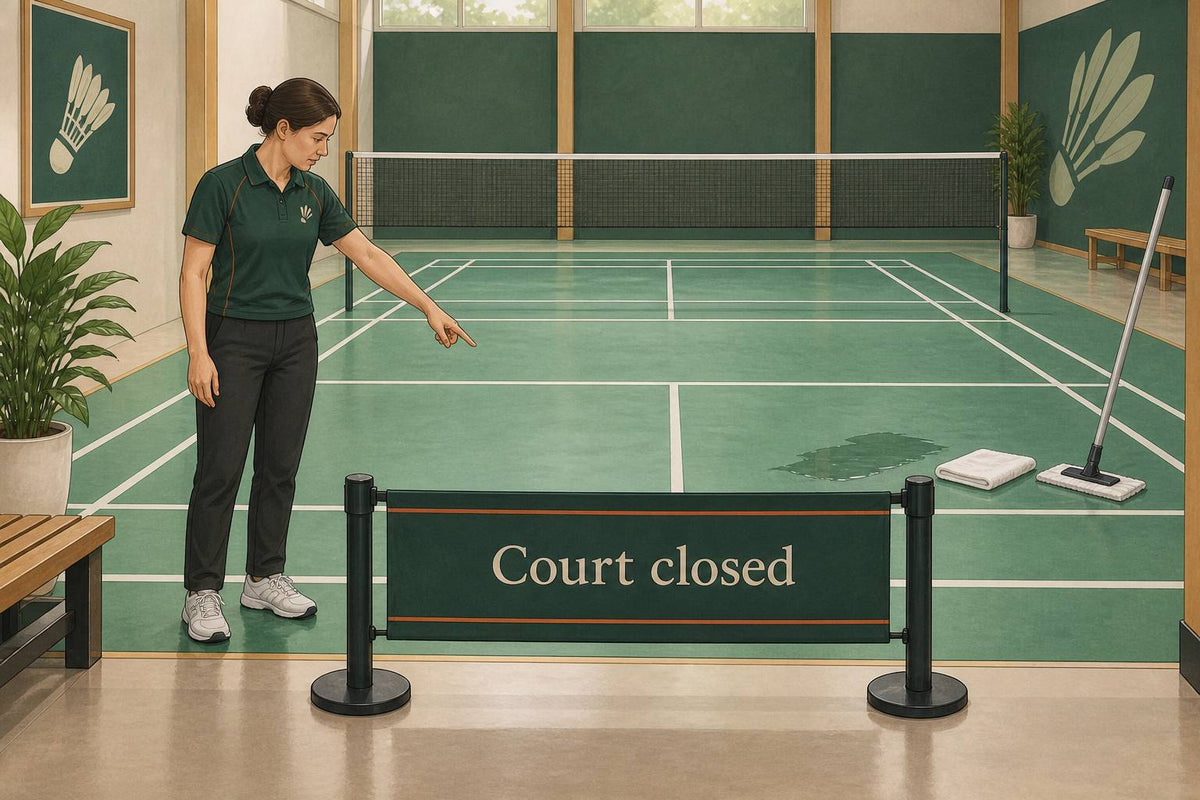
A player can wipe a sweat patch with a dry towel between points; a venue has to handle condensation, dust, and finish problems, and the single biggest mistake either side can make is reaching for a wet mop. Know which fixes are yours and which need staff.
Keep a towel courtside and wipe your own sweat off the floor as soon as you notice it. If a spot keeps recoating itself within a few rallies of being wiped, that is a floor problem, not a you problem, so flag it to staff instead of wiping it all night.
Do not improvise a wet-mop treatment during play; ask staff to follow the floor manufacturer’s cleaning instructions. Cleaning guidance is direct on this: a wet mop leaves a thin film of water that is by itself enough to create a slip risk on a smooth floor, and a floor left damp by mopping needs its access restricted until dry (HSE cleaning guidance). For MFMA maple floors, the guidance prohibits water-based power scrubbers and recommends daily dust-mopping, more often under heavy use (Maple Flooring Manufacturers Association daily care guidance). The same maple-floor guidance recommends indoor relative humidity of 35% to 50% to control moisture-related expansion and contraction; staff still need to investigate condensation separately.

Pause Play Until the Floor Is Safe
Stop the rally when you notice lost grip. Shorter lunges and earlier braking do not make a slippery surface safe; keep players off the affected court while staff resolve the cause.
Set yourself an honest stop-play threshold and use it. If a cleaned area remains slick, that is not a floor to keep adapting around; health and safety guidance calls for restricting access to a floor until it is genuinely dry rather than treating a quick clean as clearance to resume full-speed play (HSE guidance). Pause the game, report the exact spot to whoever runs the hall, and wait for a real fix instead of a lower-lunge workaround.
Handle a slick floor like this
- Look for clues such as a wet patch, a wide sheen, dust or recent floor work, and confirm the cause with staff.
- Pause to wipe sweat, and ask staff to handle dust, condensation or finish problems using the floor’s approved cleaning method.
- Keep players off the affected court until the hazard is resolved.
- Stop play if a spot is still slick after cleaning, and wait for a real fix rather than adapting around it indefinitely.


Leave a comment
This site is protected by hCaptcha and the hCaptcha Privacy Policy and Terms of Service apply.