
Last checked: August 2026 · Written by the player-led team at Badminton House
Quick answer
Use dynamic stretching and short static holds (under about 45 seconds per muscle) before play, and save long static holds for after play and non-training days. Hold duration decides the outcome more than stretch type does: pooled research finds no statistically significant strength or power loss under roughly 45 seconds, but a real, measurable cost from holds of 60 seconds or more.
Start with Static or dynamic stretching before badminton?
Read the decision table, run the 12-minute pre-play sequence before your next session, and push long static holds to the cool-down where they build range of motion instead of costing you power.
Related reading: 7 Badminton Warm-Up Exercises for Cold Gyms — the full 10-minute dynamic drill breakdown that pairs with the sequence below.
Static or dynamic stretching before badminton?
Before badminton, lean on dynamic stretching and keep any static holds short, under roughly 45 seconds per muscle. The two largest reviews of this question found no statistically significant strength or power loss at that duration, while holds of 60 seconds or more per muscle carry a real, measurable cost of roughly 4 to 7.5 percent off strength and power.
That cost is exactly the trade you do not want two minutes before your first serve, and it is exactly the habit you will see at most drop-in sessions: players sitting on the floor before the first game, holding a hamstring or quad stretch for a minute or more while they wait for a court. It feels like preparation, but hold length is the variable that actually decides the outcome. A 90-second quad stretch minutes before a session of lunges and jump smashes is close to the exact protocol the reviews below found costly, while the same stretch held for 20 seconds is close to the protocol they found harmless.
The popular "never stretch statically before sport" rule oversimplifies a duration-dependent effect. A 2012 systematic review of 106 studies found static holds under 30 seconds carried no detrimental effect at all (pooled -1.1%), holds of 30 to 45 seconds also showed no significant effect (pooled -1.9%), and the relationship between hold time and performance loss followed a dose-response curve, with a significant drop becoming likely only from about 60 seconds per muscle onward. A separate meta-analysis of 104 studies pooled the average strength loss at 5.4 percent but found the average power loss, 1.9 percent, was not statistically distinguishable from zero; the same review found the smallest effects at stretch durations of 45 seconds or less and recommended against using static stretching as the sole warm-up activity.
A 2019 review placed the transition zone around 60 seconds per muscle group: short protocols generally produce a negligible cost, about 1 to 2 percent, while longer protocols of around 60 seconds or more are associated with larger declines, about 4 to 7.5 percent, or roughly 4.6 percent when results are pooled. Because the published categories overlap at 60 seconds, this value should not be treated as an absolute boundary. Folding a short static hold into a broader dynamic warm-up does not impair subsequent performance. A 2025 international expert consensus of sports scientists reached a compatible conclusion: the panel does not recommend static holds longer than 60 seconds per muscle before a maximal or explosive effort, but short-duration static stretching inside a dynamic warm-up is not a problem.
| Stretch type | When | Why |
|---|---|---|
| Dynamic (leg swings, arm circles, lunges, footwork) | Before play, as the main pre-match activity | Raises tissue temperature and rehearses the movement badminton actually needs, with no measurable performance cost. |
| Static, short hold (under 45 seconds per muscle) | Before play, folded into the dynamic warm-up if needed | Pooled research shows no significant strength or power loss at this duration. |
| Static, long hold (60 seconds or more per muscle) | After play, or on non-training days | Builds range of motion over weeks; carries a real strength and power cost right before hitting. |
The one exception: a genuinely stiff joint that blocks a position you need (a shoulder that will not reach full extension for an overhead smash, say) is worth one brief static hold, under 45 seconds, before you move into dynamic work. Since short holds carry only a trivial cost, spending 20 to 30 seconds unlocking a specific restriction is a reasonable trade against starting the match unable to reach the shot.
The 12-minute pre-play sequence
This 12-minute sequence is Badminton House's own pre-play structure, built around three blocks: about five minutes of easy movement to raise your heart rate and tissue temperature, four minutes of dynamic mobility through the shoulders, hips and ankles, and three minutes of sport-specific footwork and shadow swings that rehearse the shots you are about to hit.
- Minutes 0 to 5, raise: easy jogging on the spot, skipping, or light shadow footwork around the court. The goal is a light sweat and a faster heart rate, nothing sport-specific yet.
- Minutes 5 to 9, mobilize: arm circles and shoulder rotations, walking lunges, high knees, ankle circles and trunk rotations. If one joint is genuinely stiff and limits a position you need, this is where the single static hold from the exception above belongs, under 45 seconds, then straight back into movement.
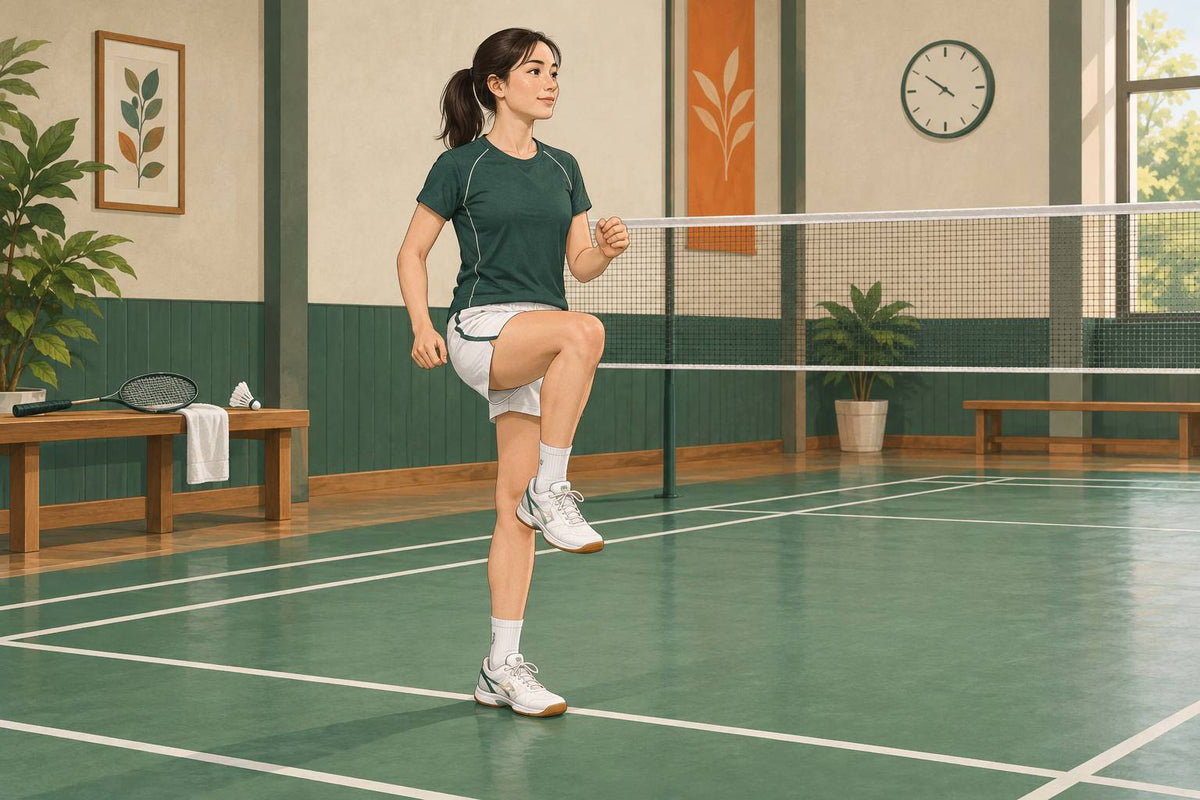
- Minutes 9 to 12, rehearse: split-step timing, lunges into all four corners, and shadow smashes and clears at gradually increasing pace, finishing with a few serves at match pace so your first real point is not also your first full-speed swing.
This sequence covers the raise-and-rehearse structure; for the exercise-by-exercise breakdown of the dynamic block, our warm-up exercises guide walks through each movement with cold-gym adjustments.

Where static stretching belongs
Static stretching does its best work after play and on non-training days. Regular holds of 30 to 120 seconds per muscle, two to three sets, on most days of the week, build range of motion over several weeks. Treat it as flexibility training you invest in between sessions, separate from whatever you do to warm up.
For most badminton players, the muscles worth that investment are the ones the sport loads hardest: hip flexors and quads from repeated lunges, calves and ankles from split steps and jumps, and shoulders and forearms from overhead swings and racket grip. A practical rest-day routine might hold each of those five areas for 60 to 90 seconds, two sets per side, most days of the week. That is the same total-duration territory the pre-match holds above deliberately stay under, just moved to a time when the performance cost does not matter.
That distinction matters because "static stretching helps you recover" is a weaker claim than it sounds. The same 2025 expert consensus that sets the range-of-motion guidance above also states the panel does not recommend static stretching as a post-exercise recovery routine, citing low confidence in the available evidence. Stretching after play earns its place through the flexibility it builds over several weeks. Do not expect it to meaningfully change how sore you feel tomorrow.
For the stretch-by-stretch cool-down routine, quads, hamstrings, hips, shoulders and wrists, use our cool-down stretches guide once you come off court.
Does stretching prevent injury?
Neither static nor dynamic stretching has strong injury-prevention evidence behind it. The 2025 international Delphi consensus does not recommend stretching for injury prevention in general, and flags that any muscle-strain benefit from static stretching may be offset by higher bone and joint injury risk. Treat stretching as a performance choice rather than injury insurance.
That does not make the static-versus-dynamic timing choice meaningless. It just changes the justification: keep long static holds off the pre-match court for the strength-and-power reason documented above, and keep static work in the cool-down and rest-day routine for the range-of-motion reason. Injury risk is a separate, unresolved question that neither choice settles on its own.
This is also where the exception from the decision table earns its keep. A joint stiff enough to block a needed position is a movement-quality problem worth a brief fix, and the fix should stay brief precisely because the injury case for stretching is not settled either way.
Put the rule to work this week
- Swap any long static holds before play for the 12-minute raise, mobilize, rehearse sequence above.
- Keep pre-play static holds under 45 seconds, and only for a joint that genuinely blocks a needed position.
- Move your longer static holds to right after play or a non-training day, two to three sets of 30 to 120 seconds.
- Re-check the joint you targeted after a few weeks; if it still limits the position, treat it as a coaching or physiotherapy question instead of stretching it longer.


Leave a comment
This site is protected by hCaptcha and the hCaptcha Privacy Policy and Terms of Service apply.