
Last updated: July 2026 · Written by the team at Badminton House
Quick Answer: Badminton Stretches Cool Down
A badminton cool-down is 5–10 minutes of light jogging or walking to bring your heart rate down, followed by gentle static stretches of about 30 seconds each for the legs, hips, shoulders, wrists and arms.
Default
Best choice: walk or jog lightly until your breathing settles, then hold each static stretch for about 30 seconds without pushing into pain.
Short
If you are tight on time after club night, prioritize the main badminton load areas: quadriceps, hamstrings, hips, shoulders and wrists, switching sides on single-side stretches.
Sore
If your legs, shoulder or wrist feel worked after clears, smashes and lunges, keep the stretch gentle; the cool-down goal is recovery, not forcing flexibility.
You finish a tough badminton session, pack your racket, and the soreness starts before you even leave the gym: tight quads from lunges, stiff hips from split steps, a loaded shoulder from clears and smashes, and a forearm that feels like it held the racket for three hours. That is exactly where a simple badminton stretches cool down routine helps.
The goal after playing is not to force deep flexibility work. Dynamic stretching belongs in the warm-up; after badminton, static stretching is the better fit because you hold positions long enough for hard-working muscles to relax and elongate. For most players, that means easing down first, then spending time on the legs, hips, shoulders, wrists, hands and arms that took the biggest load on court.
Use this guide after club night, league matches, tournaments, lessons or at-home drills. Keep each stretch gentle, avoid pushing into pain, and treat the cool-down as part of the session — not an optional extra you skip because the gym lights are about to turn off.
Better recovery starts with better court habits. Supportive badminton footwear helps manage lower-limb load during lunges and quick direction changes; browse our badminton footwear collection. Badminton House ships across Canada.
In This Guide
- Why Do Cool-Down Stretches Matter After Badminton?
- Start With 5–10 Minutes of Easy Movement
- Leg and Hip Stretches After Badminton
- Shoulder and Triceps Stretches for Overhead Shots
- Wrist, Hand and Arm Stretches for Racket Load
- What Cool-Down Mistakes Should You Avoid?
- Gear That Supports Better Recovery Habits
- Which Cool-Down Should You Choose?
Why Do Cool-Down Stretches Matter After Badminton?
A good badminton cool down is not just “doing a few stretches because you should.” It is the bridge between a high-intensity match and the rest of your day. After rallies full of lunges, jumps, split steps, overhead clears and smashes, your body needs a gradual shift from explosive movement into relaxed recovery.
The key difference is timing: dynamic stretching is typically used before badminton, while static stretching is best saved for after you play. Dynamic stretches keep you moving and prepare the body for court speed. Static stretches are held for a period of time so the muscles can relax and elongate, which makes them a better fit once the session is over.
Warm up first, stretch after. If you are building the full routine, pair this cool-down guide with our badminton warm-up exercises so your body is prepared before play and eased down after play.
Badminton loads the whole body: the quadriceps and hamstrings brake every lunge, the glutes and hip flexors drive court coverage and quick recovery steps, and the back and shoulders absorb repeated overhead clears, drops and smashes — plus trunk rotation and rapid racket preparation on top.
- Legs: quads, hamstrings and calves help you lunge, jump, stop and recover between shots.
- Hips: glutes and hip flexors support split steps, deep lunges and quick directional changes.
- Upper body: shoulders, back and trunk are heavily involved in overhead hitting and rotation.
- Racket arm: wrists, hands and forearms take repeated load from gripping, slicing, defending and smashing.
That is why badminton stretches cool down the whole playing system, not just one sore area. A useful post-match routine should cover the neck, shoulders, trunk, hips, quadriceps and wrists, with extra attention to the muscles you used most in that session.
Start With 5–10 Minutes of Easy Movement
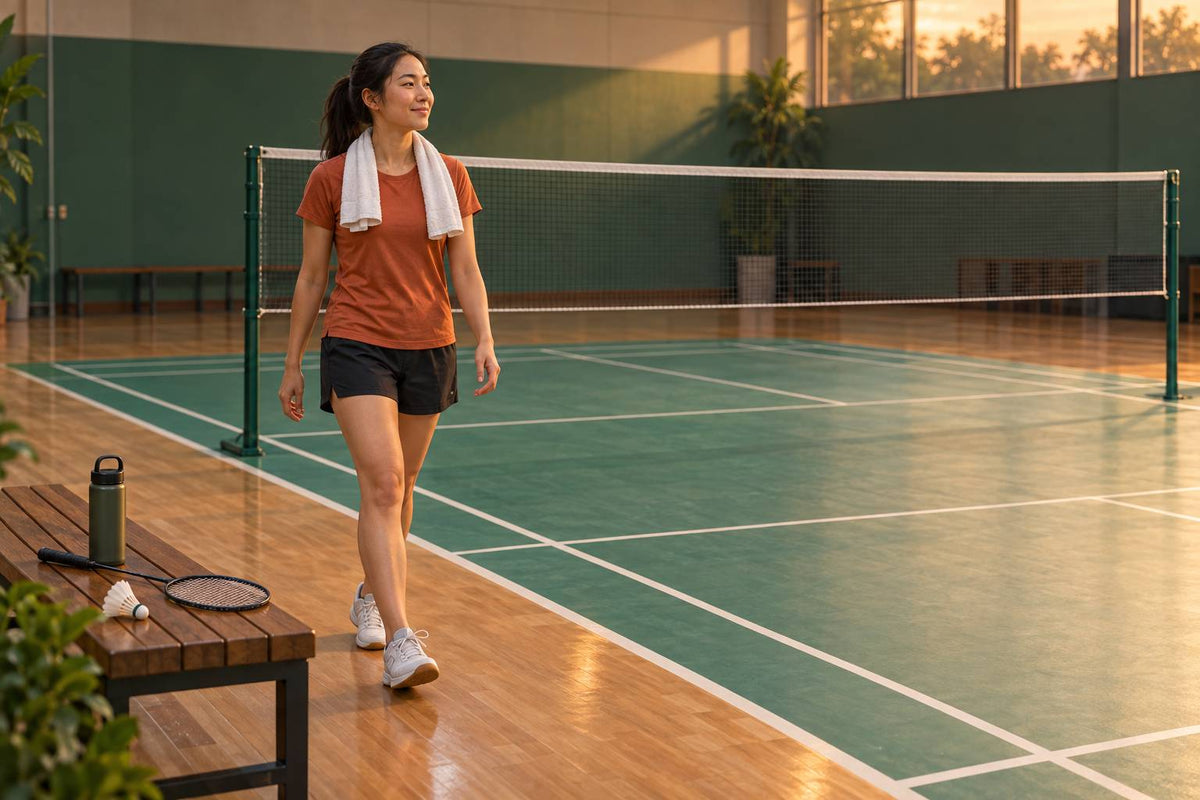
After a hard game, do not go straight from the final rally to sitting on the bench. Before static stretching, bring your heart rate down gradually with light jogging or brisk walking, then slow it down to an easy walk over about 5–10 minutes.
This matters because suddenly stopping all activity can cause blood to pool in the legs, which can potentially lead to dizziness or fainting. That risk is easy to avoid: keep moving, breathe steadily, and let your body shift out of match intensity before you hold any stretches.
Simple 5–10 Minute Cool-Down Flow
- Minutes 0–2: light jog or brisk walk around the court, keeping your steps relaxed.
- Minutes 2–5: slow to a normal walk and shake out your shoulders, arms and hands.
- Minutes 5–10: keep walking if your breathing is still elevated, especially after long singles rallies or tournament matches.
- Right away: replenish fluids and electrolytes after play finishes instead of waiting until you feel thirsty.
For Canadian club players who move between cold outdoor weather and warm indoor gyms, this gradual downshift is especially practical: it gives your legs, hips and shoulders a calmer starting point before you settle into the longer static holds.
Once your breathing feels controlled and your walking pace feels easy, move into the post-badminton static stretches for the legs, hips, shoulders, wrists, hands and arms.
Leg and Hip Stretches After Badminton

Your legs do a huge share of the work in badminton: repeated lunges, jumps, split steps and recovery steps load the quadriceps, hamstrings, glutes and hip flexors. After the easy-movement part of your cool-down, use static stretches to help those muscles relax and lengthen instead of walking straight from the court to the car.
A simple lower-body sequence is: quadriceps, hamstrings, butterfly hip stretch, then a hip-flexor/quad lunge stretch. Move gently, hold the positions long enough to matter, and change sides on single-side stretches.
Cool-down rule: these are not flexibility contests. Hold a comfortable stretch, breathe normally, and avoid pushing into pain. Static stretching after badminton should ease your body back down, not turn into another hard workout.
1. Standing quadriceps stretch
The quadriceps work hard when you brake, lunge forward and push back to base. To stretch them, stand on one leg, bend the free leg back, hold the ankle, and pull the foot higher behind the body until you feel the stretch through the front of the thigh.
- Keep the stretch controlled rather than yanking the ankle.
- Hold for at least 30 seconds before switching legs.
- If the match was tiring, do not skip this one: missing quad stretches after a hard session can contribute to aches, tightness and soreness.
2. Hamstring forward bend
Hamstrings help absorb the stop-start load from running, jumping and lunging. For a simple forward-bend stretch, stand with your feet about hip-width apart and bend forward from the hips only as far as comfortable.
- Think “hinge from the hips,” not “force the head to the knees.”
- Stop where you feel a manageable stretch through the back of the legs.
- Hold for at least 30 seconds, then come up slowly.
3. Butterfly hip stretch
The butterfly stretch is useful after badminton because it targets the hips and thighs, two areas that get loaded by wide defensive lunges and quick changes of direction. Sit down, bring the soles of the feet together, and let the knees move outward until you feel a comfortable stretch around the hips and inner thighs.
- Sit tall rather than collapsing through the back.
- Let the stretch settle gradually instead of bouncing the knees.
- Hold for at least 30 seconds before moving on.
4. Hip-flexor and quad lunge stretch
This stretch is especially relevant after a lot of front-court lunging. Set up in a lunge position and press down with the hands to drive the hips forward until you feel a stretch through the front of the hip, groin and thigh.
- Ease into the position slowly; the stretch should be clear but not sharp.
- Hold for 20–30 seconds before switching legs.
- Use this after the standing quad stretch if your thighs and hips feel especially tight from long rallies.
| Stretch | Where you should feel it | Hold time |
|---|---|---|
| Standing quadriceps stretch | Front of the thigh | At least 30 seconds per side |
| Hamstring forward bend | Back of the legs and hips | At least 30 seconds |
| Butterfly hip stretch | Hips and thighs | At least 30 seconds |
| Hip-flexor/quad lunge stretch | Front of the hip, groin and thigh | 20–30 seconds per side |
If you are short on time after a club night, do not rush every stretch for five seconds. Pick the muscles that worked hardest, hold them properly, and keep the intensity gentle. For more lower-body context, see our badminton footwork basics and knee pain badminton guide.
Shoulder and Triceps Stretches for Overhead Shots
Overhead clears and smashes load the shoulder, upper arm and wrist more than many players realize. After play, this is the time for gentle static stretching: hold the position, breathe, and let the muscle relax instead of bouncing or forcing range.

For a badminton stretches cool down routine, do not stop at the legs. The neck, shoulders and trunk are key areas to include because they are used heavily in overhead shots and quick directional movements. A simple shoulder-and-arm block can take only a few minutes but helps you finish the session feeling less locked up through the upper body.
Two upper-body stretches to include after badminton
Cross-body shoulder stretch
Bring one arm across your chest. Use the other arm to gently pull it closer to your body. Hold for about 30 seconds, then switch arms. Keep the shoulder relaxed instead of shrugging it toward your ear.
Triceps stretch
Raise one arm overhead, bend at the elbow, and use the other hand to gently push the elbow back. You should feel the stretch along the back of the upper arm, not a sharp pinch in the shoulder.
How to fit them into your cool down
- Do them after easy movement: finish your light jog or brisk walk first, then move into these static stretches.
- Change sides: stretch both arms, even if one side feels more tired after serving, smashing or defending.
- Keep the pressure gentle: the goal after badminton is to ease your body back toward rest, not force a flexibility session.
- Include the trunk and neck: overhead strokes and fast changes of direction involve more than the hitting shoulder, so avoid treating the arm as an isolated area.
If your shoulder or arm discomfort is more than normal post-match tightness, scale back and pay attention to technique and racket load. For related racket-side issues, see our guide to badminton elbow and wrist pain, and for better overhead mechanics, read how to improve your badminton smash.
Wrist, Hand and Arm Stretches for Racket Load

Badminton puts a lot of load through the wrist during overhead clears, smashes and repeated racket movements, so give the forearm, wrist and hand a few quiet minutes at the end of your cool-down. These stretches should feel controlled and mild, not forced.
If wrist or elbow discomfort keeps returning after you play, use this section as a recovery habit and read the deeper guide to badminton elbow and wrist pain for more context on racket load, grip and string tension.
1. Wrist flexion stretch: palm down, fingers dropped
- Hold one arm straight out in front of you with the palm facing down.
- Drop the fingers and palm downward at the wrist.
- Use your other hand to gently grab the fingers and pull them back toward your body.
- Keep the shoulder relaxed, breathe normally, then switch hands.
2. Wrist extension stretch: palm down, fingers bent up
- Hold the arm out again with the palm facing down.
- This time, bend the fingers and palm up at the wrist.
- Grab the fingers with the other hand and gently pull them back toward your body.
- Switch hands so both racket-side and non-racket-side wrists get attention.
3. Palm-up wrist stretch: keep it gentle
For another simple wrist variation, hold your arm out with the palm facing up. With the other hand, gently pull the fingers back and hold for 20–30 seconds. Do not jerk the hand backward, and stop at a stretch sensation rather than pain.
Cool-down cue
Your wrist stretches should feel like you are easing tension out of the forearm after racket work. If you need to grit your teeth, you are pulling too hard.
What Cool-Down Mistakes Should You Avoid?
A good badminton stretches cool down is not a flexibility contest. After hard rallies, lunges, jumps and overhead shots, the goal is to guide your body back toward rest, then use gentle static stretching to settle the muscles you used most.
The biggest mistakes are usually simple: skipping the cool-down, stopping too abruptly, or pushing static stretches too hard. Keep the routine calm, controlled and pain-free.
| Mistake | What to do instead |
|---|---|
| Skipping the cool-down completely | Set aside the extra 10–15 minutes after play. Start with easy movement, then stretch the main badminton areas: neck, shoulders, legs, hands and arms. |
| Stopping too fast | Do not go straight from a hard final rally to sitting on the bench. Ease down first with light jogging, brisk walking, then slower walking before you stretch. |
| Forcing static stretches | Static stretches belong after play, but they should stay gentle. Stretch until you feel mild tension, not pain, and avoid bouncing or jerking the joint. |
| Only stretching one side | Change sides on single-side exercises. Even if your racket shoulder, wrist or lead lunge leg feels more tired, give both sides attention so the routine stays balanced. |
Simple rule: if a stretch feels sharp, pinching or painful, back off. Cool-down stretching should help you relax after badminton, not force a new range of motion at the end of a tired session.
Pay special attention to the areas badminton loads repeatedly: legs and hips from lunging and jumping, shoulders and triceps from overhead clears and smashes, and wrists, hands and forearms from racket work. If soreness, joint pain or recurring tightness keeps showing up after club nights, use this as a cue to review your training load, technique and equipment habits.
For a broader prevention checklist, read our Common Badminton Injuries: Canadian Prevention Guide. If footwear is part of the issue, proper indoor court shoes can also help reduce lower-limb load; for example, the Babolat Shadow Tour Men’s Badminton Shoes – Orange is a non-marking indoor court shoe with lateral midfoot support.
Gear That Supports Better Recovery Habits
A good cool-down is mostly about habits: ease down, breathe, hydrate, then hold your stretches gently. Gear will not do the recovery work for you, but the right badminton basics can make that routine easier to stick with after club night, league play, or a weekend tournament.
Start with court-specific support. Supportive, cushioned badminton shoes help manage lower-limb load during lunges, jumps, and quick changes of direction. Browse badminton footwear if your current shoes feel flat, slippery, or unstable late in a session.
| Recovery habit | Gear that helps | Where to look |
|---|---|---|
| Protect your legs before they get tired | Supportive, cushioned indoor badminton shoes for lunges, split steps, and recovery steps. | Babolat Shadow Tour Men's Badminton Shoes – Orange has lateral midfoot support built for this kind of load. You can also browse the full footwear collection. |
| Stretch without restriction | Light, movement-friendly apparel that does not fight your hip, quad, hamstring, or shoulder stretches. | Yonex Men's Shorts 15204YX is a movement-friendly option built not to fight your stretches. For more options, see badminton apparel. |
| Add recovery tools when needed | Foam rollers, massage balls, compression sleeves, or stretch bands can support a post-play routine if you already know how to use them comfortably. | Badminton House does not carry dedicated recovery tools, so check Canadian specialty retailers or your local club pro shop for those items. |
If you are refreshing shoes or apparel for the season, Badminton House ships across Canada. Keep the recovery kit simple: shoes that support your footwork, apparel that lets you move, and a cool-down routine you will actually repeat after every match.
Which Cool-Down Should You Choose?
Use the table below to choose the right badminton stretches cool down focus for the session you just played. The best routine is usually simple: ease down, then hold gentle static stretches for the areas that took the most load.
| Choose this focus | Best if your session had... | Stretches to prioritize | Key cue |
|---|---|---|---|
| Full-body reset | A normal club night, lesson, drill session, or match with mixed movement. | Neck, shoulders, trunk, hips, quadriceps, wrists, hands and arms. | Change sides on single-side stretches and keep the effort gentle, not painful. |
| Leg and hip focus | Lots of lunging, running, jumping, or quick directional changes. | Quadriceps stretch, hamstring forward bend, butterfly hip stretch, and hip-flexor/quad lunge stretch. | Hold each static stretch for at least 30 seconds where comfortable; for the hip-flexor/quad lunge, 20–30 seconds per side is a useful target. |
| Overhead-shot focus | A session heavy on clears, smashes, or repeated overhead work. | Cross-body shoulder stretch and triceps stretch, with attention to the back and shoulders. | For the cross-body shoulder stretch, hold about 30 seconds, then switch arms. |
| Racket-arm focus | Your wrist, hand, forearm, or shoulder feels loaded after clears, smashes, net play, or long rallies. | Wrist flexion stretch, wrist extension stretch, palm-up wrist stretch, and overhead shoulder stretch. | Pull gently until you feel a stretch, not pain; do not jerk the wrist. |
| Minimum safe habit | You are short on time and tempted to stop immediately after the last rally. | Light jogging or brisk walking that gradually slows, then a few gentle stretches for legs, shoulders and wrists. | Avoid stopping suddenly; finish by replenishing fluids and replacing electrolytes lost through sweat. |
Gear note for recovery habits. Supportive, cushioned court footwear can help reduce lower-limb load during badminton. The Babolat Shadow Tour Men’s Badminton Shoes – Orange is built with lateral midfoot support for exactly this kind of load, and Badminton House ships across Canada.
If you are building the routine from both ends of your session, pair this cool-down approach with 7 Badminton Warm Up Exercises for Cold Canadian Gyms. If pain or recurring soreness is the reason you are rethinking recovery, start with Common Badminton Injuries: Canadian Prevention Guide and consider getting assessed by a qualified health professional.
Badminton House does not carry recovery-specific tools such as foam rollers, massage balls, compression sleeves or stretch bands. For those items, check Canadian specialty retailers or your local club pro shop.
Get new badminton guides by email
Join the Badminton House list for occasional emails with new guides, technique tips and news from our club in Moncton.
By subscribing, you agree to receive Badminton House emails and can unsubscribe anytime.
A good badminton stretches cool down works best when it becomes part of your normal court routine: ease down, stretch the areas you actually loaded, hydrate, and pay attention to recurring tightness. If you are not sure whether your shoes, grip setup, or training habits are adding stress to your body, contact us — we play badminton ourselves and are happy to help you choose practical next steps for your level.
Support your recovery habits from the ground up with badminton-specific court footwear.
Shop Badminton FootwearCanadian badminton specialty shop · Player-to-player gear advice · 14-day returns

Leave a comment
This site is protected by hCaptcha and the hCaptcha Privacy Policy and Terms of Service apply.