
Last updated: July 2026 · Written by the team at Badminton House
Quick Answer: Your Badminton First Lesson
Teach all five blocks by default: protect the basic grip, use underarm contact before overheads, and finish with a real rally.
First timer
Best choice: use 0–10 familiarisation, 20–35 serving and rallying, then movement and a 45–60 game.
Tennis/squash
Shorten familiarisation if racket control transfers, but do not allow a frying-pan grip.
Needs more time
Repeat earlier activities, then play between the short service lines to 7 instead of rushing overheads.
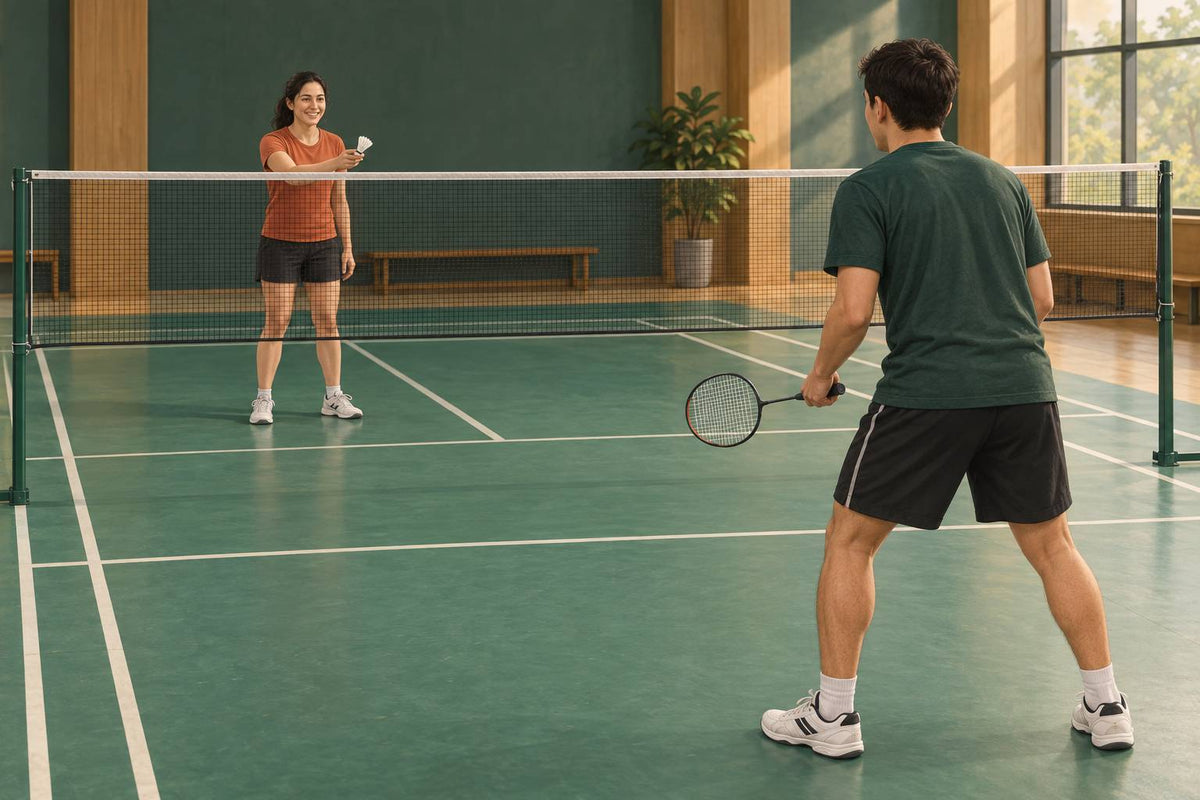
A friend’s first badminton lesson should not begin with a full-court game. If they spend the hour chasing deep shots, changing grips and hearing five corrections at once, they may never feel a clean rally. Start close to the net, feed gently, and make “keep the shuttle up” the shared goal. Teach one useful cue in each block and let success—not perfect technique—set the pace.
This 60-minute plan moves from racket-and-shuttle familiarity to an underarm hit, short serve, one-step lunge and shortened-court game. That order follows the beginner logic used in BWF Shuttle Time: simple grip and net-area skills come before harder overhead work. Take three to four minutes before the clock starts for easy running and flexibility, keep both players safely spaced, and resist showing off. Your job is to give your friend hittable shuttles.
In This Guide
- 0–10 Minutes: Make the Racket and Shuttle Feel Familiar
- 10–20 Minutes: Keep the Grip and Build an Underarm Hit
- 20–35 Minutes: Add the Short Serve and a Cooperative Rally
- 35–45 Minutes: Add One Step and a Front-Court Lunge
- 45–60 Minutes: Finish With a Shortened-Court Scoring Game
- Which Lesson Block Should You Repeat?
0–10 Minutes: Make the Racket and Shuttle Feel Familiar
Start with plenty of space and one simple cue: “Shake hands with the handle and send the shuttle upward.” Let your friend attempt gentle upward taps alone. Counting consecutive contacts gives them a target without turning the exercise into a technique lecture.

Next, place the shuttle on the strings and walk slowly while keeping it balanced. If it falls, reset and continue. Alternate this with more upward taps; do not feed the shuttle yet. The aim is simply to discover how small racket-face changes move the shuttle.
Finish with catch-and-hit over a low line. Now the partner gently hand-tosses: the learner catches the first toss by hand, then drops and lifts the shuttle across the line. Keep both players safely spaced.
Correct only an all-purpose frying-pan grip. Restore a loose, V-shaped basic grip, then keep playing. For the finer details, use this beginner grip guide.
10–20 Minutes: Keep the Grip and Build an Underarm Hit
Move to opposite sides of the net. The teaching partner slowly throws each shuttle toward the learner’s forehand side; the learner lets it drop, swings from underneath and sends it gently over. Feed for comfortable contact rather than distance or speed.
Use one cue: “Lift the cork over the tape.” This directs attention to the shuttle’s flight instead of loading the learner with instructions about their elbow, wrist and feet.
Correct only a grip that remains tightly clenched. Ask for a loose finger hold with some space between the handle and palm, then let the learner continue. A relaxed hold preserves control and makes later grip changes easier; constant corrections after every mishit usually interrupt the rhythm.
Keep throwing slow, reachable feeds until several shuttles cross the net comfortably. Do not introduce clears, smashes or any other overhead stroke yet—the underarm contact is enough for this block.
20–35 Minutes: Add the Short Serve and a Cooperative Rally
Stand in diagonally opposite service courts without touching the boundary lines. Set both feet and keep part of each foot planted and still until the serve is delivered. Hold the shuttle by the feathers with its base pointing down. Start the racket behind the shuttle, contact the base first, then continue the racket forward through delivery. The goal is to float the shuttle upward into the diagonal court—not drive it flat.
Have the receiver return the serve gently. Both players should cooperate, sending the shuttle just over the net rather than trying to win the rally. Use one simple cue: “Let the shuttle rise into the diagonal court, then keep it going.” Count consecutive contacts and restart calmly after each miss.
Correct only one serve fault here: if the shuttle travels flat or downward, ask for a softer upward path. Leave the finer legal and technical details for the full badminton serving guide.
35–45 Minutes: Add One Step and a Front-Court Lunge
Keep both players near the front service line; this is not the time for rear-court travel. Stand safely to the side and hand-feed each shuttle just beyond your friend’s comfortable reach. Give one cue: “Reach the shuttle with your racket foot.”
- Start balanced with bent knees and the racket held up.
- Step toward the shuttle with the racket leg—right leg for a right-handed player—and land heel-to-toe.
- Keep the torso upright and the lunging knee aligned with the foot, then push back to the starting position.
Feed slowly enough that each landing stays controlled, and leave enough space to prevent either player entering the other’s path. Correct only one fault here: lunging on the non-racket leg. Save longer movement patterns for later; the one-step and two-step net approach guide provides the next progression.
45–60 Minutes: Finish With a Shortened-Court Scoring Game
Turn the area between the two short service lines into an approximately four-metre court. Each short service line becomes a rear boundary, so there is no need for tape or cones. Start every rally with a gentle underarm feed rather than worrying about formal service order.

- Award one point for every rally.
- Treat every boundary line as in.
- Play to 7 or 11 instead of teaching a full match format.
Give both players one objective: “Win by keeping one more shuttle in play.”
During the game, correct only shots hit beyond the shortened back line. Let awkward grips, high returns and imperfect footwork survive for now. The aim is to finish the badminton first lesson with a real rally, a score and a reason to play again.
Which Lesson Block Should You Repeat?
Choose the earliest block your friend cannot complete comfortably. Repeat or simplify it rather than advancing because the clock says so.
| Choose this block | If your friend... |
|---|---|
| 0–10 Minutes: Make the Racket and Shuttle Feel Familiar | Misses simple taps or repeatedly returns to a frying-pan grip. |
| 10–20 Minutes: Keep the Grip and Build an Underarm Hit | Can hold the basic grip but cannot send a gentle underarm feed over the line. |
| 20–35 Minutes: Add the Short Serve and a Cooperative Rally | Makes reliable underarm contact and is ready to serve diagonally. |
| 35–45 Minutes: Add One Step and a Front-Court Lunge | Can rally while stationary and has safe space for front-court movement. |
| 45–60 Minutes: Finish With a Shortened-Court Scoring Game | Can serve, exchange shots and lunge under control. |
Get 10% off your first order
Join the Badminton House list and we’ll email you a 10% welcome code — plus training guides, technique advice, and badminton updates.
By subscribing, you agree to receive Badminton House emails and can unsubscribe anytime.
If your friend leaves their first lesson wanting one more rally, the hour has done its job. We play badminton ourselves and understand the questions that come after a first session. For help planning lesson two or choosing suitable equipment, contact us for straightforward advice.
Repeated feeds, taps and short serves put practice shuttles to work. Bring durable shuttles next time so you can spend the hour rallying rather than conserving them.
Shop Practice ShuttlecocksCheck live availability before your next session.

Leave a comment
This site is protected by hCaptcha and the hCaptcha Privacy Policy and Terms of Service apply.