
Last reviewed: August 2026 · Written by the Badminton House player-led team
Quick answer: vegetarian diet for badminton players
For a healthy adult who trains regularly, use 1.4–1.8 g of protein per kilogram per day as a practical planning band. A 70 kg player would aim for 98–126 g. Spread useful portions across ordinary meals, keep enough carbohydrate and total food in the day, and have a simple meal ready after a late session.
Daily
Start here: body weight × 1.4–1.8 g, then adjust with a qualified professional when goals or health needs require it.
Per meal
About 20–40 g every 3–4 hours is flexible guidance, not a mandatory four-feed schedule.
After court
Eat a normal protein-and-carbohydrate meal when practical; there is no rigid one-hour deadline.
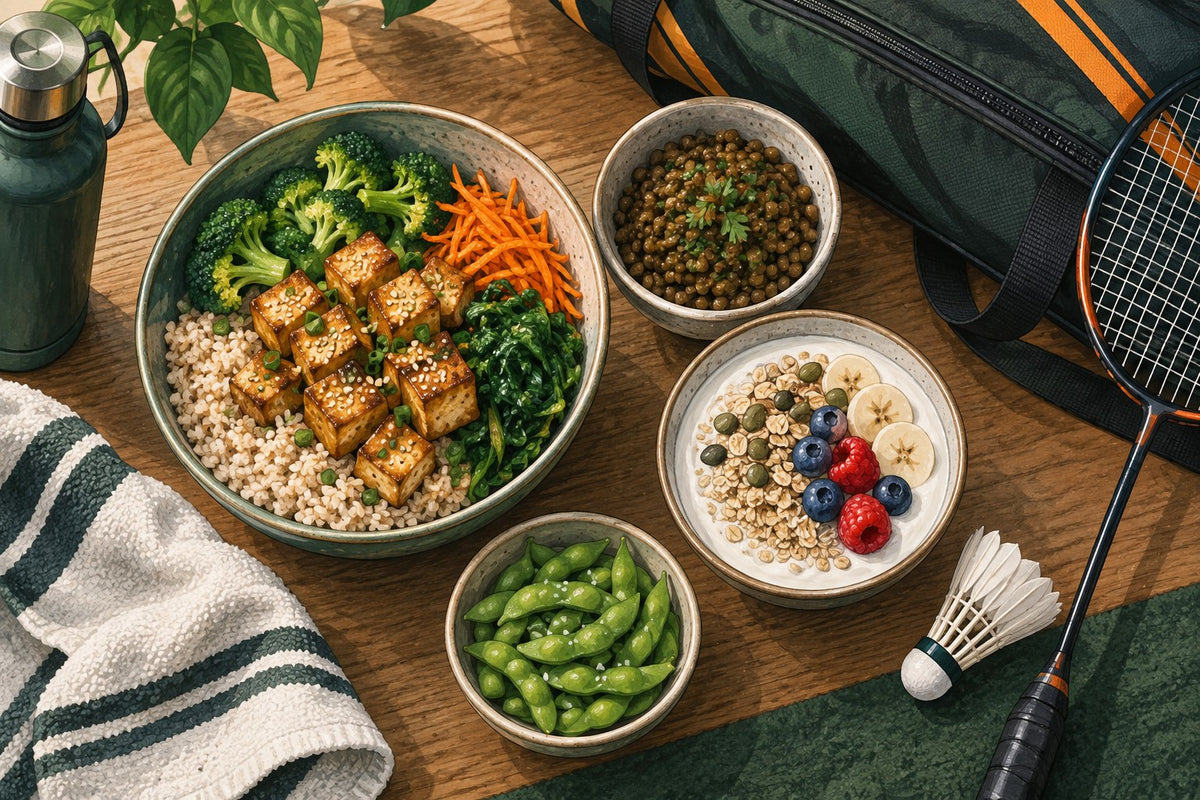
Vegetarian food can meet the demands of badminton training. The common planning problem is simpler: bread, rice, vegetables and small servings of lentils may make a filling plate without adding enough concentrated protein across the whole day. The fix is not a special powder or a perfect amino-acid puzzle. It is choosing dependable protein anchors in portions that add up.
Scope: these ranges are general sports-nutrition guidance for healthy adults, not a badminton-specific medical prescription. Young athletes, pregnant athletes and people with kidney, digestive or other health conditions need individualized advice.
What daily protein target should a vegetarian badminton player use?
The International Society of Sports Nutrition position stand places most healthy exercising adults in a broad range of 1.4–2.0 g/kg/day. This guide uses 1.4–1.8 g/kg/day as a practical starting band. It deliberately does not claim that badminton creates its own separate requirement.
| Body weight | At 1.4 g/kg | At 1.8 g/kg | Planning cue |
|---|---|---|---|
| 60 kg | 84 g | 108 g | Several 20–30 g meals or snacks can cover the range. |
| 70 kg | 98 g | 126 g | This is the worked example used below. |
| 80 kg | 112 g | 144 g | Larger portions or an extra food-based snack may help. |
Distribution can make the total easier to reach. The same evidence supports servings around 20–40 g, or roughly 0.25–0.40 g/kg, spaced about every 3–4 hours. Treat that as a flexible pattern. Breakfast does not fail because it supplies 18 g, and dinner does not fail because it supplies 35 g.
Which everyday vegetarian foods add useful protein?
Use concentrated foods as anchors and grains, vegetables, nuts and seeds as contributors. The approximate household-serving values below come from the Government of Canada’s Canadian Nutrient File. Preparation, brand and drained weight can change the result, so check the label when precision matters.
| Food | Example serving | Approx. protein | Simple use |
|---|---|---|---|
| Boiled lentils | 250 mL | 18.9 g | Dhal, soup, chilli or a grain bowl. |
| Firm tofu | 250 mL | 21.8 g | Rice, noodles, curry or a sandwich. |
| Tempeh | 175 mL | 22.8 g | Stir-fry, wrap or grain bowl. |
| Edamame | 250 mL | 23.5 g | Snack, salad, rice bowl or noodles. |
| Cottage cheese | 250 mL | 24.7 g | Breakfast, snack or post-session bowl. |
| Two large eggs | 2 eggs | 11.8 g | Breakfast, sandwich or rice bowl. |
A varied diet can supply complementary amino acids across the day; you do not need to pair a grain and a legume at every meal. The review of vegan athletes supports deliberate whole-day planning rather than a mandatory pairing rule. A more useful question is whether most eating occasions contain a meaningful source and whether the total day includes enough food.
What could a 70 kg training day look like?
This example shows where protein anchors can sit in a day. Use the food table and product labels to calculate your own total; it is a worked pattern, not a prescription.
| Time | Food pattern | Planning role |
|---|---|---|
| 7:30 a.m. | Oats with yoghurt or fortified soy beverage, seeds and fruit. | Choose portions using the label to meet your meal target. |
| 12:30 p.m. | A full lentil bowl with rice, vegetables and bread. | Choose portions using the label to meet your meal target. |
| 5:30 p.m. | Tofu or tempeh with rice, noodles or potatoes and vegetables. | Choose portions using the label to meet your meal target. |
| 8:15 p.m. | Optional familiar carbohydrate snack if hunger or session length calls for it. | Protein is secondary here; choose the snack for court readiness. |
| 10:30 p.m. | Cottage cheese or yoghurt with cereal and fruit; vegan option: tofu and noodles or edamame with rice. | Choose portions using the label to meet your meal target. |
The post-session meal is useful because it completes the day and supplies both protein and carbohydrate after court. It does not need to land inside an exact one-hour window. If a substantial dinner was close to the session and normal food follows soon afterward, the daily pattern remains the priority.
What changes on a fully plant-based plan?
Eggs, milk, yoghurt and cottage cheese give an ovo-lacto vegetarian more concentrated options in a small volume. A vegan player can still meet the same general goal by leaning more often on tofu, tempeh, edamame, lentils, beans, peas, nuts, seeds and fortified soy foods. The 2023 review of vegan athletes emphasizes careful planning for protein density, energy and selected micronutrients; it does not establish one universal protein multiplier for every vegan athlete.
Vitamin B12 needs deliberate attention because ordinary unfortified plant foods are not reliable sources. Use fortified foods or an evidence-based supplement plan discussed with a qualified professional; the NIH vitamin B12 fact sheet explains the risk boundary. Iron also deserves attention, but fatigue alone cannot diagnose deficiency and iron treatment should not start from an article.
For questions about powders and other supplements rather than food-based meal planning, use the evidence-based badminton supplements guide.
How do you avoid hitting protein while under-fuelling?
Keep rice, pasta, potatoes, oats, bread, fruit and other carbohydrate foods in the plan. Badminton includes repeated high-intensity work, and protein should not crowd out the carbohydrate or total energy that supports it. A small, high-protein menu is not successful if it leaves the player hungry, flat on court or losing weight unintentionally.
Recurring illness or injury, worsening recovery, unintended weight change, sleep disruption or menstrual changes deserve professional assessment. The IOC consensus on Relative Energy Deficiency in Sport describes why low energy availability can affect health and performance across genders.
The repeatable checklist
- Calculate a starting daily band from body weight.
- Choose three or four protein anchors you genuinely eat.
- Spread them through flexible meals and snacks.
- Keep enough carbohydrate and total food around training.
- Prepare the late-session meal before leaving for court.
The best vegetarian diet for badminton players is not the one with the most complicated combinations. It is the one that repeatedly supplies enough food, a useful protein source at several eating occasions, and a post-court option that still works when the session ends late.


Leave a comment
This site is protected by hCaptcha and the hCaptcha Privacy Policy and Terms of Service apply.