
Last updated: July 2026 · Written by the team at Badminton House
Quick Answer: Badminton Supplements
Use supplements only to solve a specific problem: creatine has the strongest case for badminton-style repeated high-intensity efforts, caffeine can help acutely, and vitamin D, magnesium, omega-3, or protein powder are mainly gap-fillers.
Default
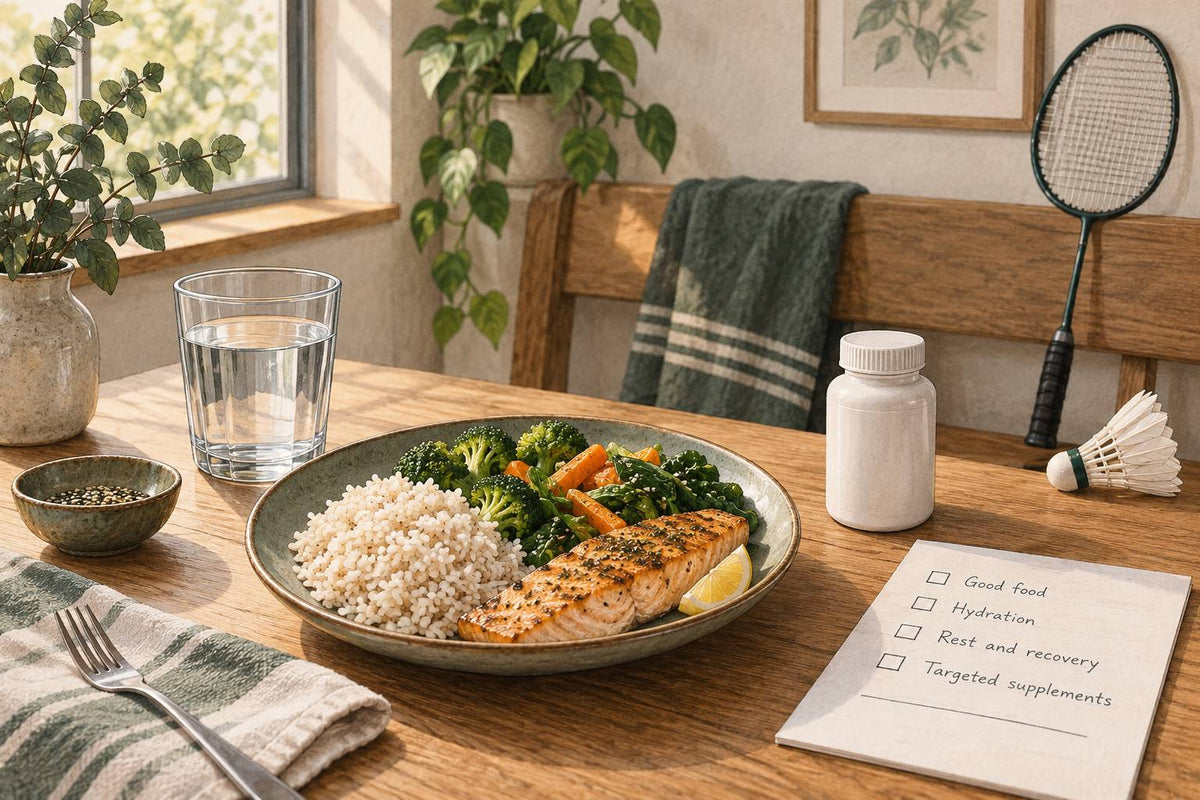
Food-first, then targeted: if your regular meals already support training and recovery, most badminton supplements are optional rather than essential.
Strongest
Creatine monohydrate: the best-supported option here for repeated short, hard efforts; consistency matters more than perfect pre-match timing.
Selective
Caffeine or deficiency fixes: use caffeine carefully for key sessions, and only consider vitamin D, magnesium, omega-3, or protein powder when testing, diet, or training load shows a real need.
Your Training Week — Quick Start
Supplements support the training week below, they do not replace it. Tap any day to open its full session.
| Day | Focus | Do this |
|---|---|---|
| Mon | Lower body + core | Lower-body session + core & rotation |
| Tue | Court: drills + footwork | Shadow footwork + multi-shuttle drills |
| Wed | Upper body + prehab | Upper-body session + prehab |
| Thu | Power + fast hands | Power / plyometrics + reflex work |
| Fri | Light skills / recovery | Easy touch session or rest. Keep it light. |
| Sat | Match play | Warm up, then club matches or games. |
| Sun | Recovery / mobility | Rest, easy mobility, or an optional light session. |
A 3-gym-day template (Mon/Wed/Thu). Training twice a week? Keep Mon + Wed. Tap any day to open its full session.
What matters is whether something helps repeated lunges, jumps, and recovery enough to justify taking it, not how popular it is. Creatine and caffeine have the clearest case; protein fills food gaps; vitamin D matters if you're low, common for indoor Canadian players in winter. Get food, sleep, hydration, and training right first. See our badminton nutrition and recovery guide.
Badminton House does not sell supplements. That is deliberate: the goal is to help Canadian players separate evidence from hype, especially where contamination or banned-substance risk matters.
In This Guide
Creatine: the strongest case among badminton supplements

Creatine monohydrate has the strongest evidence base of any badminton supplement. The ISSN calls it the most effective ergogenic supplement for high-intensity exercise capacity and lean body mass. Badminton is repeated high-intensity work, so it's most relevant with strength work, jump work, sprint footwork, or dense club nights.
What creatine helps with
- High-intensity exercise capacity: the main evidence-supported reason athletes use it.
- Lean body mass: increased when paired with training.
- Possible extras: may also aid recovery, injury prevention, and neuroprotection, per the ISSN.
How to take it: loading or no loading
| Approach | Typical dose | Best for |
|---|---|---|
| Loading phase | About 20 g/day, or about 0.3 g/kg/day, split into 4 doses for 5–7 days; then 3–5 g/day maintenance | Players who want to saturate muscle creatine stores faster |
| No loading | 3–5 g/day consistently; full muscle saturation in about 28 days | Most club players who prefer the simplest routine |
Most club players do best with no loading: 3–5 g daily, taken consistently (with breakfast or a post-training meal, including rest days). Consistency beats pre-workout timing.
Who benefits, who can skip it
Best fit: players in a real training block, plus vegetarians and vegans, who have lower dietary creatine. Skip it if you play casually with no plan. Creatine supports training, it doesn't replace it.
Omega-3: recovery markers, not a guaranteed performance boost

Omega-3's strongest evidence is about markers of inflammation and muscle damage, not a repeatable jump in match performance. Meta-analyses found reduced inflammatory markers including IL-6, TNF-α, and CRP, and reduced muscle-damage markers including CK, LDH, and myoglobin.
Practical takeaway for badminton players
- Best fit: heavy training or dense competition blocks with low oily-fish intake.
- Expectation: recovery support, not a same-day performance upgrade.
Effective dosing is at least 2 g/day EPA + DHA for about 6 weeks (roughly 2400 mg/day for 4.5 weeks). Check the label for actual EPA+DHA, not total "fish oil." Better biomarkers don't guarantee you'll move better, though: studies have not consistently shown direct performance improvements. If fueling is the real gap, fix that first in the nutrition and recovery guide.
Vitamin D: test status before topping up

Vitamin D is one of the few badminton supplements where the Canadian context matters (deficiency risk rises at higher latitudes, in winter, and in indoor sports). Supplementation reliably raises serum 25(OH)D, but once athletes reach adequacy (at least 75 nmol/L or 30 ng/mL), further topping up hasn't been shown to enhance strength or power. Test first, rather than guessing.
| Status | What it means for supplementation |
|---|---|
| Below adequate | May help. It reliably raises serum 25(OH)D. Work with a physician or dietitian on dose and follow-up. |
| Adequate: ≥75 nmol/L or 30 ng/mL | Topping up further hasn't been shown to improve strength or power. |
| Very high: around 100 ng/mL+ | Toxicity concerns arise here. Avoid blind mega-dosing. |
Bottom line: vitamin D fixes a deficiency; it doesn't add performance once you're already sufficient.
Magnesium: useful for deficiency, weak for performance

Magnesium is a correction tool, not a performance hack. A meta-analysis on muscle fitness found no performance benefit in people with adequate status, though deficient people may benefit. Studied doses run roughly 116–500 mg/day, and active people may need 10–20% more than sedentary people.
A 2025 crossover trial even found short-term magnesium chloride had a modest negative effect on sprint power in regular exercisers. Bottom line: fix a deficiency, don't expect an edge if you're already replete.
Protein powder: convenience, not magic

Protein powder is a convenient way to hit your daily target when meals don't cover it, not a recovery shortcut. The ISSN puts total intake at 1.4–2.0 g/kg/day, or 1.4–1.7 g/kg/day for intermittent sports like badminton.
How to use protein powder sensibly
- Start with the day, not the shaker: check whether meals already meet 1.4–2.0 g/kg/day before adding powder.
- Spread it out: about 0.25 g/kg or 20–40 g every 3–4 hours, with 700–3000 mg leucine.
- Pair it with strength work: the synergy is greatest around resistance exercise, not just rallies.
Main use case: convenience (an early lift, a late club night, or a tournament day when meals are hard to organize). If food already covers your target, a second shake adds nothing. For food-first fuelling, see our badminton nutrition and recovery guide.
Caffeine: acute help, but dose and timing matter

Caffeine has a clear short-term evidence base: think acute match-day tool, not a fix for poor sleep. The 2021 ISSN stand reports it can acutely enhance endurance, strength, sprinting, and jumping, which maps well onto badminton's rallies and split steps.
Practical badminton use
- Typical effective range: 3–6 mg per kg body mass.
- Lower starting point: as low as 2 mg/kg may be enough.
- Common timing: about 60 minutes before exercise.
- Avoid the “more is better” trap: ~9 mg/kg raises side-effects without added benefit.
Best fit: a player who tolerates caffeine well and wants acute alertness for a match. Start low. Skip it if you're sensitive, play evenings, or get anxious or sleep-disrupted.
What to avoid with badminton supplements
The biggest risk is that some products create health or anti-doping risk without a real benefit. In Canada, vitamins and minerals sold as natural health products fall under a distinct licensing framework with manufacturing requirements; see Health Canada’s overview. That regulatory status does not remove contamination or anti-doping risk. One review found 9–15% of tested supplements contaminated with prohibited substances (older reviews found 12–58%), mostly in multi-ingredient pre-workouts and fat-burners.
Simple rule: the more dramatic the claim and the longer the ingredient list, the more cautious you should be.
Avoid these habits
- Stacking overlapping products: a pre-workout, energy drink, and caffeine pill together can push stimulant intake far beyond what you intended.
- Proprietary blends: hidden doses mean you can't judge whether a product matches evidence-based dosing.
- Mega-dosing: ~9 mg/kg caffeine or large single creatine doses raise side-effects without adding benefit.
- Fat-burners and multi-ingredient pre-workouts: the highest-risk categories for contamination.
A safer checklist before you buy
| Check | Why it matters |
|---|---|
| Use the serving size | Side-effects start when players assume two scoops beat one. |
| Avoid overlapping formulas | Stacking can duplicate caffeine, magnesium, or creatine without you noticing. |
| Use third-party certification when relevant | For drug-tested players, NSF Certified for Sport or Informed Sport reduce contamination risk. |
FAQ: badminton supplements
Do badminton players need supplements?
Most club players don't need them if they eat well, recover, and train consistently. Treat them as targeted tools: creatine for high-intensity work, caffeine for acute output, protein for convenience, vitamin D or magnesium only when needed.
Should juniors take badminton supplements?
Juniors should focus on food, sleep, hydration, coaching, and training first. Any supplement decision needs a parent or guardian and a qualified health professional.
Medical disclaimer: This article summarizes peer-reviewed evidence for general education and is not medical advice; consult a physician or registered dietitian before starting any supplement, especially if you have a health condition or compete in drug-tested sport.
Which badminton supplement should you choose?
Simple filter: if you can't name the gap, don't add a supplement. Food, sleep, and training come first. See the nutrition and recovery guide.
| Choose this if... | Option | Evidence-based use | Don't bother if... |
|---|---|---|---|
| Strongest evidence for high-intensity training. | Creatine monohydrate | 20 g/day loading for 5–7 days then 3–5 g/day, or just 3–5 g/day for 28 days. | You want instant effects from one dose. |
| Hard training, soreness, low fish intake. | Omega-3 | 2+ g/day EPA+DHA for weeks reduces inflammation and muscle-damage markers. | You already eat fish and expect a performance boost. |
| Indoor Canadian winter player, unknown vitamin D status. | Vitamin D — test first | Raises serum 25(OH)D; adequacy is ≥75 nmol/L or 30 ng/mL. | You're already sufficient, no extra strength or power gain. |
| Diagnosed low magnesium intake. | Magnesium | 116–500 mg/day studied. | You're already replete, no benefit shown. |
| You struggle to hit daily protein from food. | Protein powder | 1.4–2.0 g/kg/day (1.4–1.7 for intermittent sport). | Food already covers your target. |
| You want an acute pre-match lift. | Caffeine | 3–6 mg/kg, ~60 min before exercise. | Caffeine-sensitive, evening play, or anxiety/palpitations. |
| You compete in drug-tested events. | Certified products, or none | 9–15% of tested supplements were contaminated with prohibited substances; choose NSF Certified for Sport or Informed Sport certified products. | Avoid proprietary blends, pre-workouts, and mega-dosing. |
Bottom line: creatine wins on performance, caffeine on acute match-day help, vitamin D and magnesium are status-dependent, omega-3 aids recovery markers, and protein powder just fills a gap.
Get new badminton guides by email
Join the Badminton House list for occasional emails with new guides, technique tips and news from our club in Moncton.
By subscribing, you agree to receive Badminton House emails and can unsubscribe anytime.
The best supplement choice is still the boring one: build food, sleep, training, and recovery first, then add evidence-backed supplements only when they solve a real problem. Want a second opinion on your setup? Contact Badminton House.
Free shipping on $200+ · 14-day returns · Canadian badminton specialty shop


Leave a comment
This site is protected by hCaptcha and the hCaptcha Privacy Policy and Terms of Service apply.