
Last reviewed: August 2026 · Written by the Badminton House player-led team
Quick answer
Badminton station training works when every station practises the same match-relevant theme, players follow a fixed route, and the end assessment checks that same theme. Use six short, self-running stations, rotate on one signal, and let the volunteer manage safety and time rather than trying to teach six strokes at once.
One theme
Every station connects to straight-line control and recovery.
Fixed route
Pods move 1 → 2 → 3 → 4 → 5 → 6 without waiting for instructions.
Same finish
The final task checks the movement and shot situations rehearsed at the stations.
This is a Badminton House worked session, not a BWF standard. The exact 90-minute timetable, six-court layout, one-volunteer design and station cards below are practical choices for a mixed group. A Danish Gym-IDRÆT badminton course provides the useful underlying model: six stations, 5–8 minutes at each station, and station work aimed at the coming assessment.
The guiding idea is simple: do not make station training a random drill catalogue. Pick one theme that can appear in movement, feed, rally and assessment. This session’s theme is move to the shuttle, play a controlled straight reply, then recover ready for the next one.
How do six stations run across six courts?
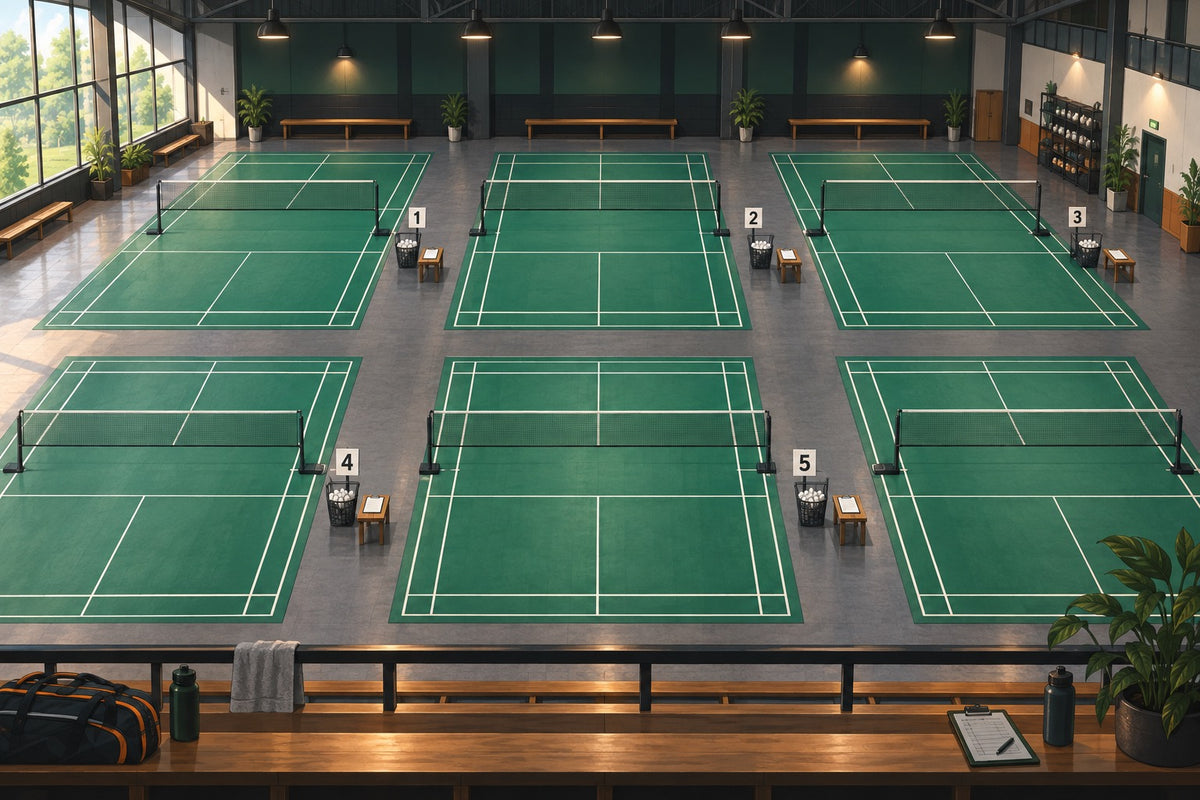
Assign one complete court to each station. Every court needs a station card, a basket or tube for spare shuttles, a timer-visible instruction and a waiting spot outside live movement. Six pods begin at Stations 1–6 and rotate upward by one number at every change signal.
| Court | Station |
|---|---|
| Court 1 | Station 1: shadow route |
| Court 2 | Station 2: forehand short corner |
| Court 3 | Station 3: long-serve return |
| Court 4 | Station 4: short-long choice |
| Court 5 | Station 5: personal sequence |
| Court 6 | Station 6: half-court game |
Keep each station inside its assigned court. No player crosses a neighbouring live court to collect a shuttle. BWF Level 1 coaching guidance emphasizes safe feeding positions, realistic shuttle flight, enough time for the learner to prepare, and a feed rate that permits reflection and preparation. It also identifies loose shuttles as a hazard.
One-volunteer rule: the volunteer owns the timer, safety pause and rotation signal. The cards own the drill instructions. The volunteer does not need to demonstrate or diagnose every stroke.

A complete 90-minute station-training schedule
This six-court timetable is a Badminton House practical choice. Six six-minute rotations sit within the 5–8-minute station range used in the Gym-IDRÆT example, but neither source prescribes this booking length, participant count or volunteer model.
| Minutes | Block | Volunteer call |
|---|---|---|
| 0–10 | Check in, name pods, assign Station 1–6 starts | “Find your pod number and read your first card.” |
| 10–18 | Shared warm-up and court walk-through | “Warm up your movement; walk your first rotation route.” |
| 18–54 | Six stations × 6 minutes | “One signal: one minute. Two signals: finish, clear your court, and move to the next numbered court.” |
| 54–60 | Water, collect shuttles, review the assessment card | “Name the route, target and recovery you will show.” |
| 60–72 | Assessment rehearsal in pairs | “Use the assessment route at a comfortable, repeatable pace.” |
| 72–84 | End assessment and peer observation | “Observe only the three listed markers; do not coach a new stroke.” |
| 84–90 | Cool down, one-change review, clear courts | “What should repeat, simplify or change next time?” |
BWF’s plan-deliver-review approach supports setting an objective, observing what occurs and adjusting the next practice. The schedule applies that logic without claiming that a volunteer can replace technical instruction from a qualified coach.
Six copyable station cards
Print or copy each card exactly as written. Every card uses the same theme—controlled straight reply plus recovery—but does not attempt to teach the stroke. Players who need stroke instruction should use the linked guide or work with a qualified coach.
Station 1 — Shadow: net to rear
Do: From base, mark a controlled move to the net, recover, then mark a rear-court overhead position and recover. Repeat the route.
Swap: Partner A moves for 45 seconds; Partner B observes the recovery route; switch. Level change: beginner uses a fixed call; experienced players receive an occasional left/right call.
Station 2 — Forehand short corner
Do: One partner hand-feeds a controlled shuttle to the forehand front corner. The worker plays the agreed short reply, recovers to base, then resets before the next feed.
Swap: Change worker after six prepared feeds. Level change: beginner receives one fixed height; experienced players choose net shot or lift from a clearly usable feed. See badminton net-shot technique.
Station 3 — Long serve to controlled clear
Do: One player delivers a legal, controlled long serve. The receiver moves, returns a straight clear and recovers. Stop and reset after each shuttle.
Swap: Change server after six feeds. Level change: beginner starts closer or with a slower feed; experienced players begin from a more realistic receiving base. See how to hit a badminton clear.
Station 4 — Short-long choice
Do: The feeder alternates a short and a long straight feed on half court. The worker moves, plays the agreed straight reply and recovers before the next feed.
Swap: Six feeds each, then change. Level change: beginner follows a known short-long order; experienced players do not know which of the two feeds arrives next. For the rear-court option, use the badminton drop-shot guide.
Station 5 — Personal sequence
Do: Choose one short-long sequence that matches the end assessment. Keep the route, target and recovery the same for every attempt.
Swap: One player works while one checks the three assessment markers; change after four sequences. Level change: beginner keeps the feed fixed; experienced players add one choice, not a new stroke family.
Station 6 — Half-court game
Do: Play straight half-court singles. Start each rally with the agreed short or long feed, then play out the rally while preserving the session theme.
Swap: Change server every two rallies. Level change: beginner uses a cooperative first two contacts; experienced players score a bonus only when the chosen straight reply creates the next controlled shot.
End assessment, odd numbers and shorter bookings
The six-court version is the full session. Use fewer courts only as a separate scaled format; do not turn two stations into adjacent live lanes on one court.
The end assessment should resemble the stations rather than surprise players with a separate test. Use one short-long straight-half-court sequence: a player receives one prepared short feed and one prepared long feed, plays the agreed reply and returns to a ready position after each. The observer records only three markers: the player reached the shuttle under control, the reply matched the agreed target or option, and recovery was visible before the next feed.
This is a Badminton House observation tool, not a grade, selection test or BWF assessment standard. Its value is alignment: the group practised the same movement-and-reply problem across six stations, then receives a simple final observation of that problem.
Three-court scaling: run one station per court, then repeat the same fixed three-station route after the break with a new condition. Session A uses Stations 1–3; Session B uses Stations 4–6. This is a reduced Badminton House format, not the six-station Gym-IDRÆT model.
| Situation | Practical adjustment |
|---|---|
| Odd-numbered pod | Use worker, feeder and observer. Rotate every two minutes; the observer counts prepared attempts and watches the three markers. |
| Two ability levels | Keep the same station purpose. Change feed height, distance, predictability or reset time—not the station route or the group’s rotation. |
| 75-minute booking | Use a 10-minute check-in, 10-minute warm-up, six 5-minute stations on six courts, 10-minute rehearsal, 10-minute assessment and 5-minute close. |
| 60-minute booking | Use a 10-minute warm-up, four 6-minute stations on four courts, 10-minute rehearsal, 10-minute assessment and 6-minute close. Run the remaining two stations in the next session. |
BWF coaching guidance supports differentiation: players working on the same skill may use different practice levels. That supports changing one demand for a player without breaking the whole group’s route. It does not validate a fixed “beginner” or “advanced” station label.



Leave a comment
This site is protected by hCaptcha and the hCaptcha Privacy Policy and Terms of Service apply.