
Last checked: August 2026 · Written by the player-led team at Badminton House
Quick answer
Before the opponent hits, the racket arm and racket can offer useful cues. Serve-anticipation studies support that early read; they do not show that you should ignore the shuttle in flight or delay your movement until the swing is finished. Gaze depends on the task, and no single fixed staring point fits every rally.
Start with the table below
Use the table to distinguish early cues from flight information, then try the observation exercise without treating it as an eye-tracking test.
Related reading: Reading the Serve Early: Anticipation Training covers which pre-contact cues to read. This guide covers where your eyes physically go, and for how long.
Where to fix your eyes in four common situations
The serve row below has direct support from anticipation research. The other rows are practical coaching extensions, not separately tested gaze prescriptions; use early cues alongside information from the shuttle’s flight.
| Situation | Where to look | Why |
|---|---|---|
| Receiving serve | The server's racket-side shoulder and upper arm through the backswing, then the racket head into contact. | These are the discriminating body parts that actually differ between serve types, and fixating them predicts direction earlier than watching the shuttle can. |
| Defending a smash | The hitter’s racket arm before contact, followed by information from the incoming shuttle. | The arm and racket may provide early clues, but the eventual racket orientation and shuttle flight determine the shot; these cues do not guarantee its direction or angle. |
| Net in doubles | The net opponent's racket face and wrist as they shape the shot. | The racket can offer a clue before contact, but deception and late changes make it a cue to test against the actual flight, not a reliable announcement of the next shot. |
| Retreating to the rear court | The opponent’s stroke before contact, then the incoming shuttle while you move back. | Avoid looking down at your own feet; the initial body cue alone cannot tell you where a clear or drop will eventually arrive. |
A serve-anticipation study using video of international-standard players serving and expert and novice receivers wearing eye-movement registration systems found that expert receivers fixated the server's discriminating shoulder, arm and racket kinematics more often and for longer than novices, and players were generally more accurate when their eyes were on that discriminating arm and racket rather than the shuttle. The same discriminating-body-parts logic is what the smash, net and rear-court rows above extend to situations the study did not test directly.
A 2026 meta-analysis pooling 26 visual-search studies across 611 individual-sport athletes found this pattern holds broadly, and that it is sport-specific in its detail: experts show fewer, longer, more selective fixations than novices, and badminton experts in particular key on distal cues such as the arm and racket. The same review found tennis experts, a different sport within the same dataset, key more on trunk and hip kinematics. That is a tennis-specific result, not a badminton one, and it is a useful reminder that a gaze habit proven in one racket sport does not automatically transfer to another.

Why the task changes where you look
Research on a player preparing their own serve concerns aiming before a self-paced action. It does not establish how a receiver should track an incoming shuttle during a rally.
The clearest evidence comes from the serve itself. Twelve skilled and twelve less-skilled singles players wore mobile eye-tracking glasses through 662 serves against a live opponent, and the frame-by-frame analysis found skilled players took longer preparatory time before serving and fixated on significantly more distinct areas, especially the court and net, while less-skilled players found the shuttle more informative. Those findings describe the server’s preparation; they should not be turned into a rule against watching an incoming shuttle.
The same study found a genuine nuance worth keeping: quiet eye duration, the length of the final fixation before the serving action begins, did not differ significantly between the two skill groups for this particular self-paced task. A separate backhand-serve study reported longer quiet eye in skilled players, so the evidence is task-specific rather than a simple reactive-versus-self-paced rule.
How a stronger player's eyes behave differently
Skill shows up in the eyes as fewer, longer, more selective fixations. In badminton specifically, gaze also splits by stroke: players glance more before committing on a backhand than a forehand, beginners glance more than everyone on both strokes, and the last look before movement gets measurably shorter under pressure in every skill group.
The clearest badminton evidence for the stroke split comes from an eye-tracking comparison of beginner, intermediate and expert players hitting forehand clears and backhand drives from a controlled shuttlecock launcher. Gaze counts, the number of distinct fixations per stroke, were significantly higher on forehand clears than backhand drives at every skill level, while pre-fixation counts, extra unstable glances made before the eyes settle, were significantly higher on backhand drives than forehand clears at every level. Beginners produced significantly more of those unstable glances than intermediate or expert players on both strokes. The comparison involved a backhand drive and a forehand clear, so it cannot isolate handed side from stroke type or diagnose a player’s technique from their gaze alone.
Quiet eye duration, the length of that final fixation before you commit to a movement, drops under pressure too. In a serve-anticipation study using expert and novice badminton players, high match-style anxiety produced a significantly shorter final fixation than low anxiety in both groups, and the resulting drop in anticipation accuracy was significantly larger for novices than for experts. In a separate study of the badminton backhand serve, skilled players held a longer quiet eye than novices, most clearly in the doubles short-serve condition, where quiet eye duration tracked with wrist control through contact. These studies describe associations with skill and pressure; they do not validate the practice exercise below or show that deliberately staring longer always improves a return.
One exercise for noticing pre-contact cues
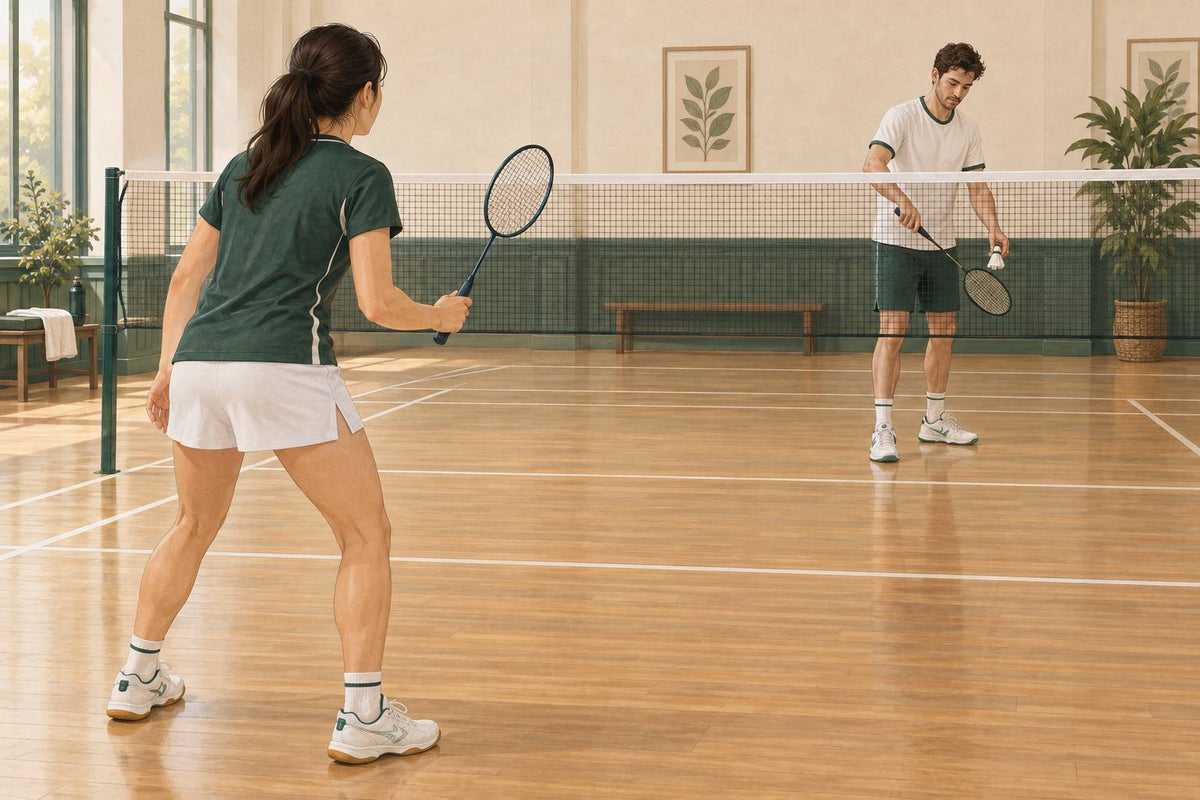
Use a slow partner feed to notice what changes before contact. Choose two clearly different shots, such as a short serve and a flick, and describe after each return what you noticed in the racket action. This is a coaching observation exercise, not a validated quiet-eye intervention.
Start with cooperative feeds at a pace you can return comfortably, then mix the two shots. Move naturally and follow the resulting flight; do not wait to speak before moving. A spoken number would test hearing, not prove where your eyes were looking.
A phone placed safely outside the court can show broad head and movement habits, but ordinary video cannot measure fixation location or quiet-eye duration. Discuss which cue helped and which misled you, then finish with normal rallies.
Put this into practice this week
- Pick one situation from the table above. You cannot fix four gaze habits in one session.
- Try ten cooperative feeds and describe the cue after each return.
- Use video for broad movement habits, not as an eye-tracking measurement.
- Mix two feed types when comfortable, then return to normal rallies.


Leave a comment
This site is protected by hCaptcha and the hCaptcha Privacy Policy and Terms of Service apply.