
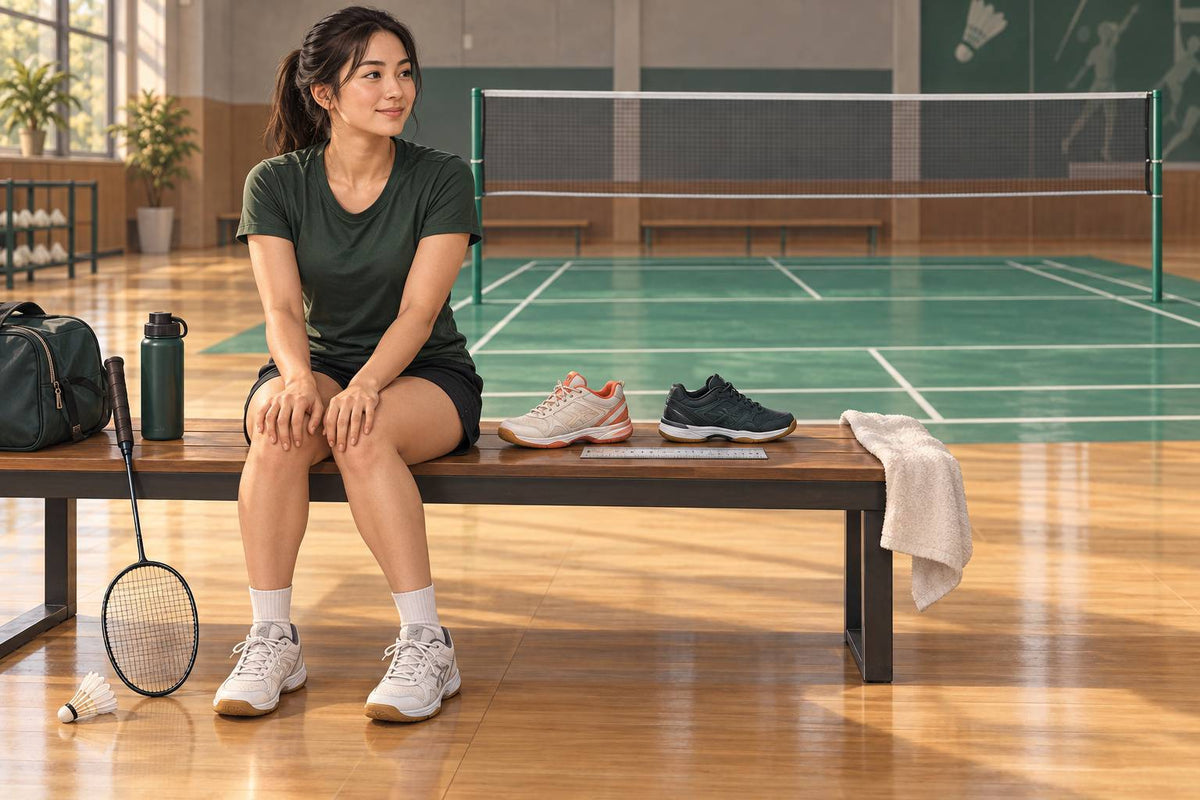
Last updated: July 2026 · Written by the team at Badminton House
Quick Answer: Women's Badminton Shoes
Start with a women's-last badminton shoe when you can; if Canadian stock is limited, measure in cm and convert into men's/unisex sizing by matching the same JP/cm length.
Women's
Best choice: choose a dedicated women's-fit badminton shoe if unisex shoes slip at the heel or feel roomy in the rearfoot while the forefoot still feels tight.
Unisex
When a women's model is not available, use your cm/JP foot length instead of guessing by US size; at the same cm length, US women's sizing is typically 1.5 sizes above US men's sizing. See the Badminton House size guide.
Fit Issue
If you have wide forefeet, flat feet, or heel pain, do not solve everything by sizing up; compare the fit checks in our wide-feet guide and flat-feet and heel-pain guide.
If you are searching for women's badminton shoes in Canada and every pair seems to create the same trade-off (heel slipping in the back, toes squeezed in the front, or a size chart that jumps between women's, men's, and centimetres), the problem is not just you.
Women's feet are not simply smaller men's feet. Foot-shape research has found that women's feet tend to taper more from forefoot to rearfoot, meaning the heel is often narrower in relation to the forefoot. That is exactly why a men's or unisex badminton shoe can feel fine in length but loose at the heel, while sizing down can make the forefoot feel pinched.
This guide explains how women's badminton shoe fit works, how to read model codes like Men, Women, Slim, and Wide, and how Canadian players can use centimetre sizing to convert into men's or unisex stock when a true women's-last model is not available.
Start with current Canadian court-shoe stock. Browse our badminton footwear collection for available sizes in CAD, and use this guide to check whether a women's-specific, men's, or unisex fit makes sense for your foot. Free shipping is available within Canada on orders over $200.
In This Guide
- Why Do Women's Badminton Shoes Fit Differently?
- What Is a Shoe Last, and Why Does Heel Slip Happen?
- How to Read Women, Men, and Wide Model Codes
- Which Women's-Last Models Are Worth Knowing in 2026?
- How to Convert Women's Sizing into Unisex or Men's Shoes
- What Canadian Buyers Can Actually Order Right Now
- Fit Checks for Wide Feet, Flat Feet, and Heel Pain
- Which women’s badminton shoes should you choose?
Why Do Women's Badminton Shoes Fit Differently?

Women's badminton shoes are not just men's badminton shoes in smaller sizes. The important difference is shape: foot length, forefoot width, heel width, instep height, and the way the foot narrows from the ball of the foot back to the heel.
A major foot-shape study summarized by the Institute for Preventive Foot Health found that men generally have longer and broader feet for their stature, while women's feet tend to taper more dramatically from forefoot to rearfoot. In plain badminton terms: many women need enough room across the forefoot for toe spread, but a more secure hold around the heel.
That matters because badminton is full of small fit tests that running shoes rarely face: split-step landings, chasse steps, hard side pushes, quick recoveries, and deep lunges. If the heel cup is too roomy, your heel can lift or slide inside the shoe even when the shoe is technically the right length. If you then size down to lock the heel, the forefoot can feel pinched.
The fit trap: a shoe can be the correct length in centimetres and still be the wrong shape. For badminton, heel hold and forefoot room both matter because your foot is constantly braking, pushing, and changing direction.
The fit issue is not new. For a long time, many women's athletic shoes were built from scaled-down men's lasts rather than from lasts shaped around women's feet. A large U.S. foot-scan study later found significant male/female differences across 11 foot measurements, with female feet relatively higher but narrower than male feet. That helps explain why a unisex or men's-lasted court shoe may feel fine in the toe at first, then reveal heel movement once you start playing.
| Fit area | Why it matters in badminton | Common sign |
|---|---|---|
| Heel | A narrower heel relative to the forefoot needs a secure heel cup, especially during recoveries and lateral pushes. | Heel lifting even after the laces are snug. |
| Forefoot | Your toes need enough room to spread when you brake into a lunge or load for a push-off. | Toes feel squeezed when you size down to stop heel slip. |
| Midfoot / instep | The shoe has to hold the foot over the base during fast direction changes, not just feel comfortable standing still. | You overtighten the laces to feel locked in. |
Older fit studies show how often women have had to compromise. In one study of 255 women aged 20–60, 73 percent had chosen athletic shoes that pinched the forefoot in order to get better heel fit. Another study of 356 women found that 88 percent wore shoes narrower than their feet, by an average of 1.2 cm. Those numbers are not badminton-specific, but they describe the exact tradeoff many players recognize: secure heel, cramped toes; or roomy toes, slipping heel.
This is why women's-last badminton shoes exist. A women's last can keep the length and forefoot space appropriate while reducing excess volume at the rearfoot. It is also why some brands now separate model codes by fit instead of treating every size as interchangeable. Later in this guide, we will use Yonex's current 65 Z fit system as an example because that line is offered globally in Slim, Women, Men, and Wide fits.
For Canadian buyers, the practical takeaway is simple: do not choose women's badminton shoes by US size alone. Start with your foot length in centimetres, then check whether the model is built on a women's, men's, wide, or unisex last. If you are converting into a men's or unisex shoe, the centimetre size is the safest anchor. You can also compare sizing against our Badminton House size guide before ordering.
If your main problem is width, arch support, or heel discomfort, keep that separate from the women's-size question. A women's last can help with heel hold, but it does not automatically solve every foot shape. For deeper fit help, see our guides to badminton shoes for wide feet and badminton shoes for flat feet and heel pain.
What Is a Shoe Last, and Why Does Heel Slip Happen?

A shoe last is the foot-shaped form a shoe is built around. In practical badminton terms, the last controls the shape of the heel cup, midfoot wrap, forefoot width, toe box, and overall volume, not just the printed size on the box.
That is why two court shoes in the same cm size can feel completely different. One may hold the heel securely but squeeze the toes; another may give the forefoot enough room but let the heel lift. For many women shopping in men’s or unisex badminton shoes, the second problem is the common one.
As covered above, women’s heels are typically narrower relative to the forefoot. If a shoe is built around male forefoot-width measurements, the forefoot length and width can feel acceptable while the rearfoot area is still too large. That shape mismatch is the heel-slip problem.
Heel slip is not always a size problem
The easy assumption is: “my heel is moving, so the shoe is too big.” Sometimes that is true. But in women’s badminton shoes, heel slip often means the shape is wrong, not the length.
Sizing down can make the heel feel more secure for a few minutes, but it can also recreate the old fit compromise: the forefoot pinches just so the heel stays put. For badminton, that is not a good trade. Your toes still need enough room at the front, and your forefoot should not be crushed just to solve rearfoot movement.
| What you feel | Likely fit issue | Better fix |
|---|---|---|
| Toe length feels right, but the heel lifts | Rearfoot volume is too generous for your heel | Try a women’s-last model when available, or compare unisex models by heel hold rather than length alone |
| Heel only feels secure when the laces are extremely tight | The shoe is being pulled down to compensate for the wrong last shape | Do not size down automatically; look for a narrower heel shape or a women-specific fit |
| Big toe touches the front, but the heel still moves | The shoe is too short and still too loose in the heel | Use your cm measurement for length, then choose a model with better rearfoot hold |
| Forefoot spills over the side, but the heel feels okay | You may need more forefoot width, not a longer shoe | Use the same cm length and compare wider-fit options; see our wide-feet badminton shoe guide |
| Heel or arch discomfort becomes the main issue | The problem may involve support, cushioning, or foot mechanics as well as last shape | Start with fit, then compare support needs in our flat-feet and heel-pain shoe guide |
The two-part fit check
When you are converting from women’s sizing into a men’s or unisex badminton shoe, do not start with the US number. Start with length in centimetres, then check heel security separately.
- Length check: measure your foot wearing your usual badminton socks, from heel to longest toe, then add 1–3 mm of wiggle room. Use that cm number as your safest reference point. If you need a chart, use the Badminton House size guide.
- Heel check: once the length is right, ask whether the heel feels held without crushing the forefoot. If the heel only locks when the laces make the front of the shoe uncomfortable, the last is probably the issue.
This is the key difference between “wrong size” and “wrong shape.” A women’s badminton shoe should not force you to choose between toe comfort and heel security. If you are shopping from Canadian men’s or unisex stock, the goal is to match your cm length first, then be stricter about heel hold before you commit.
How to Read Women, Men, and Wide Model Codes
Shoe model codes look like random letters until you know what to scan for. For women’s badminton shoes, the most important clue is not the colourway. It is whether the model is built on a women’s, men’s, slim, or wide fit.
Yonex’s current POWER CUSHION 65 Z lineup is the cleanest example. Yonex launched the 4th-generation POWER CUSHION 65 Z on January 24, 2025, with four fit options: Slim, Women, Men, and Wide. Yonex also notes that the wrong fit can increase injury risk and accelerate shoe wear, which is why reading the fit code matters before you convert sizes.
| Code or label | Example | What to check |
|---|---|---|
| L | SHB65Z4L | This is the women’s POWER CUSHION 65 Z model code. If you are looking specifically for a women’s-last 65 Z, this is the code to recognize. |
| M | SHB65Z4M | This is the men’s-fit version. Use the Yonex SHB65Z4M Men’s Badminton Shoes – White as a model-code example, then check the live product page before treating it as a buyable option. |
| Wide | 65 Z Wide fit | Look for the actual Wide fit label. Do not assume a men’s shoe automatically solves wide forefoot pressure or heel slip. |
| Slim | 65 Z Slim fit | This is a separate fit option in the 65 Z family, not just a smaller US size. |
Code-reading rule: choose length by centimetres first, then choose the right fit family. If you need help converting women’s sizing into a men’s or unisex model, check the Badminton House size guide before ordering.
There is one important Canadian availability note: Yonex’s Slim/Women/Men/Wide 65 Z system is the global lineup, but local Canadian availability can differ. At the moment, Badminton House’s footwear collection does not show a women’s-specific L-suffix badminton shoe in the live collection. Prices on badmintonhouse.ca are shown in CAD, and orders over $200 ship free within Canada.
If the women’s-last model you want is not available, do not just grab the same US number in a men’s shoe. Measure in centimetres, convert by length, and then re-check heel hold, forefoot width, and arch comfort. For fit-specific help, see our guides to wide badminton shoes and flat feet, heel pain, and plantar fasciitis.
Which Women's-Last Models Are Worth Knowing in 2026?
Think of this section as a fit map, not a ranked shopping list. The goal is to know which women-specific or narrow-fit badminton shoe lines are worth recognizing when you see them in a Canadian size chart, club pro shop, or product request.
As noted in the model-code section above, Yonex uses fit suffixes across the POWER CUSHION 65 Z line; the women’s model code to recognize is SHB65Z4L.
| Model or line | Why it matters for women’s fit | Canadian buying note |
|---|---|---|
|
Yonex POWER CUSHION 65 Z Women SHB65Z4L |
The anchor example because Yonex officially lists a dedicated Women fit in the current 65 Z generation. The line also uses an integrated inner bootie designed to create a smoother toe-to-midfoot transition and a more secure feel during intense movement. | Worth asking for by model code. Canadian availability of the Women fit should be checked before assuming it is orderable locally. |
|
Yonex POWER CUSHION 65 Z Men SHB65Z4M |
Useful as the men’s-code comparison when converting women’s sizing into a unisex or men’s-lasted shoe, but it is not the women’s-last version. | Listed at Badminton House, but check live availability. |
| FZ Forza Trust V3 / Trust V3 W | The FW2026 FZ Forza range includes the Trust V3 as a narrow-fit model, positioned for players who want a tighter, more locked-in feel. That makes it especially relevant for women who get heel slip in standard men’s or unisex shoes. | FZ Forza Canadian distribution and CAD pricing for Trust V3 W are unverified, so treat it as a model to request rather than a guaranteed Canadian stock item. |
| FZ Forza S-430 / S-430 W | The S-430 sits in FZ Forza’s FW2026 mid-range shoe lineup, making it a name to recognize if you are comparing dedicated women’s or narrower badminton options below flagship pricing. | FZ Forza Canadian distribution and CAD pricing for S-430 W are unverified. |
How to use this list
If your main problem is heel slip with normal forefoot pressure, start by looking for a true women’s fit or a narrow-fit badminton model before simply sizing down. Sizing down can lock the heel, but it can also squeeze the forefoot — exactly the compromise many women are trying to avoid.
If your main problem is forefoot width, do not chase a women’s or narrow model just because it sounds more precise. You may be better served by a men’s/unisex conversion or a wide model. For that path, read our wide-feet badminton shoe guide.
Buying in Canada? Check our current badminton footwear collection first, then use the size guide and cm measurement to compare women’s, men’s, and unisex options. Orders over $200 ship free within Canada.
How to Convert Women's Sizing into Unisex or Men's Shoes
If the shoe you want does not come in a women's-specific version, do not guess from your usual sneaker size. The safest method is to size badminton shoes by foot length in centimetres, often shown as JP or CM on badminton shoe charts.

This matters because US men's, US women's, UK, EU, and brand labels can all feel slightly different. The centimetre length is the common reference point that lets you convert into a men's or unisex badminton model with less guesswork.
Start with the centimetre size. Measure your foot, add a small amount of toe room, then compare against the Badminton House size guide before choosing a men's or unisex model.
The 3-step conversion method
- Measure in your usual badminton socks. Stand with your heel against a wall and measure from the wall to the longest toe. Do both feet and use the longer foot.
- Add 1–3 mm of wiggle room. Badminton shoes should feel secure, but your toes should not be jammed at the front when you lunge, brake, or recover.
- Buy by CM/JP length first. Use the US men's or US women's label only after you have matched the centimetre length.
Standard women's-to-men's badminton shoe conversion
At the same CM/JP length, a US women's badminton shoe size is typically 1.5 sizes larger than the US men's size. That means you are not changing the actual foot length — only the label printed on the box.
| CM / JP length | US men's label | US women's label | What it means |
|---|---|---|---|
| 24.0 cm | US men's 6 | US women's 7.5 | Choose the men's 6 only if the shoe's CM/JP length matches your measured foot length plus toe room. |
| 25.0 cm | US men's 7 | US women's 8.5 | Choose the men's 7 when the 25.0 cm length is the better match, not simply because you normally wear a women's 8.5. |
Working example: Babolat Shadow Tour Men's Badminton Shoes
The Babolat Shadow Tour Men's Badminton Shoes – Orange is a men's/unisex-lasted court shoe, which makes it a practical working example for women sizing into a non-women's model. Check the product page for current price, sale status, and sizes.
Here is how to approach it:
- If your measured foot length plus toe room points to 24.0 cm, look for the men's size that corresponds to 24.0 cm: commonly US men's 6, equivalent to US women's 7.5.
- If your measured foot length plus toe room points to 25.0 cm, look for the men's size that corresponds to 25.0 cm: commonly US men's 7, equivalent to US women's 8.5.
- If you are between two CM lengths, prioritize secure heel hold and enough forefoot space for lunges. A badminton shoe that feels fine standing still can feel too short when your toes slide forward on court.
View Babolat Shadow Tour Details
Free shipping on $200+ · 14-day returns
When conversion is not enough
A correct centimetre conversion solves length. It does not automatically solve width, arch support, or heel shape. If the shoe length is right but your heel lifts, your forefoot is squeezed, or your arch collapses inward, the issue is fit geometry rather than size label.
- For forefoot pressure or sidewall squeeze, read our wide-feet badminton shoe guide.
- For arch discomfort, heel pain, or plantar-fascia irritation, read our flat-feet and heel-pain shoe guide.
- If you are still unsure, compare your measurement against the size guide and choose by CM/JP length before using the US label.
What Canadian Buyers Can Actually Order Right Now
Here is the honest Canadian availability picture: the Badminton House footwear collection does not show a women’s-specific badminton shoe in the live collection. If you need a true women’s-last model, check Canadian badminton specialty retailers or your local club pro shop rather than forcing a poor fit.
If you are comfortable converting by centimetre length into a men’s or unisex-lasted court shoe, a current example to compare is the Babolat Shadow Tour Men’s Badminton Shoes in Orange; check the product page for price, sale status, and sizes. Badminton House prices are shown in CAD, and Canadian orders over $200 qualify for free shipping.
| Model | Current status | Fit note for women |
|---|---|---|
| Babolat Shadow Tour Men’s Badminton Shoes – Orange | Check the product page for current price, sale status, and sizes | Men’s/unisex-lasted model. Use centimetre foot length first, then convert into the listed men’s size; do not buy by your usual women’s sneaker size alone. |
| Yonex SHB65Z4M Men’s Badminton Shoes – White | Check product page for current price and availability | Model-code example from the suffix section above; confirm availability on the product page before ordering. |
| Women’s-specific badminton shoe models | No women’s-specific model shown in the live collection | Best path if you struggle with heel slip, narrow heels, or forefoot pinching. If unavailable here, check Canadian badminton specialty retailers or a local club pro shop. |
Before ordering a men’s/unisex-lasted shoe, measure both feet in your usual badminton socks and use the centimetre length as your anchor. Then compare it against the Badminton House size guide. If one foot is longer, size from the longer foot; if your heel lifts or your forefoot feels squeezed during lunges, the shape is wrong even if the length looks correct.
For more fit-specific help, use our guides to badminton shoes for wide feet and badminton shoes for flat feet and heel pain before choosing a substitute model.
Fit Checks for Wide Feet, Flat Feet, and Heel Pain
If women’s badminton shoes still feel wrong after you have checked length, heel hold, and the model code, do not keep sizing up blindly. First, decide whether the problem is width, support, or pain management. Those lead to different buying decisions.
| What you feel | Likely fit issue | Best next guide |
|---|---|---|
| Forefoot pinching, pinky-toe pressure, or the shoe feels narrow even when length is right | Width or toe-box volume | Wide-feet badminton shoe guide |
| You can stop heel lift only by tightening the laces enough to squeeze the forefoot | Heel-to-forefoot mismatch | Wide-feet badminton shoe guide |
| Arch fatigue, under-foot soreness, or discomfort that feels more about support than space | Arch support and cushioning preference | Flat-feet and heel-pain shoe guide |
| Heel soreness, plantar-fascia comfort concerns, or pain after hard court sessions | Heel cushioning, support, and landing comfort | Flat-feet and heel-pain shoe guide |
A simple rule: space problems usually need a different width or last; support and heel-comfort problems usually need a shoe chosen for cushioning, stability, and arch feel. If you are between sizes in a men’s or unisex model, use your measured cm length first, then confirm against the Badminton House size guide.
If discomfort continues after you have the right length and width, treat it as more than a sizing issue. A badminton shoe can improve court grip, stability, and fit, but persistent foot or heel pain is worth discussing with a qualified health professional.
Which women’s badminton shoes should you choose?
Use foot shape first, then model name. For women’s badminton shoes, the biggest decision is whether you need a true women’s last, a wide fit, or a careful cm-based conversion into a men’s/unisex shoe.
| Choose this if... | Best direction | Why it makes sense |
|---|---|---|
| Your heel slips in men’s or unisex court shoes | Start with a women’s-last model | Women’s feet tend to taper more from forefoot to rearfoot, so a men’s-based last can feel roomy at the heel even when the forefoot feels right. |
| You keep sizing down to lock the heel | Do not solve heel slip by crushing the forefoot | A common women’s fit compromise is choosing a shoe that pinches the forefoot just to secure the heel. If that sounds familiar, prioritize last shape before smaller length. |
| You need to compare current Badminton House footwear | Measure in cm, then convert into men’s/unisex sizing | When a women’s-specific model is not listed, cm length is the safest anchor. Use the Badminton House size guide and the conversion section above instead of guessing from your usual women’s US sneaker size. |
| Your forefoot feels squeezed even when the length is right | Look for a Wide fit | Some current performance lines separate Women, Men, Slim, and Wide fits. If pressure is across the forefoot, changing width is usually more logical than adding extra length. See our wide-feet badminton shoe guide. |
| You have flat feet, heel pain, or arch-support concerns | Prioritize stable court support and heel security | Fit still comes first, but support and cushioning details matter more when your foot is already irritated. Use the fit checks in our flat-feet and heel-pain shoe guide. |
| You want a narrower, locked-in 2026 option | Consider narrow-fit women’s models only after confirming Canadian availability | FZ Forza lists the Trust V3 as a narrow-fit shoe in its FW2026 range, and dedicated women’s versions exist in that line. Canadian availability and CAD pricing are not verified, so check Canadian badminton specialty retailers or your local club’s pro shop. |
Current example to compare. If you are sizing into a men’s/unisex-lasted shoe, the Babolat Shadow Tour Men’s Badminton Shoes – Orange is one option to compare; check the product page for current price, sale status, and sizes. Use your measured cm length first, then confirm the fit carefully at home before playing hard lateral movement.
Get new badminton guides by email
Join the Badminton House list for occasional emails with new guides, technique tips and news from our club in Moncton.
By subscribing, you agree to receive Badminton House emails and can unsubscribe anytime.
The best women's badminton shoes are the ones that lock your heel, leave your forefoot comfortable, and still feel stable when you lunge, split-step, and recover. We play badminton too, so if you're unsure whether to choose a women's-last model, convert into a men's/unisex size, or prioritize wide-foot or flat-foot support, contact us for fit advice before you order.
Find court shoes that actually fit your game.
Shop Badminton FootwearFree shipping on $200+ · 14-day returns · Canadian badminton specialty shop

Leave a comment
This site is protected by hCaptcha and the hCaptcha Privacy Policy and Terms of Service apply.