
Last updated: July 2026 · Written by the team at Badminton House
Quick Answer: Badminton ACL and Knee Ligament Risk
Treat ACL risk as a landing-and-cutting control problem: watch the knee cave inward, especially after rear-court jumps and lunges.
Default
Best focus: train softer single-leg landings with a neutral knee, more knee bend, and controlled trunk position.
Video
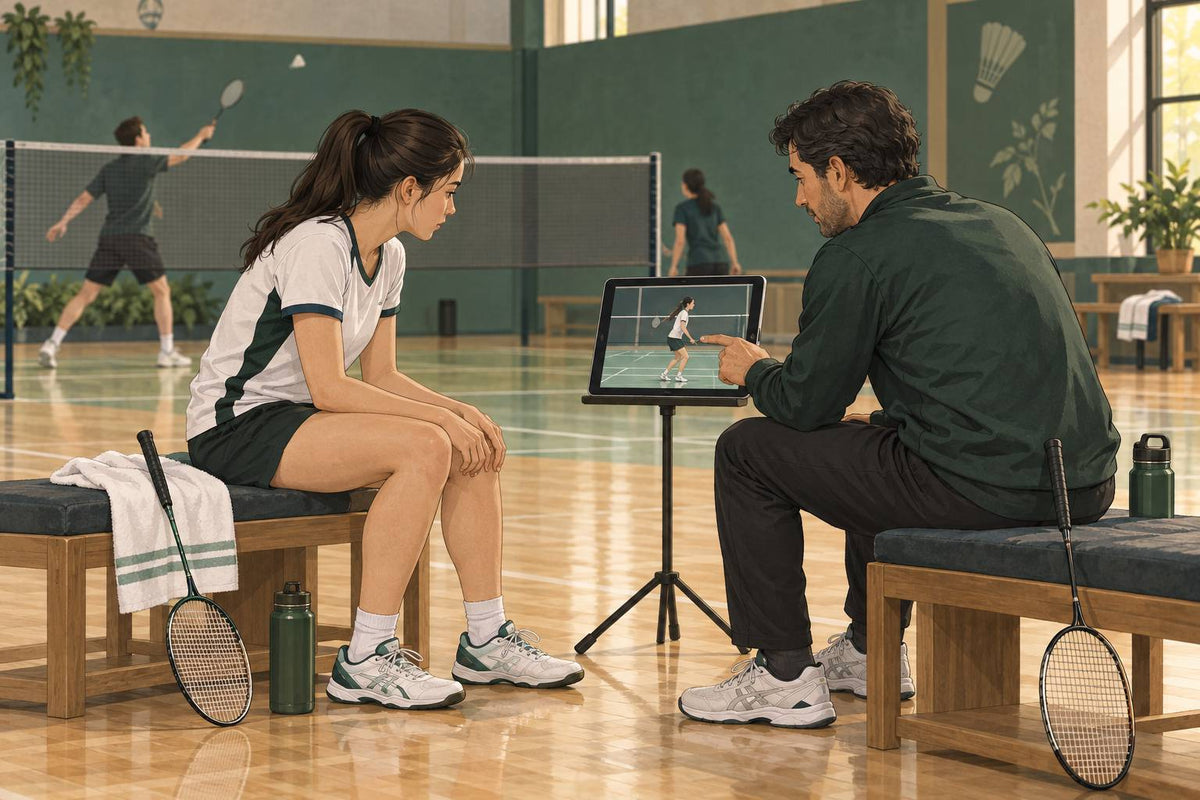
Use match or drill footage to check whether the knee tracks inside the foot during jump-smash or scissor-kick landings.
Context
Competitive players should pay extra attention to rear-court backhand landings and forehand-side lunges, both identified in badminton ACL injury data.
Badminton knee ligament injuries rarely come from one “bad step” alone. The risk shows up when a fast rear-court jump, scissor kick, lunge, or emergency change of direction lands with the knee drifting inward instead of tracking over the foot. That is why ACL prevention for badminton should feel specific: watch the landing after overhead strokes, control the first step out of a lunge, and train your body to absorb force with a softer, straighter knee position. This guide focuses on the mechanics players can actually see and practise, not scare tactics.
In This Guide
- Why ACL and knee ligament risk shows up in badminton
- The key mechanic to watch: knee abduction, or valgus collapse
- What recent badminton landing studies found
- Trainable cues: softer, straighter, better-controlled landings
- Gear note: shoes can support court movement, but they are not an ACL guarantee
- Which should you choose?
Why ACL and knee ligament risk shows up in badminton

Badminton ACL injury risk is not limited to collisions. Non-contact situations, especially jump landings and plant-and-cut movements, can stress the knee because the sport repeatedly asks the lower body to accelerate, brake, rotate, and recover in a very small space.
A 539-player ACL rupture registry makes that pattern feel specific to badminton rather than generic field-sport advice. The rear court was the most frequent injury location, and the most common movement before injury was the scissor kick jump on the rear court at 19%. Lunges were also prominent: lunge at the net and lunge at the rear court each accounted for 13%.
That is why rear-court recovery quality matters. The scissor jump is useful footwork, but it has to be trained with controlled takeoff, landing, and re-balance rather than treated as just a power move.
The key mechanic to watch: knee abduction, or valgus collapse

Knee abduction angle is the amount the knee moves inward relative to the hip and foot during landing or cutting. Players often call this valgus collapse: the foot is planted, the thigh drifts inward, and the knee no longer tracks cleanly over the toes.
For coaches and players, angle is useful because it can be seen on slow-motion video. Knee abduction moment is a deeper force measurement, but it is harder to assess outside a lab. That makes visible knee position a practical field marker when reviewing jump-smash landings, scissor jumps, and hard lunges.
The danger window is extremely short. Peak ACL load occurs about 30–50 milliseconds after initial foot contact. Video analysis found immediate knee abduction of 12° within 40 milliseconds, along with internal knee rotation. Low knee flexion around 23° adds to the problem because a straighter knee leaves less room to absorb landing forces.
What recent badminton landing studies found

In a 2025 Bioengineering paper from the National Sports Institute of Malaysia, Universiti Malaya, and Loughborough University, 21 male junior players performed jump smashes on an instrumented badminton court. The variables associated with peak knee abduction angle were knee external rotation at foot contact, peak knee internal rotation, landing time, and trunk lateral flexion at foot contact.
A separate 2025 Frontiers in Bioengineering and Biotechnology paper by Zhejiang Normal University, with data collected at Beijing Sport University, tested female players under unanticipated conditions. The backhand rear-court jump smash produced greater knee abduction angles and knee adduction moments at initial contact than the compared lateral jump smash. That matters because unplanned movement can leave only about 300 ms to react, so the safest landing pattern has to be trained before the rally demands it.
Trainable cues: softer, straighter, better-controlled landings

The useful takeaway is not to diagnose your own knee mechanics, but to make landing quality part of normal badminton training. On jump-smash recoveries, scissor jumps, and hard lunges, aim for a knee that tracks in line with the toes rather than collapsing inward. A simple cue is: “land with the kneecap pointing where the toes point.”
- Land softer: avoid a stiff, noisy touchdown. A softer landing lengthens landing time and usually allows more knee flexion.
- Check alignment: use slow-motion phone video from the front to see whether the knee drops inward on single-leg landings.
- Build control: prevention programs commonly combine plyometrics, neuromuscular training, and strength training rather than relying on one magic drill.
For lower-body preparation, start with a progressive strength base: Badminton Leg Strength Training. No drill can guarantee injury prevention, but better strength, proprioception, and landing awareness give you more tools when rallies get chaotic.
Gear note: shoes can support court movement, but they are not an ACL guarantee

For landing practice, footwear is worth reviewing for the right reason: badminton-specific court shoes are the relevant gear category for indoor court movement, where repeated split steps, lunges, and jump landings demand cushioning under impact and lateral stability during push-offs and recovery steps. If your current pair feels flat, slides inside the shoe, or lets your foot roll during side-to-side work, that is a signal to reassess it — see the table below for what to do next.
Keep the promise realistic: footwear can support court movement, but it is not an ACL guarantee. The badminton landing evidence discussed in this article does not show that shoes prevent ACL injuries; knee position, hip control, trunk control, fatigue management, and progressive training still do the injury-risk work.
Which should you choose?
Match the next step to the movement pattern you see most. For badminton ACL injury knee ligament risk, landing control is the priority; gear is only a support decision.
| Situation | Choose this | Why |
|---|---|---|
| You land jump smashes or scissor jumps on one leg | Video-review knee line, toe direction, and trunk lean | Knee abduction angle, knee rotation, and trunk lateral flexion at foot contact are measurable landing risk factors. |
| Your knee dives inward or lands nearly straight | Prioritize neuromuscular, strength, and plyometric training | Prevention programs target dynamic valgus, increase knee flexion, and reduce valgus motion. |
| Rear-court backhand or unanticipated smash landings feel messy | Give those reps extra landing review | Rear-court backhand jump landings and unanticipated conditions show higher-risk knee mechanics. |
| You are checking your setup | Browse badminton court footwear | Cushioning and lateral stability help the foot absorb landing loads and support quick push-offs during recovery steps. |
Get 10% off your first order
Join the Badminton House list and we’ll email you a 10% welcome code — plus training guides, technique advice, and badminton updates.
By subscribing, you agree to receive Badminton House emails and can unsubscribe anytime.
We play badminton ourselves, so our knee-safety advice stays practical: sharpen the mechanics first, then make sure your equipment matches how you actually move on court. If you are unsure what to adjust in your setup, contact us and tell us your level, weekly volume, and current footwear.
Ready for a cleaner court setup?
Check Live Footwear AvailabilityBadminton-specific footwear collection for players comparing fit, grip, and cushioning.

Leave a comment
This site is protected by hCaptcha and the hCaptcha Privacy Policy and Terms of Service apply.