
Last updated: July 2026 · Written by the team at Badminton House
Quick Answer: Badminton Court Conditions
Read the room before you blame your game: adapt to conditions that are safe but different, report facility issues that affect fairness, and stop play when the court is genuinely unsafe.
Adapt
Most common: the court is playable but drafts, lighting, or a low ceiling change timing and visibility, so test your clears, use safer margins, and simplify shot choices.
Report
Tell staff or the organizer about any facility-related issue. If it is a slippery area or any other immediate danger, stop play until the issue is fixed.
Stop
Pause play if the court is wet, damaged, obstructed, or consistently unplayable — unsafe footing and overhead obstructions are never just a tactical challenge.
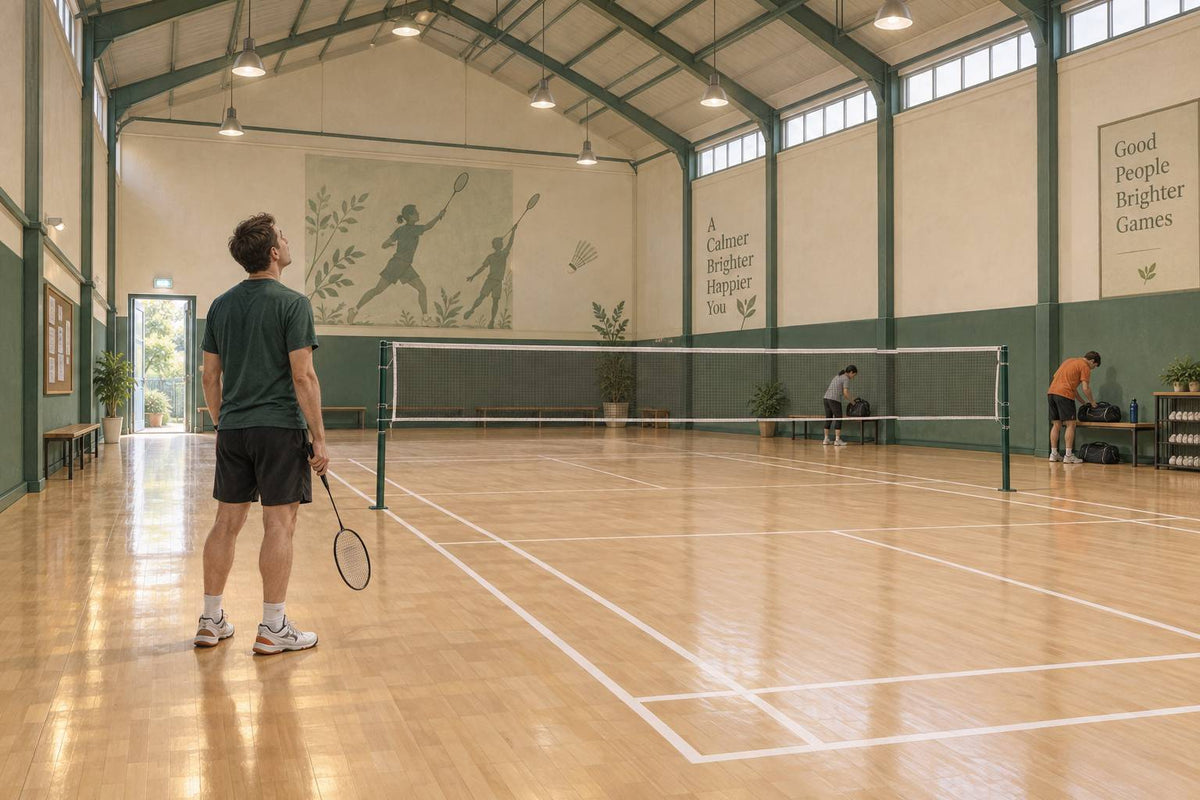
Before you blame your timing, take one rally to read the room. In shared school gyms, community centres, and club rentals, the court lines may be regulation size, but the playing conditions can still change the match: a side door can push the shuttle, bright wall colour can hide it, a low rafter can take away your clear, and dusty flooring can make a normal lunge feel risky.
Good players adjust to badminton court conditions before they adjust their whole technique. The goal is not to complain about every unexpected flight or drift; it is to separate normal venue quirks from conditions that affect safety or fairness. Some problems call for small tactical changes, like testing a few clears before starting. Others should be reported to staff, agreed on with opponents, or treated as a reason to stop play.
Control what you can control. You cannot fix a drafty gym, but you can show up with reliable non-marking court shoes; check live availability in our badminton footwear collection.
In This Guide
Arrive Early and Scan the Court Before Warm-Up

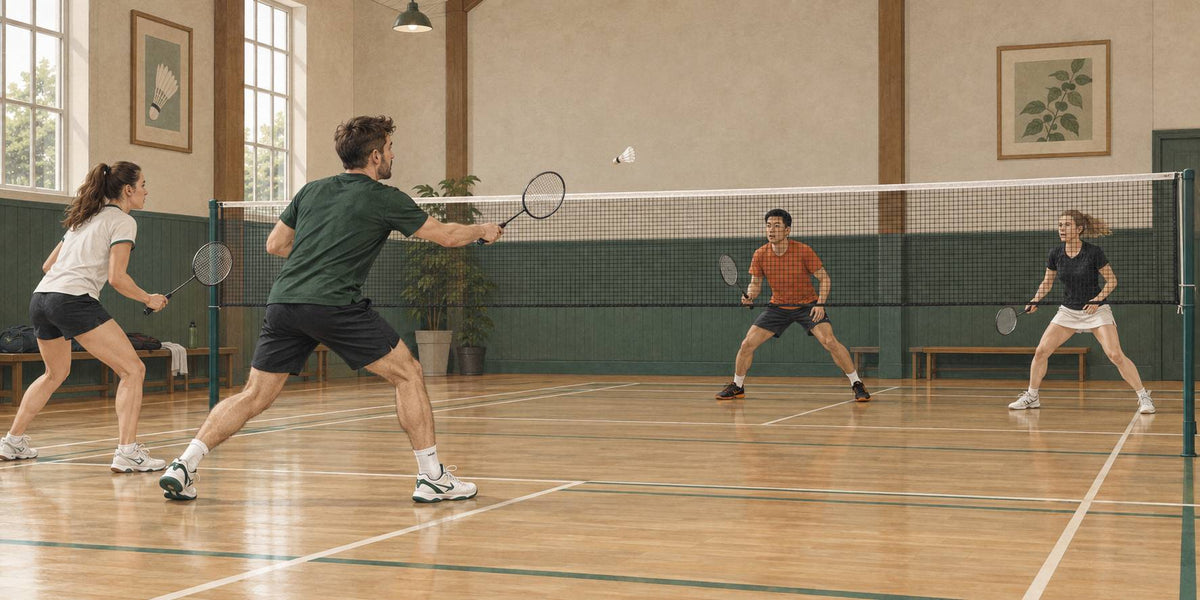
Good players do not only read opponents; they read the room. Before your first rally, take a short walk-through of the badminton court conditions: airflow, lighting, background colour, overhead obstacles, floor grip, and anything close to the sidelines or back lines. This is especially useful in clubs, schools, and community centres, where badminton is often played in multi-use gyms rather than purpose-built halls.
If you are unsure what the court itself should look like, start with our badminton court dimensions and lines guide. It explains the regulation court measurements, boundary lines, ceiling context, and floor considerations that apply whether you are playing in a dedicated club, school gym, or community centre.
Quick pre-warm-up rule
Before you blame your timing, strings, or shot choice, check whether the court is changing the shuttle, your vision, or your footing.
Use a simple six-point scan
You do not need to inspect the gym like a tournament referee. You just need enough information to warm up intelligently and avoid surprises once the score starts. Scan these six areas before you hit full-speed:
| What to scan | What you are looking for | First warm-up adjustment |
|---|---|---|
| Airflow | Doors, vents, fans, or air-conditioning that may push the shuttle off its normal line. BWF facility guidance says the field of play should be free of draughts or other air movement. | Test clears, lifts, and high serves from both ends before deciding whether the shuttle is carrying long or dying short. |
| Background | Hard-to-see sightlines behind the far court. BWF tournament guidance recommends darker background colours behind courts because visibility matters. | During warm-up, look at the shuttle from your rear corners and front court so you know where tracking gets difficult. |
| Lighting | Glare, shadows, or daylight behind the court. BWF facility guidance places lighting along the sides rather than directly over or behind the playing area, and calls for daylight behind or along the court to be eliminated. | Notice which shots disappear late: deep clears, flat drives, or tumbling net shots. Then prepare earlier in those sightlines. |
| Ceiling and overhead gear | Rafters, lights, ducts, basketball backboards, or other equipment in the shuttle’s flight path. The Laws of Badminton do not set one universal minimum ceiling height. | Ask about the local house rule before play: some venues replay obstruction contacts as a let, while other ceiling contacts may be treated as faults. |
| Floor grip | Slick patches, dusty areas, or a surface that does not support lunges, split steps, quick recovery, and sudden stops. Hardwood and sprung wood floors are common because they offer appropriate grip and shock absorption. | Start with controlled split steps, stops, and lunges before moving at match speed. |
| Runoff and nearby obstacles | Walls, benches, posts, bags, or equipment close to the back line or sideline. Proper spacing helps prevent collisions with walls or obstacles. | Identify where you need safer movement margins before you chase a wide lift or deep attacking clear. |
Read both ends of the court
Do not judge the whole court from one baseline. A door, vent, window, bright wall, or overhead fixture may affect one end more than the other. Stand at each end, look through the far court, and imagine the shuttle path on the shots you use most: high serve, clear, lift, drop, drive, and net shot.
This matters because badminton shuttle flight is naturally sensitive. Even indoors, a clear can appear to sail long, slow down, and fall inside the back line; a drop can hang briefly, then fall sharply. If the room adds airflow or visual difficulty on top of that, late preparation gets punished quickly.
Separate adjustment from safety
Some court conditions are normal playing variables. You adapt by warming up with more purpose, choosing better margins, and agreeing on local rules. Other conditions should be reported before the game gets intense. A tricky background is one thing; a floor that will not let you stop safely is another.
- Adapt: slight shuttle drift, unfamiliar lighting, a high ceiling that affects depth perception, or a background that requires earlier tracking.
- Clarify: ceiling contacts, rafters, basketball gear, or any local house rule that could decide a rally.
- Report before hard play: unsafe floor grip, equipment too close to the playing area, or any condition that creates a realistic collision or slipping risk.
Lighting, Backgrounds, and Losing the Shuttle

Good badminton court conditions are not just about the floor and net. If you cannot pick up the shuttle early, your timing breaks down: clears feel late, defensive blocks pop up, and easy overheads suddenly become guesses.
For high-level facility design, BWF guidance points lighting along the sides of the court rather than directly over or behind the playing area. It also calls for daylight or sunlight behind or beside the court to be eliminated, and for darker background colours behind courts at sanctioned tournaments. The reason is practical: the shuttle is small, fast, and constantly changing height, so the background behind it matters as much as the brightness of the lights.
Player read: if you keep losing the shuttle at one end, do not assume your technique suddenly disappeared. Check whether the shuttle is crossing a bright fixture, pale wall, window, scoreboard, or shadowed ceiling area.
The main sightline problems to watch for
- Glare behind the shuttle: windows, open doors, sunlight, or bright fixtures behind the far court can make the shuttle disappear for a split second.
- Lights directly in the flight path: if a high clear passes through a row of ceiling lights, you may lose the shuttle at exactly the moment you need to judge depth.
- Uneven lighting: dim corners, shadow bands, or dark patches over the rear court make late overhead preparation more likely.
- Busy or pale backgrounds: a light wall, folded bleachers, basketball backboards, wall padding, banners, or moving people behind the court can reduce contrast.
- Very high ceilings: there is no maximum ceiling height in the playing laws, but an extremely high ceiling can make depth judgment harder, especially when the lights and ceiling structure give poor visual reference points.
How to adapt without blaming every miss
During warm-up, test both ends of the court with a few high clears, punch clears, and defensive lifts. Do not only hit from the comfortable side. Stand at the rear court and watch your partner’s shuttle travel through the ceiling and background from both corners.
- Pick up the shuttle earlier: track it from your opponent’s strings, not after it crosses the net. Poor lighting punishes late visual pickup.
- Use slightly safer targets: if one rear corner is visually difficult, aim with more margin instead of trying to paint the back line.
- Shorten your backswing under uncertainty: when you lose the shuttle briefly, a compact preparation gives you a better chance of making clean contact.
- Communicate in doubles: if your partner is facing the worse background, call earlier and avoid forcing them into blind rear-court overheads when a safer rotation is available.
This is especially relevant in school gyms and community centres, where badminton courts often share space with basketball lines, wall padding, windows, stages, scoreboards, and multi-sport lighting. The court may be marked to regulation size, but the way it plays can still change from one end to the other. For the regulation court layout itself, see our guide to badminton court dimensions, lines, and net height.
When it becomes more than a playing adjustment
Most sightline issues are manageable if both sides know what is happening and adjust fairly. But if a light is out over one end, glare is severe, daylight is directly behind the court, or players are repeatedly losing the shuttle in a way that creates unsafe movement, report it to the organizer, facility staff, or club captain before continuing serious play.
A fair match starts with both players being able to see the shuttle. If the lighting or background turns normal overhead shots into guessing, treat it as a court-condition issue—not just a bad day with your timing.
Ceilings, Rafters, Basketball Gear, and Local House Rules
Ceiling height is one of the easiest badminton court conditions to misunderstand. The Laws of Badminton do not set one universal minimum ceiling height for every court. A court can have correct lines and net height, yet still feel awkward if the shuttle keeps clipping rafters, scoreboards, basketball hoops, hanging dividers, ducts, or lights.
The practical question is simple: can both sides play normal clears, lifts, and high serves without the roof or fixtures becoming part of the rally? If the answer is no, the court may be usable for a casual hit, but it will change tactics. Players start flattening clears, avoiding high defensive lifts, or serving lower than they normally would.
Do not treat one number as the global rule
- Laws of Badminton: no universal minimum ceiling height is specified.
- High-level tournament guidance: BWF tournament facility guidance uses higher clear-height targets, including 12 metres for Olympic Games, YOG, Grade 1 events other than senior tournaments, and BWF World Tour Level 1–5 events, with 9 metres used for other BWF-sanctioned tournaments and international competitions where 12 metres is still preferred.
- Club and school reality: many community centres and school gyms are multi-use spaces, so basketball equipment, curtains, scoreboards, and rafters often matter as much as the raw ceiling height.
How to test overhead clearance during warm-up
Before the first game, hit a few honest clears from both back corners. Do not just tap shuttles around at half speed. Test the shots that actually rise into the ceiling area:
- Full defensive clear: from deep in your rear court to the opponent’s rear court.
- High lift under pressure: from the forecourt or midcourt when you are late.
- High singles serve: if singles is being played and the venue allows enough room for it.
- Cross-court clear path: this often exposes rafters, lights, or hanging hoops that a straight clear misses.
If only one corner has an obstruction, note it before you start. That corner may punish one player more than the other, especially in singles where high recovery clears are a normal part of the rally. If both sides know the limitation, you can adapt more fairly.
Ceiling faults and local obstruction rules
The standard BWF rule makes contact with the ceiling or side walls a fault (Law 13.3.3). Where a building’s structure requires it, the local badminton authority may set obstruction by-laws, subject to its Member Association. Ask which approved rule applies before playing:
| Contact | Common local ruling | What to do before play |
|---|---|---|
| Shuttle hits the ceiling | A fault under the standard law; check any approved local exception | Agree clearly before the first serve |
| Shuttle hits a light, basketball hoop, rafter, curtain track, or other fixture | A let only where the applicable local obstruction rule provides for it | Ask the venue, club organizer, or home side what rule they use |
| Obstruction affects only one side or one corner | May still be playable, but it can create an advantage | Switch ends as usual and keep the same ruling for both pairs or players |
The key is not whether your club’s rule matches another gym’s rule. The key is that everyone on court knows the rule before a close rally happens. For the core scoring, faults, lets, and rally rules, see our badminton rules and scoring guide.
Simple pre-game agreement. Say it out loud: “Ceiling is a fault, fixtures are a let” — or whatever the local rule is. That ten-second conversation prevents arguments later.
How to adapt when the roof is in play
If the venue is safe but low, adapt your shot selection instead of pretending it plays like a purpose-built badminton hall. Use flatter clears, faster drops, punch clears, and controlled drives. In doubles, expect more flat exchanges because very high defensive lifts may bring the ceiling or basketball gear into the rally.
But if overhead fixtures are loose, hanging into the shuttle path, or close enough to distract players during normal movement, do not just “play around it.” Report it to the organizer or facility staff. Court conditions should challenge your skills, not turn the gym ceiling into a random opponent.
Adapt, Report, or Stop: A Simple Court-Condition Framework
Not every drift or missed clear means the court is unsafe. Badminton is sensitive to air, light, flooring, and overhead space, so good players learn to adjust. The key is knowing the difference between normal adaptation and a condition that should be raised with the facility.
Use this simple framework before you decide to play through the problem.
| Decision | Use it when | What to do |
|---|---|---|
| Adapt | The court is playable, but conditions affect timing, visibility, or shot height. | Test the shuttle, add safer margins, simplify shot choices, and communicate clearly with your partner. |
| Report | The issue is facility-related. | Tell staff or the organizer about drafts, poor lighting, loose equipment, slippery patches, or unclear house rules; stop play if a surface creates a slipping risk or another immediate danger. |
| Stop | The condition is unsafe, wet, damaged, obstructed, or consistently unplayable. | Pause the game and get the condition fixed before continuing. Do not treat unsafe footing or obstacles as a normal part of the match. |
Adapt: make practical shot and positioning changes
If the court is safe but plays a little differently, give yourself a short adjustment period. In many school gyms and community centres, badminton shares space with basketball lines, curtains, bleachers, and local setup choices, so the first few rallies should be about reading the room, not proving a point.
- Test your clears and lifts. Hit a few full-court clears from both ends and notice whether the shuttle holds up, carries long, or drops short.
- Use safer margins. If the shuttle is drifting, aim a little farther inside the sidelines and back line until you trust the flight. Remember: a shuttle touching any part of the correct boundary line is in.
- Adjust serves. If a low serve is getting pushed by air movement or a flick serve is flirting with rafters, choose the serve that gives you the most repeatable start.
- Reduce all-or-nothing smashes. In poor lighting or against a difficult background, a controlled steep smash, half-smash, drop, or fast push may be a better choice than swinging at 100%.
- Recover with extra space in mind. If runoff is tight, avoid drifting too far behind the back line after a clear or lift. Stay balanced enough to stop before walls, benches, posts, or other courts.
For doubles, make the condition part of your communication: call earlier, cover the drifting side, and agree who takes middle shuttles when visibility is poor. If you need a positioning refresher, see our badminton doubles positioning and rotation guide.
Report: facility issues are not your partner’s problem to guess
Some conditions are playable for one rally but should still be raised. Tell the facility, coach, league organizer, or front desk when you notice:
- a consistent draft from doors, fans, vents, or air conditioning that changes shuttle flight;
- lighting that makes the shuttle disappear against the ceiling, walls, windows, or background;
- basketball nets, hanging fixtures, curtains, or rafters that are repeatedly interfering with normal clears and lifts;
- unclear local rules for what happens when the shuttle hits the ceiling or overhead equipment;
- dusty or slippery areas, curled floor tape, loose mats, or damaged boards.
Be specific when you report it. “Court 3 is slippery in the rear forehand corner” is more useful than “the floor is bad.” “The shuttle is drifting toward the entrance whenever the door opens” gives staff something concrete to check.
Stop: do not play through unsafe conditions
Stop play when the court creates a real risk of slipping, colliding, tripping, or being hit by an obstruction. Wet floors, damaged surfaces, exposed equipment, unsafe runoff, and unstable posts are not tactical challenges. They are safety issues.
The same applies when a condition makes the court consistently unplayable. If every high lift hits the same obstruction, if the shuttle repeatedly disappears in the same lighting zone, or if a draft makes normal control nearly impossible, the fair solution is to fix the condition, move courts, or agree on a house rule before continuing.
Simple rule of thumb. Adapt to conditions that are safe and consistent. Report conditions the facility can improve. Stop when the court is unsafe or when the issue decides rallies more than the players do.
Which Court-Condition Response Should You Choose?
Use this table when you arrive at a school gym, community centre, club, or tournament venue and the court feels different from your usual home court. The goal is simple: adapt when the condition is playable, agree on house rules when the issue is local, and stop or switch courts when movement or visibility is no longer safe.
| Court condition | Choose this response | Why it matters | Practical action |
|---|---|---|---|
| Light draft or uneven shuttle flight | Adapt first | Badminton shuttles are highly wind-sensitive, and even small air movement can change the trajectory. | Test clears from both ends in warm-up. If you are checking shuttle speed formally, the Laws describe a full underhand stroke from over the back boundary line; a correct-speed shuttle lands 530 mm to 990 mm short of the opposite back boundary line. |
| Noticeable air-conditioning, open doors, or cross-breeze | Report or ask for control | BWF facility guidance expects the field of play to be free of draughts and gives special attention to air-conditioning effects and entry points. | Ask staff or the organizer whether doors, fans, or vents can be adjusted. If not, agree with your opponent that both sides are dealing with the same condition and be conservative on tight back-line judgments. |
| Dim lighting, shadows, glare, or pale background | Adapt, then report if tracking is poor | Uneven or insufficient lighting can make the shuttle harder to see. BWF guidance places lighting along the sides rather than directly over or behind play, and tournament background guidance favours darker colours behind courts. | During warm-up, check high clears, flat drives, and lifts against the ceiling and far background. If players repeatedly lose sight of the shuttle, tell the organizer instead of treating it as a normal tactical problem. |
| Low ceiling, rafters, lights, basketball hoops, or ducts | Agree on house rules before playing | The Laws of Badminton do not set one universal minimum ceiling height. Recreational halls can still be playable with lower ceilings, but overhead obstacles can limit clears, lifts, and high serves. | Before the first rally, confirm what happens if the shuttle hits the ceiling or a fixture. Standard ceiling contact is a fault; an approved local obstruction rule may make a specified fixture contact a let. |
| Dusty, slick, carpeted, or inconsistent floor | Choose safer movement; stop if you cannot brake | Badminton footwork depends on lunges, split steps, fast side-to-side recovery, and sudden stops. Hardwood, sprung wood, sports vinyl, and controlled-friction sport surfaces are preferred over carpet or overly slick surfaces. | Test split steps, lunges, and recovery steps before full-speed rallies. If your shoes slide unpredictably or your plant foot cannot hold, reduce intensity, ask for the floor to be cleaned, switch courts, or stop. |
| Tight runoff near walls, benches, curtains, or other courts | Choose safer margins | Clear space helps prevent collisions. Recreational design guidance commonly plans about 1.5–2.0 m beyond end lines and about 1.2–1.5 m on sidelines, with tournament venues allowing more. | Do not chase every shuttle into a wall, bench, or neighbouring court. In casual play, call safety early. In organized play, ask the official or organizer how interference and unsafe runoffs should be handled. |
| Close line calls under bad light or drifting shuttle flight | Use the line rule, not a guess | All boundary lines form part of the area they define, so a shuttle touching any part of the correct line is in. | If you are unsure, be fair and replay only when your club or event rules allow it. Do not blame every close call on the gym; first confirm whether the shuttle touched the line. |
Gear decision: if the main issue is floor grip, start with proper non-marking badminton footwear rather than changing your footwork around a sliding shoe. You can check live availability in badminton footwear before your next club night.
Get 10% off your first order
Join the Badminton House list and we’ll email you a 10% welcome code — plus subscriber-only restock alerts, giveaways, and honest gear advice from players.
By subscribing, you agree to receive Badminton House emails and can unsubscribe anytime.
Most court-condition problems are about awareness, not equipment — read the room, adapt early, and know when to report or stop. We play badminton ourselves, so if you want a second opinion on how a specific venue’s conditions should change your setup, contact Badminton House and we will help you think it through.
The one thing you control on any court: reliable footing.
Check Badminton Footwear10% off first order · 14-day returns · Badminton specialty shop

Leave a comment
This site is protected by hCaptcha and the hCaptcha Privacy Policy and Terms of Service apply.