
Last checked: August 2026 · Written by the player-led team at Badminton House
Quick answer
For most players, a laced or semi-rigid ankle brace is the steadier everyday choice: guideline-level evidence favors it over tape, and it does not loosen mid-session the way tape does. Reach for tape only when you want quick, single-session cover and do not mind reapplying it. Save a rigid stirrup brace or boot for the first days after a genuinely severe sprain, not for ongoing play.
Start with the comparison, then find your situation
Skim the table below, then jump to the decision tree and read the branch that matches your ankle history.
See a professional if: the ankle is unstable, still swollen, or too painful to bear weight days after a roll. None of these three supports fix that on their own. Get assessed by a healthcare professional before you tape, brace, or play through it.
Tape, brace, or rigid support: the quick comparison
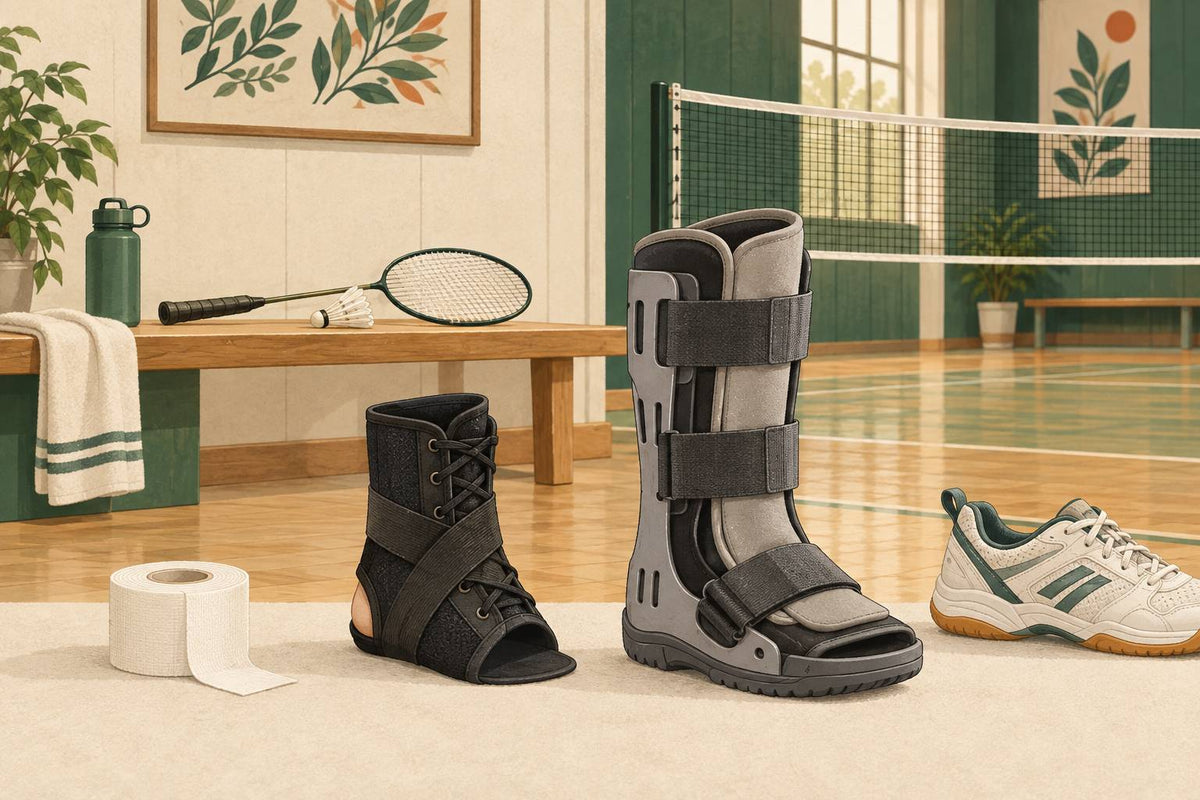
Tape gives quick, single-session support that loosens as you move and sweat. A laced or semi-rigid brace resists rolling for longer and works across many sessions. A rigid stirrup brace or boot restricts the ankle almost completely and belongs to the first days after a significant sprain, not to regular play.
The table lines up all three side by side. Read support level as how much roll the option actually resists once you are moving, and faff as how much attention it needs after you are already dressed and warming up.
| Option | Support level | How long it lasts | Movement cost | Faff |
|---|---|---|---|---|
| Tape | Firm at first, then drops off fast. | One session. Restriction fades noticeably within a few hours of play. | Minimal once applied; does not change shoe fit. | 5 to 10 minutes to apply well, plus practice to get consistent. |
| Laced or semi-rigid brace | Strong and steady; limits the extreme inward roll that causes a sprain. | Holds its support across a full session, and across many sessions after that. | Some stiffness at the ankle, but full footwork stays available. | Seconds to put on; no skill required. |
| Rigid support | Near-total restriction of ankle motion. | Built for continuous wear over days or weeks, not just one session. | High. Normal footwork and lunging are not realistic while wearing one. | Fitted once, then left in place for days. |
Guideline consensus leans toward the brace. A 2024 scoping review of ankle-brace clinical guidelines found several guidelines state plainly that taping is less effective than bracing for preventing a sprain, because tape causes a rapid loss of mechanical support, and one guideline recommends a brace over tape outright. Head-to-head injury outcomes are murkier, though. A systematic review pooling seven controlled trials in previously injured players found braces and tape cut the odds of a repeat sprain by a similar amount, with neither proven statistically better than the other for that outcome. Treat the brace as the safer default for durability, fit, and convenience, not as a guaranteed extra layer of protection that tape cannot match.
Badminton adds one wrinkle worth naming: most rolls happen on the lunge, not on a flat sprint, when the front foot plants at an angle and the ankle has to resist load and rotation at the same moment. That is exactly the movement a laced or semi-rigid brace is built to limit, and exactly the movement tape gives up on first, since the repeated lunging and quick direction changes are what stretch a taped ankle loose within a session.

How long tape actually lasts mid-session
Tape is not a set-and-forget fix. In one measured study, several ankle motions kept only about half their original restriction after 2.5 to 3 hours of continuous activity, and some motions lost more than half. A badminton session or club night runs long enough to feel that decline.
A measured study of taped ankles before and after a practice session found inversion and eversion restriction dropped to roughly half of its starting value, and plantarflexion and dorsiflexion loosened by more than half, after 2.5 to 3 hours of continuous football practice. The tape does not fail all at once. Movement stretches the strip, and a wrap that felt locked down at the start of the night is doing noticeably less work by the third game.
Plan around that decline rather than fighting it. Retape between games if you feel the strip start to slide, keep a spare roll in your bag for a full tournament day, and do not assume a strip applied before your first match is still doing its job three matches later. If you want the full step-by-step method, our badminton ankle taping guide walks through the anchor, stirrup, and figure-six layers, plus the checks that confirm a safe fit.
Which one fits your situation
Your history decides more than preference does. A never-injured ankle usually needs no support at all, or light taping only for high-risk sessions. A recent sprain calls for rigid support only if it was severe, and a brace otherwise. A chronically unstable ankle needs a brace paired with balance training, long term.
Never sprained an ankle before? You do not need daily tape or a brace just to show up. Guideline reviewers point to reserving prophylactic taping or bracing for competition and for high-risk sessions, indoor sports named specifically among them, rather than wearing it every training night, on the reasoning that this cuts both the odds of a new injury and how bad a relapse would be if one happens. If you do want cover for a big match day, a laced or semi-rigid brace is the more durable option from the table above. In one trial of collegiate tennis players, a semi-rigid brace produced faster sprint-speed gains than tape did, but also made players measurably slower on a complex agility test right after putting it on, so expect that agility cost to be real at first and to fade as you adapt over a few sessions.
Sprained it in the last few weeks? Match the support to how bad it was. A severe sprain, where the ankle felt unstable or you could barely put weight on it, calls for a rigid stirrup brace or boot for roughly the first 10 days, based on guideline recommendations for severe ligament injury. A milder sprain, the common ankle roll, does better in a semi-rigid brace than in rigid immobilization: functional treatment lets you load the ankle in a protected, controlled way while it heals. The same guidance recommends wearing a brace for at least six months after you return to play, well past the point the swelling and pain are gone.
Ankle rolls or feels wobbly on you repeatedly? That is chronic ankle instability, and support alone will not fix it. The scoping review above found a brace combined with balance and strength training works far better than either one on its own, and states plainly that bracing or taping should not be used as a stand-alone fix for balance problems. Wear the brace during play, and put the training in outside of it. Our badminton ankle sprain prevention guide covers the balance and strength work that actually rebuilds the joint, rather than just protecting it session to session.
Get the fit right, or none of this works
A support only works if it fits. A loose brace shifts around and adds nothing beyond the placebo of wearing something. A shoe laced over a brace has less internal volume than it did before, and forcing your foot into the old lacing can undo the support you just put on.
Check three things before you step on court. First, the brace should feel snug through the heel and midfoot without pinching or going numb; walk and lunge in it before you play, not just stand in it. Second, expect to loosen your laces a notch or move up half a shoe size once you add a brace under the tongue, since the extra material takes up real space that your foot used to have. Third, re-check the fit at the first break in play: straps and laces can loosen slightly once you start moving; tighten them as needed so the brace stays snug.
None of the three options replace basic ankle preparation. Warm up the joint, and keep working on the balance and strength side of the equation regardless of which support you choose tonight.
A brace is not a lifetime purchase, either. Hook-and-loop straps lose their grip after months of sweat and washing, and a strap that no longer bites stops doing its job even though the brace still looks fine. Check the closure at the start of a new season: if it slips under light hand pressure, replace the brace rather than trusting it in a match.
Put this to work tonight
- Match your ankle history to one of the three branches above.
- If you choose a brace, buy a laced or semi-rigid design, not a soft sleeve.
- Recheck tape tension or brace fit at the first break in play.
- If the ankle feels unstable rather than just sore, get it assessed before you tape, brace, or play through it.


Leave a comment
This site is protected by hCaptcha and the hCaptcha Privacy Policy and Terms of Service apply.