
Last checked: August 2026 · Written by the player-led team at Badminton House
Quick answer
For junior badminton coordination training, use short racket-and-shuttle tasks that ask a player to notice, move, hit, recover, and choose. A ladder can be one warm-up option, but it does not supply a shuttle, an opponent’s cue, or a recovery decision.
Default
Use the court: keep a racket, shuttle, net, or court target in every activity.
Progress
Change one demand at a time after the player can land, recover, and stay aware of the shuttle.
Cut first
Cut long queues, repeated rung patterns, and hard landings when they replace a badminton decision.
This is an editorial coaching plan for a junior group, not a diagnostic test or a developmental promise. BWF’s school badminton material includes hand-eye coordination, balance, agility, jumping and landing, and decision making among the skills developed through badminton activities. BWF Shuttle Time Teachers’ Manual
Related reading: use badminton agility-ladder and cone drills for a separate ladder-and-cone session. This guide is for making the court task more badminton-specific.
What coordination should mean on a badminton court
Coordination in junior badminton is best coached as a set of visible on-court jobs: hold balance, keep a rhythm, react to a cue, find space, vary touch, and adapt when the next shuttle changes. This guide uses those six jobs as an editorial practice framework, not a scientific score.
The distinction matters because a fixed ladder pattern mainly asks the player to remember feet and rungs. Badminton asks for feet, racket, shuttle flight, court position, and another person. A useful activity therefore leaves at least one badminton problem for the player to solve.
| Job | What a coach can see |
|---|---|
| Balance | A controlled stop and recovery after a reach. |
| Rhythm | Movement and contact that keep a shared rally tempo. |
| Reaction | A start that follows a real visual or sound cue. |
| Orientation | A player who can name their base and target space. |
| Touch | A deliberately soft or firm racket contact. |
| Adaptation | A sensible response when the next feed or rule changes. |
Six shuttle-led activities for a junior group
Give each coordination job one brief, low-queue activity and keep the first version simple enough to watch clearly. The activities below are editorial prescriptions: use a slower feed, shorter movement, larger target, or more space whenever the current version no longer looks controlled.
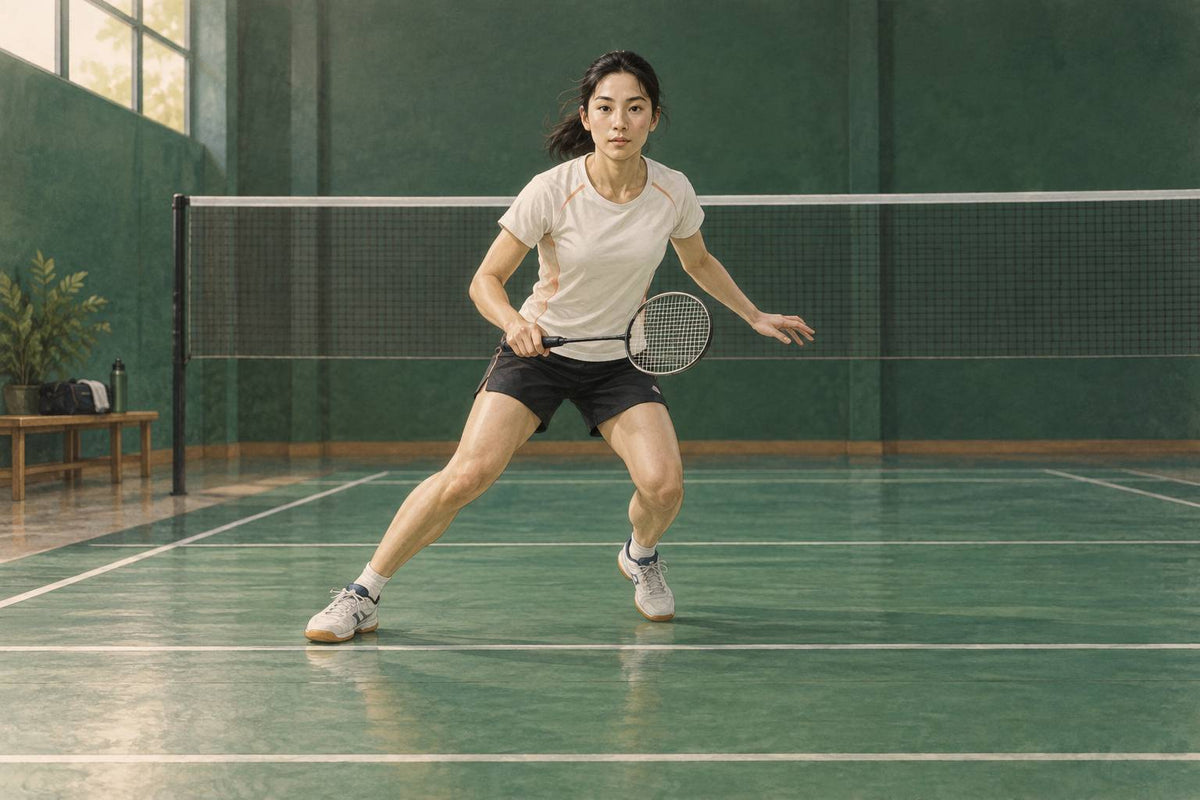
- Balance: catch, stop, recover. A partner underhand-tosses a shuttle to either forecourt side. The player catches it after one controlled reach, holds the finish for a count, then returns to base. Coach cue: “Land quietly, then look up.” Harder: replace the catch with a gentle net return.
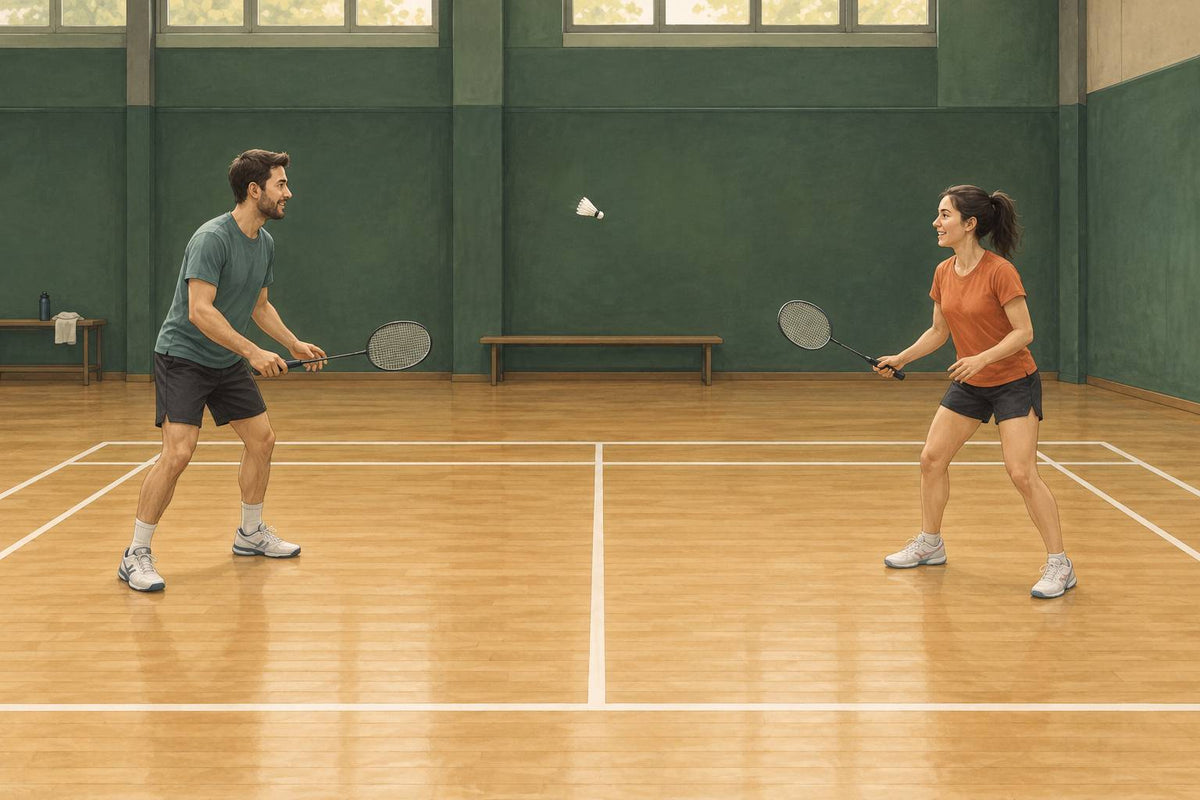
- Rhythm: two-hit rally pulse. Pairs send two comfortable underhand lifts, then one gentle net shot, and repeat. The target is a shared pattern, not power. Coach cue: “Move after your hit.” Harder: let either player choose when to use the net shot.
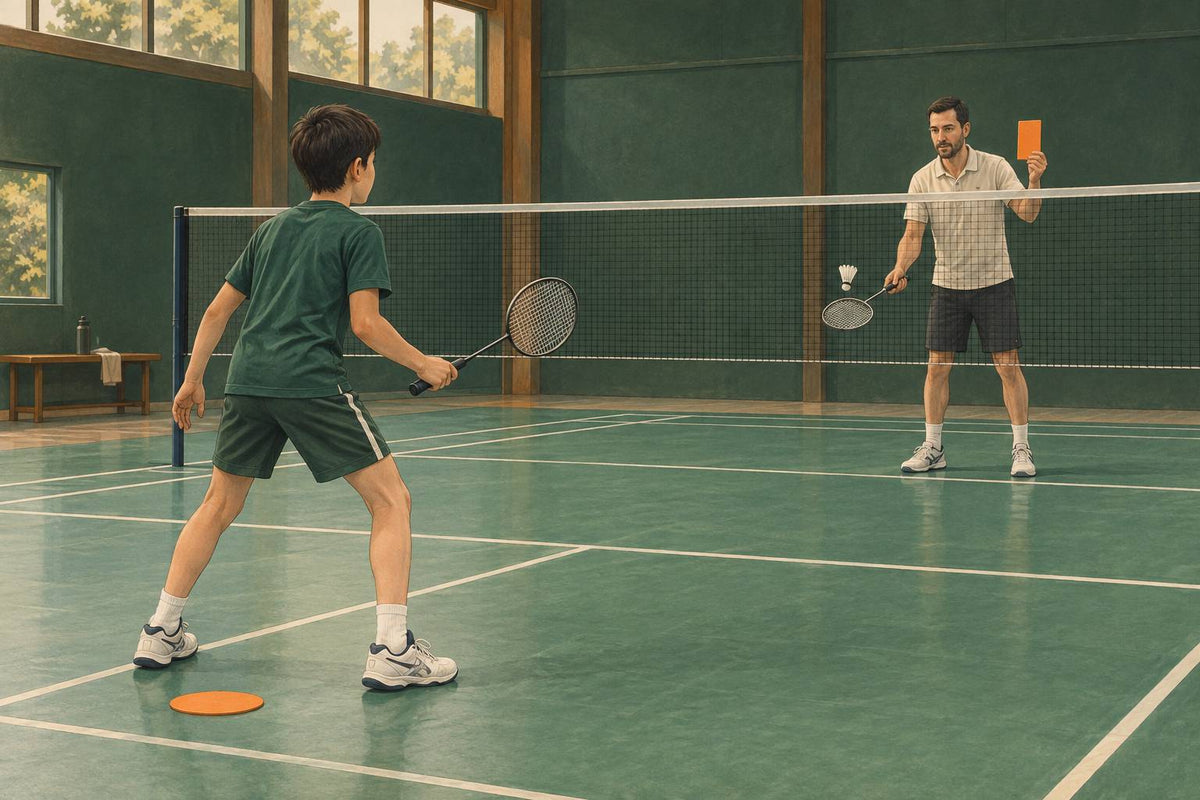
- Reaction: colour or hand cue feed. The feeder shows one of two simple cues before sending a shuttle to a matching side. The player moves, returns safely, and resets. Coach cue: “See the cue before the feet go.” Harder: make the cue appear later, while keeping the feed comfortable.
- Orientation: home-base return. Place a flat floor marker at the player’s chosen base. After every feed to a front or rear target, the player points to the base before the next feed. Coach cue: “Know where home is.” Harder: alternate forecourt and rear-court feeds.
- Touch: high, low, high. Partners alternate a lift, a net shot, then a lift. Keep the feed slow enough that the player can name whether the next contact should be soft or firmer. Coach cue: “Match the racket touch to the height.” Harder: remove the spoken sequence.
- Adaptation: change-on-call mini rally. Start a cooperative half-court rally. On a call of “front” or “back,” the next shot must travel to that area and the partner responds. Coach cue: “Hear it, choose it, recover.” Harder: let the feeder call after the shuttle crosses the net.
BWF’s teaching material explicitly uses variations to make activities easier or harder for different levels. That supports changing the task for the player in front of you; it does not supply a universal repetition count, score, or pass standard. BWF Shuttle Time’s inclusivity guidance

How to use one weekly gym hour
In one weekly gym hour, keep coordination work short, rotate one or two court jobs, and leave most of the time for playable badminton. A simple session works when every player has regular turns with a shuttle and enough space to stop, recover, and attend to the next cue.
An editorial starting layout is 10 minutes of active warm-up with a racket and shuttle, 15 minutes for two of the six activities, 25 minutes of conditioned games, and 10 minutes to replay one activity at an easier or harder level. Rotate the two focus jobs each week rather than attempting all six at once.
For children and adolescents aged 5–17, WHO recommends an average of at least 60 minutes a day of mostly aerobic moderate-to-vigorous physical activity across the week. This one-hour layout is an editorial badminton-session example, not a complete daily activity prescription. WHO physical-activity guidance
What to cut first
- Long ladder queues where a player has no racket, shuttle, target, or choice.
- Fast progressions that make landings noisy, crowded, or uncontrolled.
- Complex scoring that makes juniors watch rules instead of watching the shuttle.
Progress with a clearer badminton problem
Progress a junior coordination activity by changing one meaningful badminton demand at a time, such as the target, cue timing, recovery point, or choice of reply. Keep the current version when players lose safe spacing, controlled landings, or awareness of the shuttle; harder is not automatically better.
Before moving on, ask three simple questions: Did the player see the shuttle or cue? Could they complete the movement under control? Could they recover to a usable place? If one answer is no, reduce one demand and give another short turn. This is coaching observation, not a ranking system.
The goal is a session that resembles badminton enough for juniors to stay engaged with the racket, shuttle, court, and partner. Use a ladder if it adds enjoyment or a simple rhythm prompt, then bring the player back to a shuttle-led decision. That is the practical move beyond a station-only hour.

Leave a comment
This site is protected by hCaptcha and the hCaptcha Privacy Policy and Terms of Service apply.