
Last updated: July 2026 · Written by the team at Badminton House
Quick Answer: Badminton Agility Ladder Drills
For most players, the best footwork session combines one or two ladder patterns with one cone shuttle drill, then adds speed only after the steps stay crisp.
Mix
Best choice: do 10–15 seconds of quick ladder feet, then a short cone shuttle where you sprint, decelerate, touch the marker, and change direction.
Ladder
Choose this if your feet feel slow or heavy: use one-foot-per-rung runs, two-feet-in-each-box, lateral shuffles, and in-and-out steps for fast, precise placement.
Cones
Choose this if court coverage is the issue: side-to-side, four-corner, L-drill, T-drill, and zigzag patterns train acceleration, braking, and change of direction.
Use a flat, stable surface and grippy indoor court shoes for lateral work; Badminton House carries badminton footwear in CAD, while ladders and cones are best sourced through Canadian specialty retailers or your local club’s pro shop.
If your legs feel one beat late in rallies, the problem is not always stamina or racket skill. Badminton asks you to split, push, brake, recover, and change direction over and over; in fast exchanges, players may execute 6 to 12 strokes in 6 to 10 seconds. That is why footwork training has to teach your feet to move quickly and land under control.
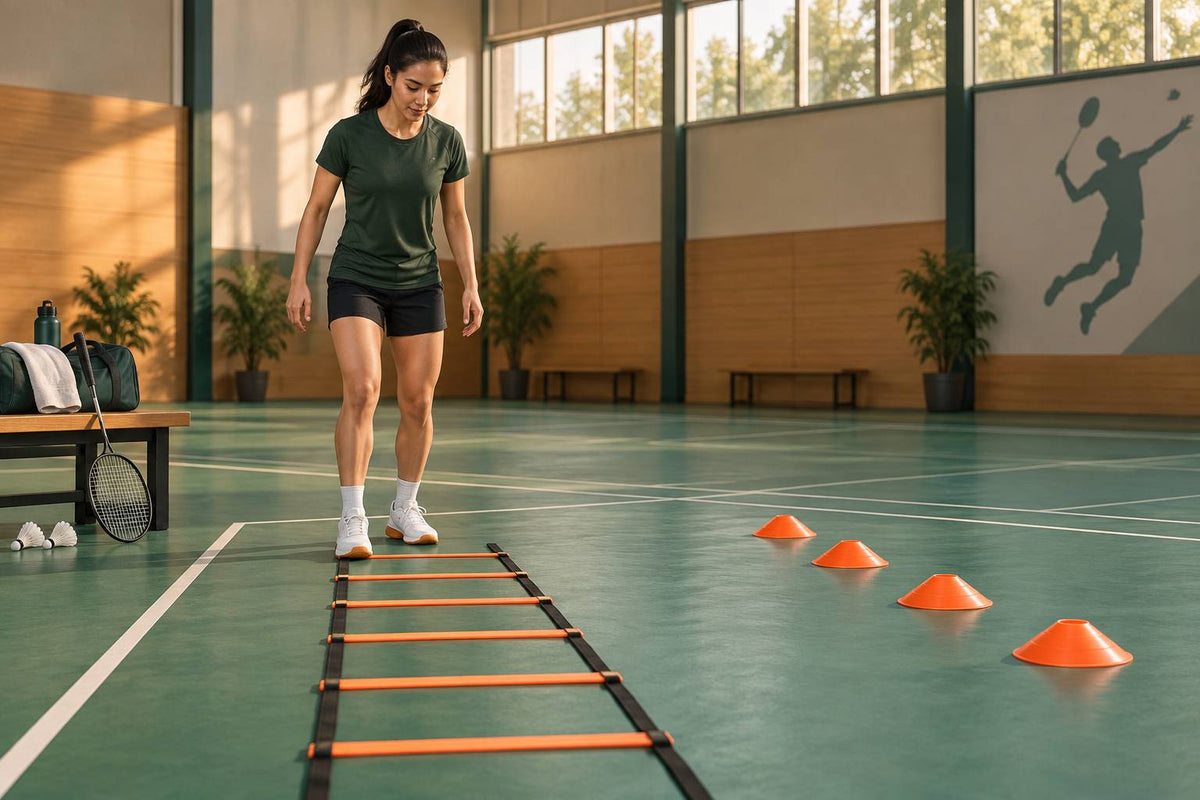
Badminton agility ladder drills and cone footwork are useful because they make that movement visible. The ladder trains fast, precise foot placement: one foot per square, two feet in each box, lateral shuffles, and in-and-out patterns. Cones train the court movement that matters after the feet leave the ladder: sprinting, decelerating, touching a marker, changing direction, and recovering for the next shot.
This guide keeps the focus practical for Canadian players: simple patterns you can run at a club, school gym, community centre, garage, or basement training space, with enough structure to improve without turning every session into a sloppy race.
Build speed on a safe base. Before you push ladder or cone drills faster, use grippy indoor court shoes made for lateral badminton movement. Browse badminton footwear in CAD; orders ship free across Canada.
In This Guide
- Why Do Ladder and Cone Drills Help Badminton Footwork?
- Agility Ladder Drills for Quick, Precise Feet
- Cone Drills for Badminton Change of Direction
- How Should You Structure Sets, Reps, and Rest?
- Quality and Safety Cues Before You Add Speed
- What Gear Do You Need: Ladders, Cones, and Court Shoes?
- Which Should You Choose: Ladder Drills, Cone Drills, or Both?
Why Do Ladder and Cone Drills Help Badminton Footwork?
Badminton footwork is not just “being fast.” A rally asks you to side-step, cross-step, make tiny positional adjustments, jump, accelerate, decelerate, and change direction again before your balance has fully settled — which is why clean movement mechanics matter as much as raw speed.
Agility ladder drills and cone drills help because they isolate two pieces of that movement puzzle. Ladder work trains quick, precise foot placement: light steps, low posture, and the habit of moving without heavy stomping. Cone work adds the court-like problem: sprint or shuffle to a marker, brake under control, touch or turn, then push off into the next direction.
Use drills as a bridge, not a shortcut. If your split step, lunge, chasse, and recovery position are still inconsistent, start with Badminton Footwork Basics, then add ladder and cone patterns to sharpen speed and timing.
The transfer to badminton is simple: better foot placement makes the first step cleaner, better braking keeps you balanced for the shot, and better recovery helps you get back into the next rally position faster. That is especially useful for Canadian club players training in shared gym time, where a ladder, a few cones, or even tape markers can create a focused footwork session without needing a full match court.
Just remember that the goal is not to “win” the ladder or rush the cones. The goal is sharper court coverage: arrive balanced, recover smoothly, and stay ready for the next shot. If you are doing lateral work on indoor courts, use proper non-marking court shoes with reliable grip; you can browse Badminton House badminton footwear in CAD, with free shipping within Canada.
Agility Ladder Drills for Quick, Precise Feet

Use the agility ladder as a precision tool, not a race. The goal is to teach your feet to land quickly, lightly, and exactly where you want them before you try to move faster. For badminton, that matters because good court coverage depends on small, repeatable steps: split, push, adjust, recover.
Start each drill either facing the ladder or side-on to the ladder, depending on the pattern. Keep a low athletic stance, knees slightly bent, chest balanced over your hips, and feet quiet on the floor. If you slap the ground loudly or clip the ladder every few steps, slow down and clean up the pattern.
New to footwork patterns? Pair these ladder drills with the basic movement shapes in our Badminton Footwork Basics guide so the quick feet you build in the ladder transfer back to the court.
| Ladder drill | How to perform it | Badminton cue |
|---|---|---|
| One foot in each square | Stand facing the ladder with feet about hip-width apart. Move forward with quick, light steps, placing one foot inside each square. | Stay tall enough to see the court, but low enough that your knees can spring into the next step. |
| Two feet in each box | Step both feet into the first square, then both feet into the next square, continuing down the ladder without crossing your feet. | Think “split-step rhythm”: quick contact, quick reload, no heavy heel landing. |
| Lateral shuffle | Stand side-on to the ladder. Step one foot into the first box, quickly bring the other foot in, then continue shuffling sideways down the ladder. | Keep your shoulders square and avoid popping upright; this should feel like a controlled defensive movement. |
| In-and-out steps | Move forward by placing both feet inside a square, then stepping both feet outside the ladder before entering the next square. | Use small, crisp steps. The drill is about fast foot placement, not big strides. |
| High knees | Face the ladder and drive the knees up while stepping through the squares in rhythm. | Stay on the balls of your feet and keep the upper body relaxed so the legs can cycle quickly. |
| Shuffle steps | Use a compact shuffle pattern through the ladder, keeping your feet close to the floor and your steps short. | Match the feel of quick defensive adjustments: light feet, stable hips, no bouncing too high. |
| Carioca | Move side-on down the ladder with a crossing-step rhythm, alternating the lead leg in front and behind as you travel. | Keep the movement controlled. If your hips twist too much or your balance breaks, slow the pattern down. |
| Single-legged hops | Hop through the ladder on one leg, placing the foot cleanly in each square. Switch legs on the next pass. | Land softly with the knee slightly bent. Stop if the landing becomes loud, wobbly, or uncontrolled. |
How to make ladder drills feel more like badminton
- Look ahead, not straight down. Glance at the ladder enough to place your feet, but do not train yourself to stare at the floor.
- Stay low between steps. A slightly bent-knee position lets you push off again quickly instead of standing up after every contact.
- Keep the steps light. Quiet feet usually mean better balance and faster recovery.
- Use both directions. For lateral patterns, go down the ladder leading with one side, then come back leading with the other side.
- Clean placement first, speed second. If your foot lands on the ladder or outside the intended square, reset the rhythm before increasing tempo.
A simple progression is to begin with one foot in each square and two-feet-in each box, then add lateral shuffle and in-and-out steps once your rhythm is reliable. High knees, carioca, and single-legged hops are more demanding, so use them only when you can stay balanced and precise.
Brief footwear note: Ladder work includes fast lateral contacts, so use grippy indoor badminton shoes rather than unstable running shoes. Badminton House carries badminton footwear in CAD; the Babolat Shadow Tour Men’s Badminton Shoes use a Michelin Premium Rubber Outsole for grip on indoor surfaces. Free shipping applies within Canada.
Cone Drills for Badminton Change of Direction

Cone drills are the court-shaped cousin of ladder work. Instead of repeating foot patterns in a straight line, you create stop-start targets: sprint, brake, touch a marker, push off, and recover into the next direction. That is much closer to badminton, where rallies demand repeated acceleration, deceleration, lateral movement, balance, speed, agility, and full-court coverage.
Keep the cones close enough that each rep feels like a badminton point, not a track workout. You are training the first two or three steps, the braking step, and the re-acceleration after a change of direction.
| Cone drill | Setup | How to run it | Badminton transfer |
|---|---|---|---|
| Zigzag course | Place cones in a zigzag pattern so each marker forces a new angle. | Accelerate to the first cone, decelerate under control, cut toward the next cone, and repeat through the course. | Builds acceleration, deceleration, and change-of-direction skill for stop-start rallies. |
| Side-to-side shuttle run | Place two cones on opposite sides near the sidelines and start in the centre. | Sprint or shuffle to one cone, touch it, then move quickly to the other cone and repeat. | Trains lateral movement and speed for defensive coverage and doubles-style side pressure. |
| Four-corner course | Place cones at the four corners of the court. | Move from your start point to each corner cone, touch the marker, then recover and continue to the next corner. | Improves overall court coverage and the habit of moving with purpose to front, rear, left, and right targets. |
| L-drill | Set cones in an L shape, about 5 yards apart. | Touch the first cone, run and shuffle laterally through the next cones, then jog back to the start. | Combines forward movement, lateral movement, balance, and controlled recovery. |
| T-drill | Arrange cones in a T shape with a base cone, centre cone, and two side cones. | Move from the base to the centre, change direction to each side, then return under control. | Develops balance, speed, agility, and the ability to brake before pushing into the next direction. |
How to make cone drills feel more like badminton
- Start from a ready stance. Begin low, with knees bent and weight slightly forward, rather than standing tall and waiting to run.
- Brake before you turn. The value of a cone drill is not just the sprint; it is the controlled deceleration before the next push-off.
- Use quick, powerful steps. Short, sharp steps help you stay balanced when the direction changes.
- Keep your centre of gravity low. This makes lateral changes cleaner and reduces the tendency to drift past the cone.
- Stop the rep when the shape breaks down. If your feet get heavy or you start reaching instead of moving, rest before adding speed again.
For indoor cone work, grip matters because these drills ask you to stop, push, and move laterally. One current Badminton House option is the Babolat Shadow Tour Men’s Badminton Shoes – Orange, built with a Michelin Premium Rubber Outsole for grip on indoor surfaces.
How Should You Structure Sets, Reps, and Rest?
Badminton agility ladder drills work best when they are short, crisp, and repeatable. The goal is not to grind through sloppy fatigue reps; it is to build fast feet, clean direction changes, and the habit of recovering into a ready position.
A simple default: 4–6 rounds of 10–15 seconds per ladder pattern, or 3 sets of 6–8 reps per cone drill, resting long enough between efforts that every rep stays crisp. Pick one of these structures based on your goal and the time you have after warm-up.
| Structure | How to Run It | Best For |
|---|---|---|
| Short ladder rounds | Do 4–6 rounds of 10–15 seconds. Pick one pattern, move with quick light feet, then rest before repeating. | Beginners, warm-ups, and technical foot-placement work. |
| Reps and sets | Perform 3 sets of 6–8 repetitions for each drill, with brief rest between sets. | Players who want a clear, repeatable practice plan for ladder or cone drills. |
| Circuit intervals | Use 3 sets of each exercise in a row: about 20 seconds at a slow-to-moderate pace, then 10 seconds at full speed. | More advanced players adding a conditioning element without losing footwork quality. |
For most club players, a good starting point is 2–4 drills total: one straight ladder pattern, one lateral ladder pattern, one cone shuttle, and one change-of-direction pattern. Complete your planned reps, rest long enough to keep your steps sharp, then move to the next drill.
Simple rule: if your feet start crossing awkwardly, your posture rises, or you stop decelerating under control, end the set or extend the rest. Quality comes before speed.
If you want these drills to become part of a broader conditioning plan, pair them with the ideas in our badminton fitness and stamina guide. Keep the ladder and cone work focused on movement quality, then build your longer fitness work separately.
Quality and Safety Cues Before You Add Speed
Fast feet only help if the movement stays balanced, repeatable, and safe. Before you turn badminton agility ladder drills or cone footwork into a race, make sure the pattern looks like badminton: low hips, light contacts, controlled deceleration, and a clean push into the next direction.
Safety first: ladder drills can be risky when rushed or set up poorly. They work best inside a warm-up or conditioning block, not as a sloppy fatigue test at the end of practice.
- Warm up first. Raise your body temperature before sharp footwork. If you play in cold Canadian gyms, start with easy movement and progress gradually; our badminton warm-up guide has a simple structure you can use before drills.
- Set the ladder on a flat, stable surface. A ladder that bunches, slides, or sits on an uneven floor turns a coordination drill into a tripping hazard. Cones should also be far enough from walls, bags, and other courts that you can decelerate safely.
- Keep the steps light and quick. Aim for quiet contacts on the balls of your feet. Loud stomping usually means you are landing heavy instead of staying reactive.
- Stay low through the pattern. Keep knees slightly bent and your centre of gravity low, especially before a direction change. If your hips pop upright every time you touch a cone, slow down and reset the posture.
- Add a small split step. Before the first movement or before a planned change of direction, use a compact split step rather than a big jump. It should help you load the legs, not waste time in the air.
- Push off the non-racket leg for direction changes. When you need an explosive first step, think about driving from the non-racket-side leg instead of just reaching with the lead foot. That push is what makes the next step sharper.
- Choose quality over speed. If you clip rungs, cross your feet awkwardly, lose balance, or cannot stop under control, the rep is too fast. Get the pattern right first, then add tempo.
A useful rule: the drill should make your court movement cleaner, not just make you tired. If your ladder or cone work starts to break down, reduce the pace, shorten the rep, or switch to slower shadow movement from the badminton footwork basics before trying again.
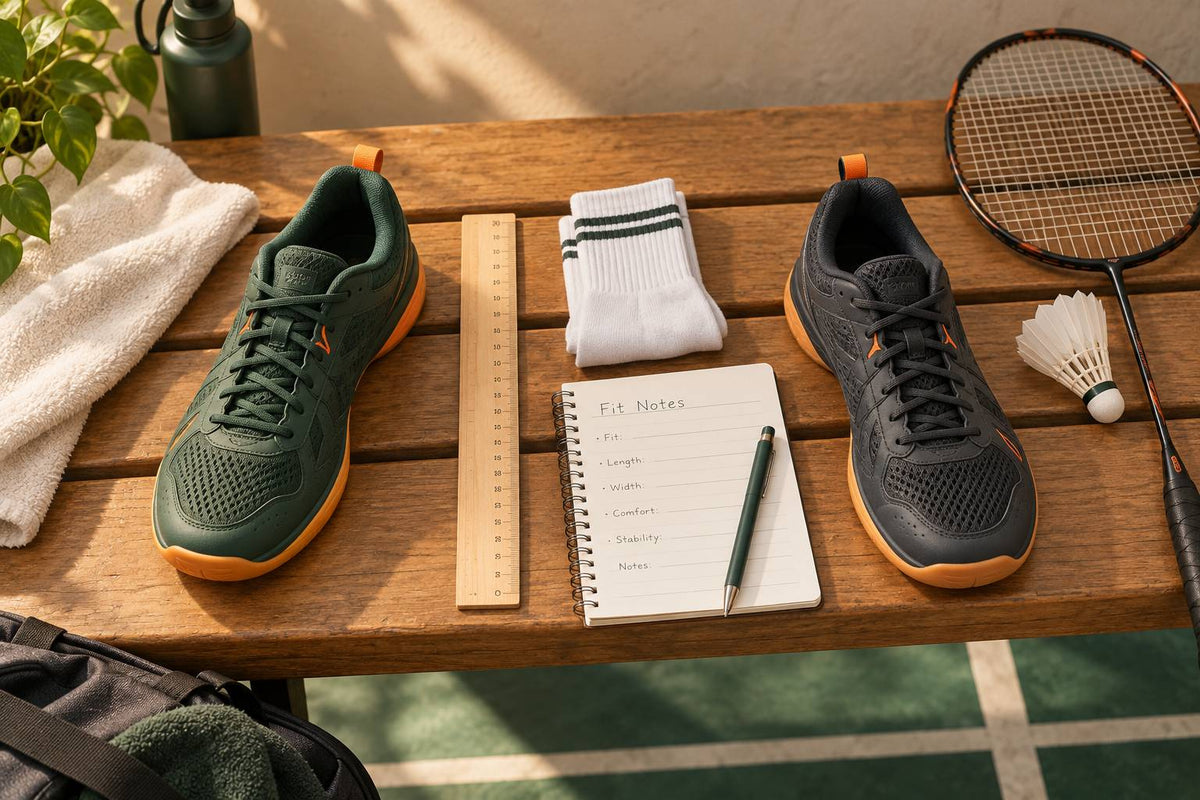
Footwear note: for lateral work on indoor courts, non-marking badminton shoes are safer than running shoes because badminton footwork repeatedly loads side-to-side cuts and stops. If you are unsure what to wear, read Badminton Shoes vs Running Shoes or browse our badminton footwear collection. The Babolat Shadow Tour Men’s Badminton Shoes use a Michelin Premium Rubber Outsole for grip on indoor surfaces; Canadian orders ship free.
What Gear Do You Need: Ladders, Cones, and Court Shoes?
You do not need expensive equipment to run good badminton agility ladder drills. A flat agility ladder, a few low-profile cones, or even simple floor markers can be enough as long as the surface is stable and the markers are not a tripping hazard.
Badminton House does not carry agility ladders or cones. For those training aids, look for generic markers through Canadian badminton specialty retailers or your local club pro shop. If you train at a school or community centre, ask whether they already have cones you can borrow before buying your own.
| Item | What to look for | Badminton note |
|---|---|---|
| Agility ladder | Flat rungs, stable layout, and enough length for short footwork patterns. | Best for rhythm, posture, and precise foot placement before adding speed. |
| Cones or markers | Low-profile markers that are visible but not bulky. | Useful for shuttle runs, four-corner patterns, and change-of-direction work. |
| Court shoes | Grippy indoor outsole, lateral support, and a badminton-specific fit. | Running shoes are not ideal for hard lateral stops; see our guide to badminton shoes vs running shoes. |
Training on indoor courts? Start with grip and support. Browse badminton footwear, including the Babolat Shadow Tour Men's Badminton Shoes – Orange.
The Babolat Shadow Tour Men's Badminton Shoes use a Michelin Premium Rubber Outsole designed for long-lasting grip and abrasion resistance on indoor surfaces. That matters during ladder and cone work because the whole session is built around sudden sprints, rapid lateral movements, stops, and re-accelerations.
If you are ordering shoes with strings, grips, shuttles, or other badminton essentials, Badminton House offers free shipping within Canada on qualifying orders. Combine items only if they are things you actually need for your game.
For more shoe-specific help, read Non-Marking Badminton Shoes or Best Badminton Shoes for Beginners in Canada before you buy.
Which Should You Choose: Ladder Drills, Cone Drills, or Both?
Use the tool that matches the footwork problem you are trying to fix. Ladders are best for quick, precise foot placement; cones are better when you need to practise accelerating, braking, and changing direction like you do during rallies.
| Choose this | If your main issue is... | Why it fits badminton | Keep it quality-focused |
|---|---|---|---|
| Ladder drills | Your feet feel heavy, late, or messy between shots. | Patterns such as one-foot-per-square, two-feet-in-each-box, lateral steps, in-and-outs, high knees, carioca, and single-leg hops train quick, light foot placement. | Stay low with knees slightly bent, keep steps light, and add tempo only after the pattern is clean. |
| Cone drills | You struggle to stop, redirect, and cover the next corner. | Side-to-side shuttle runs, four-corner courses, L-drills, T-drills, and zigzag runs practise sprinting, decelerating, touching a marker, and changing direction. | Keep a low centre of gravity and use quick, powerful steps rather than reaching with long, slow strides. |
| Both together | You want a more complete off-court footwork session. | Badminton demands repeated side-steps, cross-steps, sudden direction changes, quick positional adjustments, and jumping at high speed. | Treat the ladder as your precision primer, then use cones for court-like change-of-direction work. |
| Shadow footwork | You have no ladder, no cones, or limited training space. | Shadow badminton lets you practise movement patterns without hitting a shuttle, while still building stamina and refining technique. | Use the same quality cues: small split step, light feet, controlled push-off, and a clean recovery position. For the basics, see Badminton Footwork Basics. |
Gear pointer. Badminton House carries badminton court shoes, but not agility ladders or cones right now. If your drill sessions involve hard lateral pushes, the Babolat Shadow Tour Men’s Badminton Shoes – Orange is a court-shoe option worth a look; for ladders and cones, check Canadian specialty retailers or your local club’s pro shop.
Get 10% off your first order
Join the Badminton House list and we’ll email you a 10% welcome code — plus subscriber-only restock alerts, giveaways, and honest gear advice from players.
By subscribing, you agree to receive Badminton House emails and can unsubscribe anytime.
Clean ladder and cone work should make you move sharper on court, not just faster through a pattern. We play badminton ourselves, so if you are unsure whether your shoes, footwork habits, or training plan are helping or holding you back, contact us and we will point you in the right direction.
Free shipping across Canada · 14-day returns · Canadian badminton specialty shop

Leave a comment
This site is protected by hCaptcha and the hCaptcha Privacy Policy and Terms of Service apply.