
Last checked: August 2026 · Written by the player-led team at Badminton House
Quick answer: badminton games without a net
Use these as short, indoor partner activities on a marked court when a net is unavailable. Pick the centre-box rally for newer players, the sideline rally for forehand timing, or the alternating-racket game when you need to absorb four players. None replaces a netted badminton match.
Default
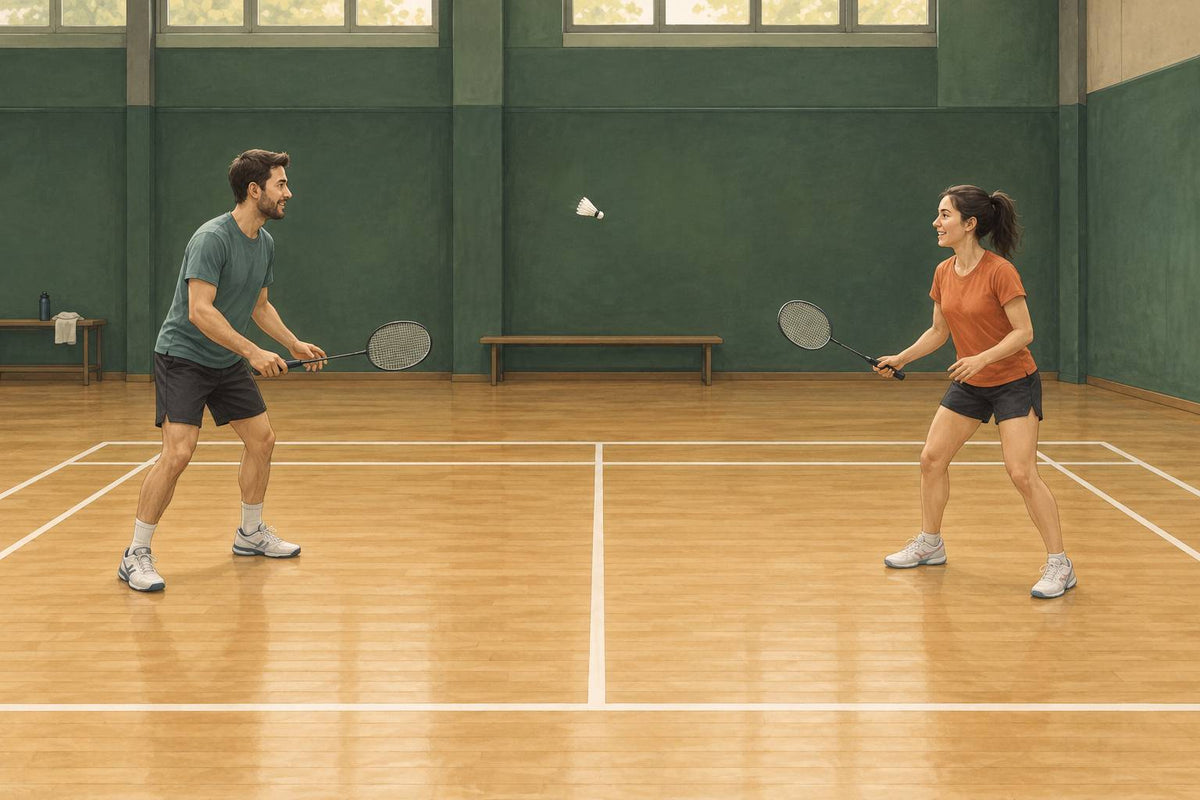
Centre boxes: two players, underhand-only, rally for a shared count. It is the simplest place to start.
Four players
One racket per pair: teammates alternate every hit, so each player has to call, move and recover.
Busy hall
Rotation loop: use two separated floor areas and a timed changeover to prevent a queue forming at one court.
A missing net removes a central part of badminton. BWF describes the sport as a net game on a rectangular court, and regulation net height is above 1.5 metres, so a floor line cannot stand in for net clearance or net shots. These are deliberately limited games for an indoor marked floor, a partner and a shuttle. Their job is to keep players moving and make useful contact while they wait for normal court time.
Keep the expectation clear: a net-free rally is practice, not a substitute for a match. For a normal session once a court opens, use this badminton practice session plan to turn court time into focused work.
When is a net-free game useful?
A net-free game is useful when players need a short indoor activity while nets, courts or coaching attention are limited. It works best as a clearly bounded six-to-ten-minute station, with low-to-medium pace and a marked no-crossing zone, rather than as an attempt to recreate full badminton.
The practical planning problem is familiar: a BWF Shuttle Time teachers’ manual kit example includes 24 rackets and four nets. That is enough equipment for a busy hall, but it can still leave groups waiting when every available net is in use. A marked side area gives the waiting pair a job, a shuttle and a time limit instead of another line behind a court.
Choose one boundary before the first serve: the centre line, a sideline lane or two non-adjacent marked areas. Keep every player on their own side of that boundary. A real court’s lines define areas under the BWF Laws of Badminton; here, use the visible lines only to make a simple shared agreement about space. Stop the activity if another group needs to cross the lane.
Six indoor games for a marked floor
These six Badminton House formats use a partner, a shuttle and existing indoor floor markings, with rules chosen to keep the shuttle low and the players separated. Start with the easiest version, make the shared target achievable, then change format instead of forcing a longer rally after control has gone.
1. Centre-box underhand rally
Setup: Put one player in each of two centre service boxes that meet at the centre line. Rules: only underhand pushes or lifts, no overhead action, and the shuttle must travel above the line without either player stepping over it. Count the pair’s longest rally, then restart. Players: two. What it trains: soft contact, watching the shuttle and a compact ready position. This is an original editorial game. Run two rounds of three minutes, then change partners.
2. Sideline forehand lane
Setup: Stand two players offset along the same sideline, facing one another across a narrow lane. Rules: each player may use forehand drives only, with the shuttle travelling through the lane and below shoulder height. If either player drifts into the lane, reset. Players: two. What it trains: a short forehand preparation and direction control. This is an original editorial game. Use a shared target of 12 clean contacts before increasing pace.
3. No-downward-shot points
Setup: Use a side-by-side strip of marked floor with one player at each end. Rules: start from behind a sideline with an underhand serve, then play to five points. Any downward shot, smash-like action or shot struck above shoulder height gives the point away. Players: two. What it trains: patience and a controllable upward flight. This is an original editorial game. The underhand opening echoes the BWF teaching description of rallies beginning with an underarm serve, but this scoring is not an official rule.
4. One-racket alternating rally
Setup: Make two pairs on opposite sides of a centre line. Each pair has one racket. Rules: teammates must alternate hits and pass the racket handle-first after every contact; a player without the racket calls “mine” or “yours.” Keep strokes underhand and stop on any rushed pass. Players: four. What it trains: calling, anticipation and recovery after contact. This is an original editorial game. Play a two-minute round, then change partners while keeping one racket with each pair.
5. Two-zone relay rally
Setup: Mark two non-adjacent areas with clear walking space between them. Two players rally in Zone A while two wait in Zone B. Rules: after eight successful contacts, everyone walks to the other zone and the waiting pair begins. No one runs through a live lane. Players: four. What it trains: organisation and quick readiness without crowding a single space. This is an original editorial game. Keep the eight-contact trigger if rallies are short; use 15 only when both pairs can control it.
6. Consecutive-contact challenge
Setup: Use any of the safe lanes above. Rules: do not award points against the other player. Instead, record the pair’s best uninterrupted contact count, with one point for each clean return. Players: two, or four taking turns after a set. What it trains: cooperative control and a reason to slow down. This is an original editorial game. Set a six-minute clock, note the best number, then let the pair decide whether a smaller lane or a faster pace is the next challenge.
Choose by the problem in front of you: use centre boxes when players keep reaching too far; use the sideline lane when they need a quieter forehand contact; use no-downward-shot points when the shuttle is being hit too hard for the space. The one-racket game is for a group that needs communication as much as contact. The two-zone relay is for a hall where a stationary group would block a walkway. The consecutive-contact challenge is for a pair that needs a success measure without turning every miss into an argument.
Do not stack restrictions. A player learning the centre-box rally does not also need a score target, a tiny landing area and a rapid changeover. Start with one rule that protects the space, then add one challenge only after the group can complete several calm exchanges. These are Badminton House editorial coaching choices, not a prescribed progression. The useful outcome is simple: every participant knows where to stand, what kind of shot is allowed and when the activity ends.
If a group reaches the target too easily, change only the shared target on the next round. If it cannot reach the target, widen the lane or lower the count. A clear adjustment keeps the game cooperative and makes the next attempt understandable.

How do you run the stations without making a queue?
Give each station one pair or one four-player group, one stated boundary and one short timer. The organiser should change activity before the group loses control, keep unused shuttles off the floor, and send players to a netted court as soon as it opens rather than extending a net-free game indefinitely.
A simple 20-minute block is four five-minute stations: centre boxes, sideline lane, one-racket alternating rally and consecutive-contact challenge. Use the first minute to demonstrate the boundary and the last 30 seconds for changeover. The doses are Badminton House editorial suggestions, so shorten them for beginners who are still learning to control the shuttle.
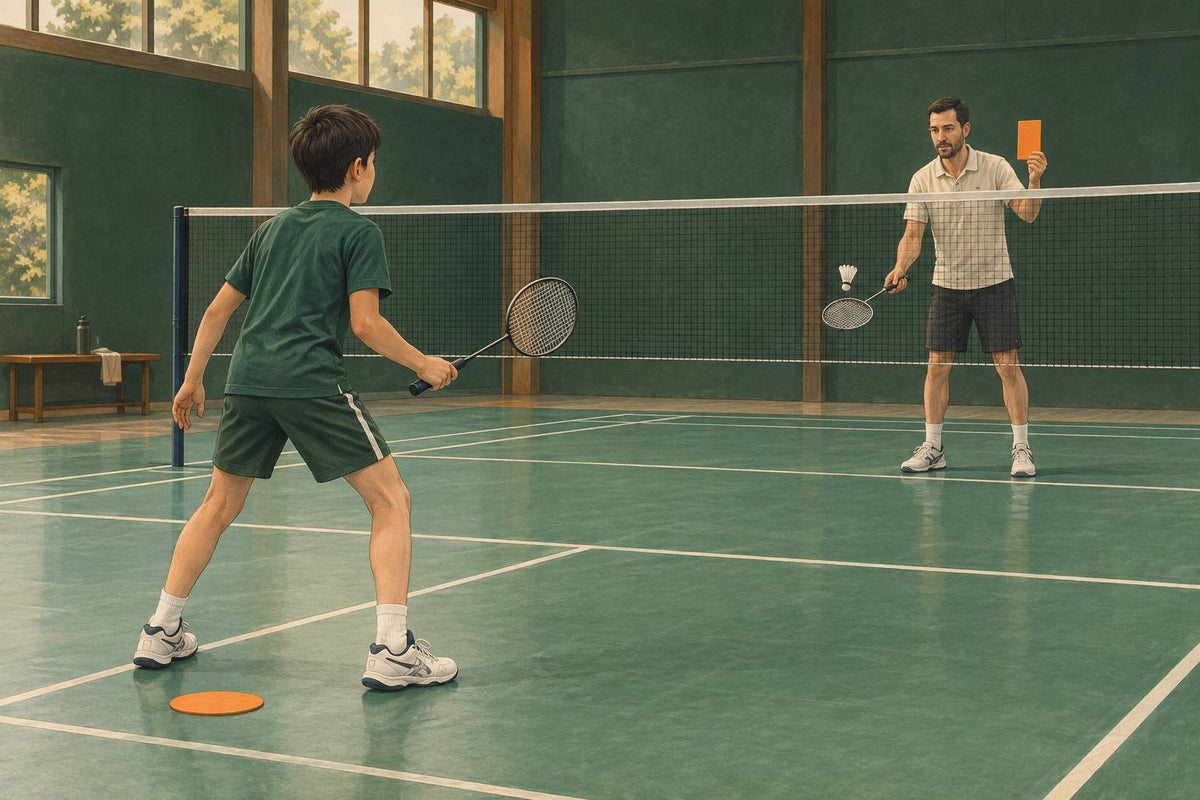
Keep the safety rule uncomplicated: low strokes, eyes up when walking, and no chasing a shuttle across another group’s lane. Never put a “net” activity where players will collide at a centre line. If you have space and suitable equipment, BWF’s schools manual notes that a rope or elastic cord can be tied across a hall as a net; that is a better progression than pretending a painted line gives the same challenge as a real barrier.
When a court becomes free, move from cooperative counts to a normal rally with a net. That is where you can practise clearance, service, net shots and the decisions that make badminton badminton. For players who need a partner-based warm-up before that transition, try the first-step drills for badminton guide.

Leave a comment
This site is protected by hCaptcha and the hCaptcha Privacy Policy and Terms of Service apply.