
Last checked: August 2026 · Written by the player-led team at Badminton House
Quick answer
Use a chassé for a short adjustment before or after a shot: one foot moves, the other follows without crossing, then you can take the final lunge or push back toward base. Do not try to chassé the length of a court.
Short gap
Chassé: travel a little, stay low, then arrive ready for the final step.
Long gap
Run: cover the distance first, then organise the final step near the shuttle.
Cross-behind
A different tool: the non-racket leg passes behind the racket leg. It is not the same as a chassé.
A recreational player often knows the destination but not the travel. They see a net shot, run at it, and take one last step that is too long. Or they shuffle sideways until the shuttle has already passed the useful contact point. The badminton chassé step fills the space between the split step and the final action. It is the small travel step that lets you judge the remaining distance instead of guessing it.
Start here: if the split step and lunge still feel unfamiliar, use the badminton footwork basics guide first. The chassé makes more sense when it has a start and an ending.
What the Chassé Step Does Between Split Step and Lunge
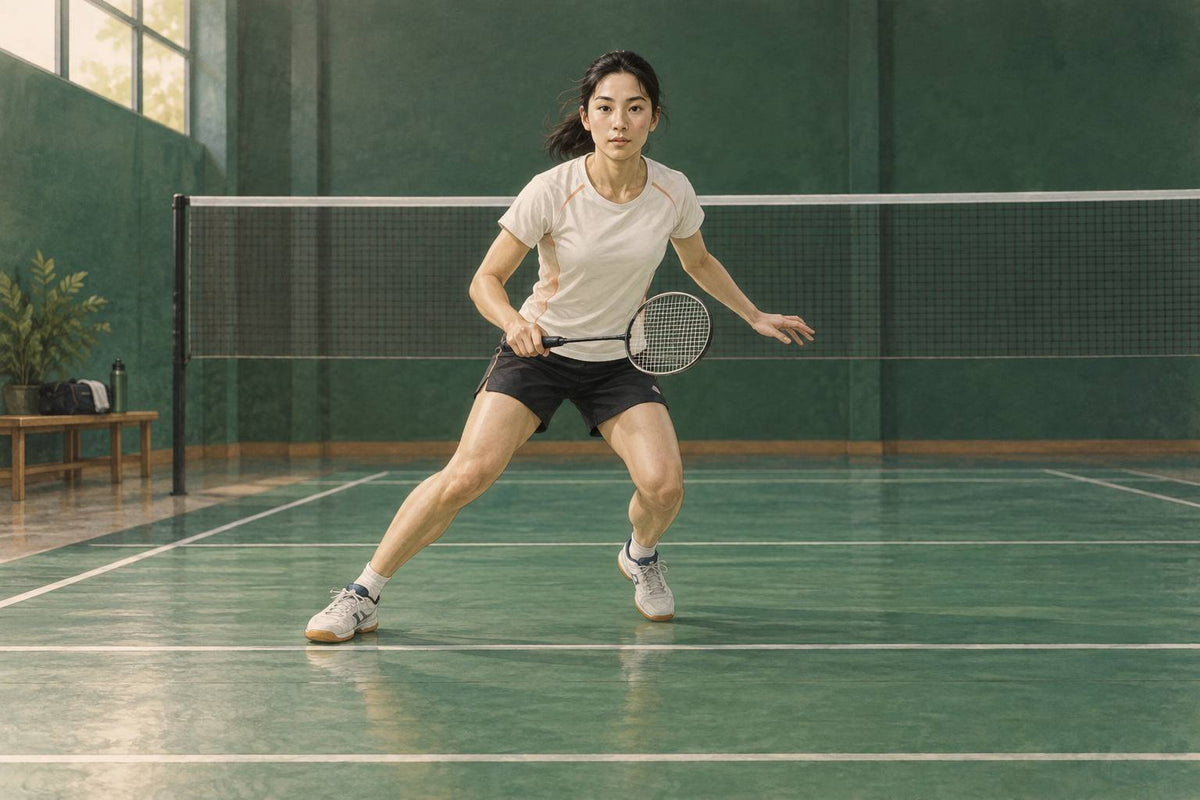
A chassé is short travel, not the shot itself. It starts after you have read the direction, carries you through a small gap, and leaves room for a final lunge, reach or recovery. The useful feeling is controlled arrival: your last step is chosen because you are close enough, not thrown out in panic.
The BWF Level 1 coaching manual puts the idea in plain language: one foot chases the other but never quite catches it. It also places chassé in both approach and recovery, which is a helpful correction for players who stop thinking about their feet as soon as they hit the shuttle.
Begin from a light split step. Move the foot toward the shuttle. Let the other foot follow in the same direction without stepping across it. Keep the follow-up compact, then decide whether one more small chassé is enough or whether the final action is now a lunge. Keep your feet separated at the finish instead of clicking them together. That gives you a usable base for the shot and the next push.
For a front-court lunge, aim the lead foot toward the shuttle and let the lead leg, knee and foot point in the same direction. Those are BWF's lunge cues, not a reason to force a long stride. If you arrive leaning beyond that front foot, the travel was probably too large for the time available. Reset the drill closer, then add distance only when the landing remains quiet and controlled.
There are three useful places to notice the step in an ordinary rally. On a net approach, it is the short travel before the final lunge. In flat defence, it is the low sideways adjustment that keeps you able to block or drive. In mid-court, it is the tiny correction that changes a cramped contact into one you can take in front of your body. The exact number of steps changes with the feed. The purpose does not: make the final action fit the shuttle.

Choose Chassé, Running or Cross-Behind by the Gap You Need to Cover
Choose the step from the remaining gap, not from a rule that one pattern is always correct. A chassé suits a small adjustment; running covers a long chase; cross-behind is a separate directional option. The aim is to arrive in time with enough control to play and recover, rather than forcing one pattern across every court distance.
| Situation | Choose | Cue | Missing-step sign |
|---|---|---|---|
| A short move into a net shot | Chassé, then lunge | Move, follow, then make the final stride toward the shuttle. | The last stride becomes a reach and your body keeps drifting forward. |
| Sideways defence or a mid-court correction | One or two chassés | Keep the head level and the steps low enough to reverse. | Your feet meet, cross, or bounce before you can hit. |
| A long diagonal or a shuttle already far away | Run, then organise | Cover the big distance first; use the last short step to set the shot. | You use many little shuffles and still arrive late. |
| A movement that needs the non-racket leg behind the racket leg | Cross-behind | Name it separately; do not call a crossing action a chassé. | The pattern feels tangled because two different steps are being mixed. |
This is the point that gets lost in the crossover debate. The BWF manual lists cross-behind separately, defining it as the non-racket leg passing behind the racket leg. A chassé is not a disguised crossover. It is a short movement with the feet following rather than crossing. Use that distinction to diagnose your own video: if the legs cross, you practised another tool.
Distance matters too. BWF says chassés normally happen singly or in pairs and specifically discourages using them for long court diagonals because that is slow. When the shuttle is far away, run to make up the distance. When you are almost there, a small chassé can help you stop arriving with one oversized final step.
Three Directional Chassé Progressions for Court Use
Build the chassé from a simple pattern into a response to a shuttle. Start where you can make the feet do exactly what you intend, then add direction, a final lunge and a feed. The doses below are editorial starting points; stop a set when the pattern turns into running, crossing or uncontrolled reaching.
1. Hall pattern: move without a shuttle
Editorial dose: 3 passes of 10 to 15 metres each direction, walking pace first, then a smooth faster pass. Choose a floor line. Make one chassé, pause in a ready stance, then repeat. Do parallel side steps on one pass and diagonal forward/backward travel on the next. BWF's schools material uses those directions and asks for flexed knees, a straight body and a head that stays at the same height.
Coach yourself with one cue: “move, follow, separate.” If your feet come together under you, shorten the travel. If you begin crossing, slow down and return to one direction. This drill is only a pattern rehearsal, so there is no prize for covering the whole hall in chassés.
Progression check: use a wall line or court line only as a direction guide, not as a distance target. You are ready to move on when the head does not bob up and down and you can stop in the same ready shape you started from. If the rhythm changes from a glide to several hurried steps, keep the distance shorter for another set.
2. Shadow: add the final action
Editorial dose: 2 sets of 6 repetitions to each front corner, then 2 sets of 6 sideways defensive adjustments. Start at base, split, use one small chassé and finish with a controlled lunge into the front corner. Return to base before the next repetition. For defence, split, take one or two lateral chassés, pause as if blocking a drive, then recover.
Coach yourself with one cue: leave a gap between the travel and the final action. The error is visible when the lunge becomes the only way you reach the corner, or when the torso tips past the front foot. Bring the imagined shuttle closer until you can land, hold the shape for a beat, and move back out.
3. Fed shuttles: make the step answer a real direction
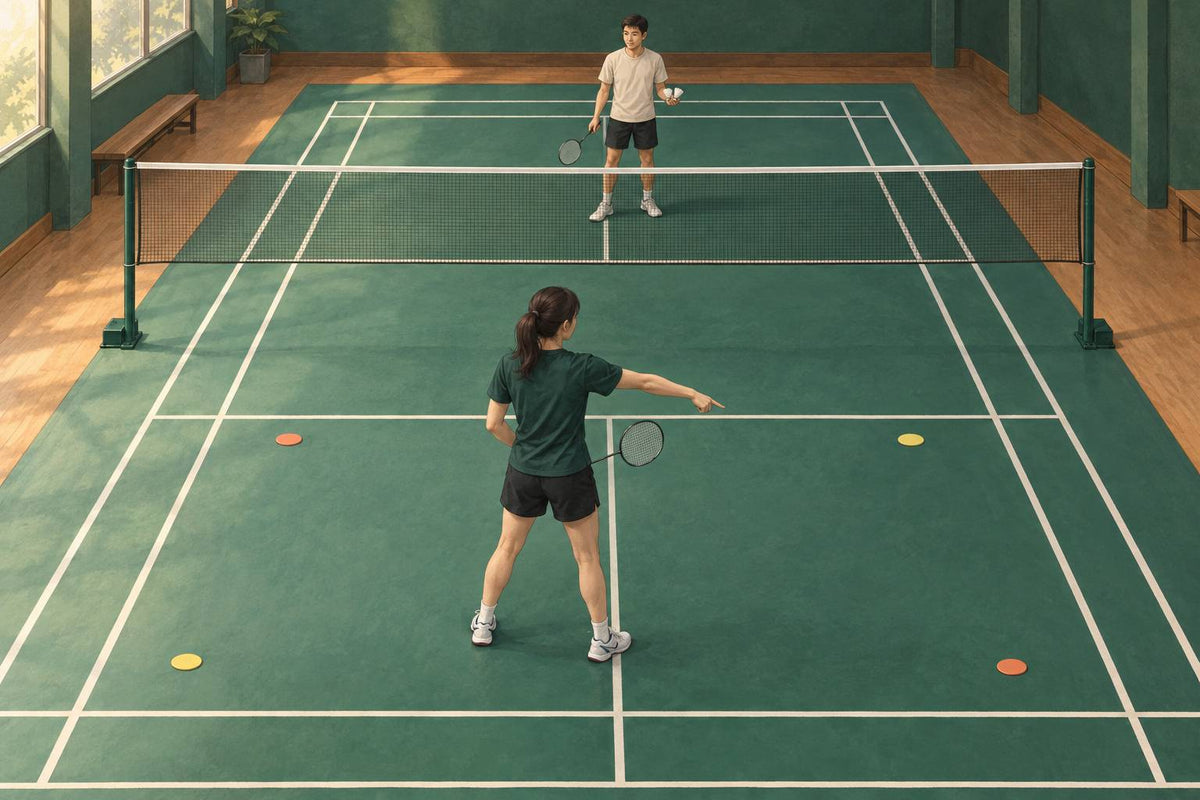
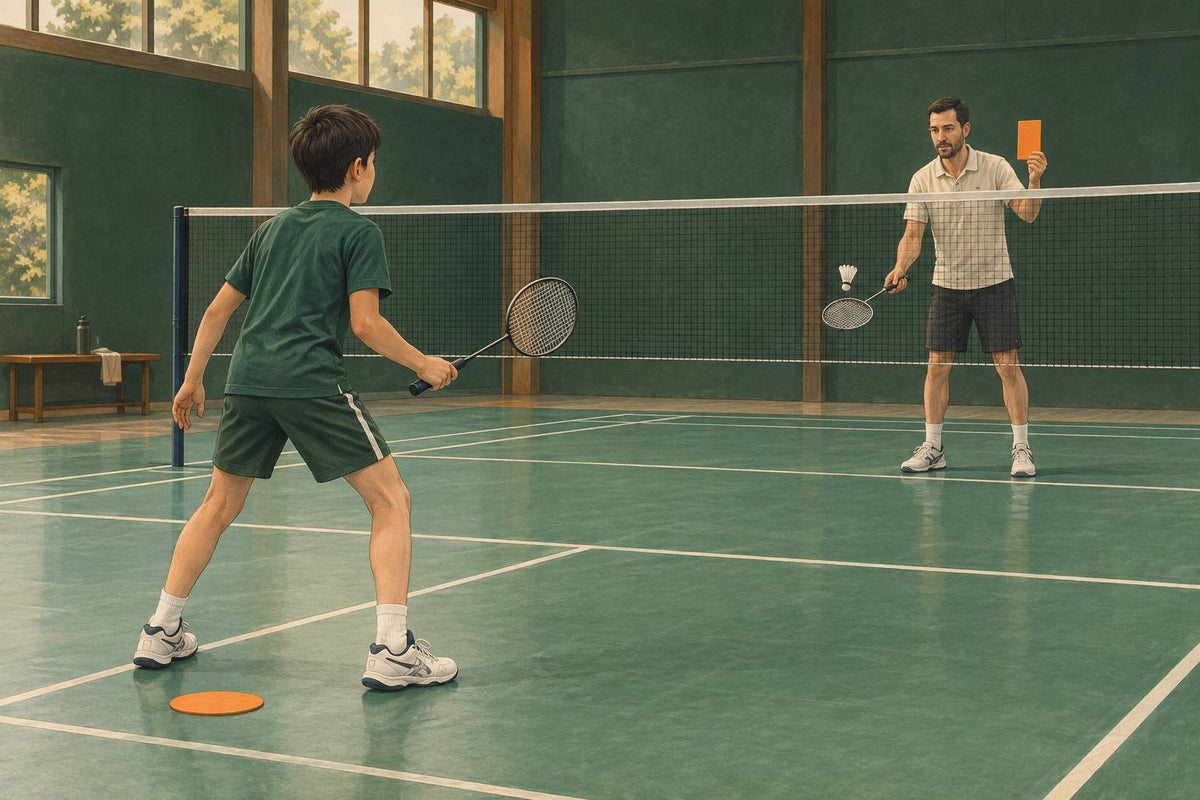
Editorial dose: 2 rounds of 8 feeds to one side, then change sides. Ask a partner to feed a predictable net shuttle first. Begin with one chassé and a lunge, play a gentle net return, and recover. Once the arrival stays controlled, alternate a net feed with a side feed so the player has to choose a short adjustment rather than rehearse it.
Coach yourself with one cue: hit only after the feet have organised the distance. BWF Shuttle Time uses pairs facing each other for its short-distance Mirror Chase, changing roles about every 30 to 40 seconds, then builds net-play work from pairs about three metres apart. Those Shuttle Time lesson plans are a useful reminder to progress from a visible pattern to a simple partner task before adding unpredictable rally pace.

Leave a comment
This site is protected by hCaptcha and the hCaptcha Privacy Policy and Terms of Service apply.