
Last checked: August 2026 · Written by the Badminton House player-led team.
Quick answer: which badminton court flooring is better?
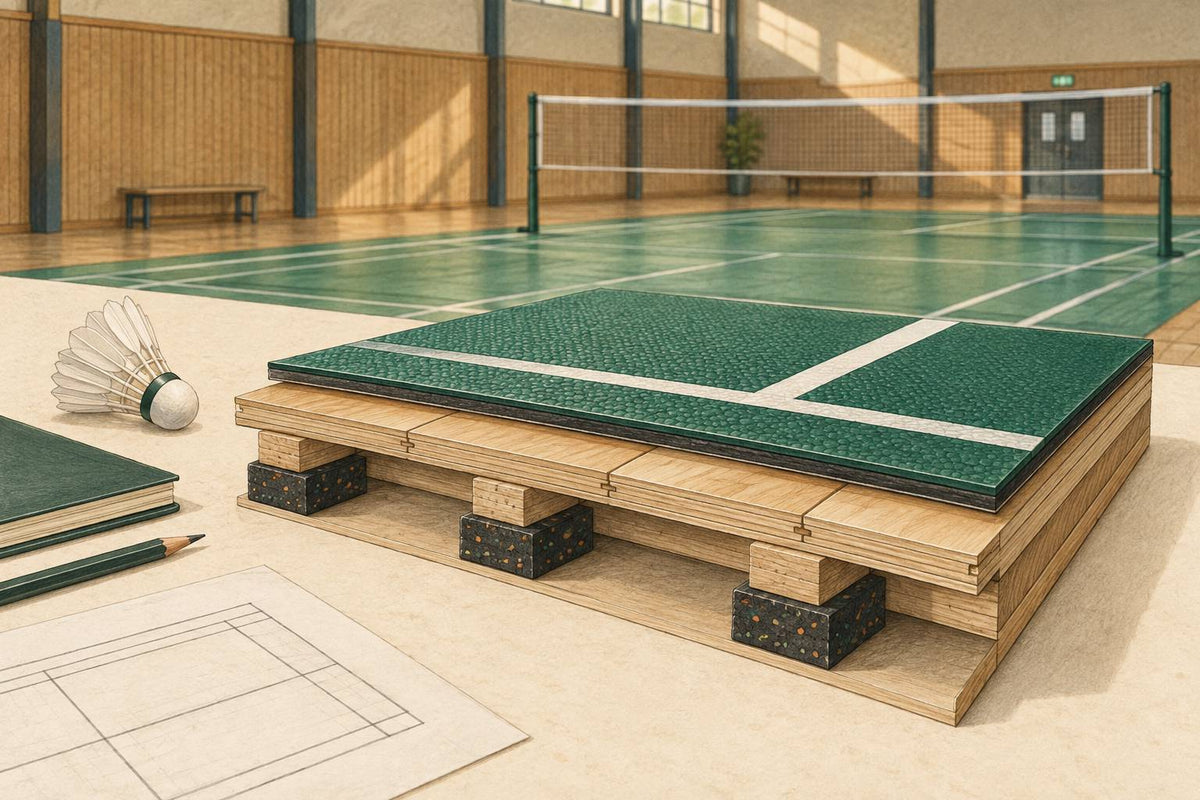
There is no universal winner because “wood” and “synthetic” describe only part of a floor system. A synthetic competition mat can sit on sprung wood. Compare the playing surface, supporting floor, measured friction and shock properties, installation and maintenance—not the top-layer name alone.
Reference
Sprung wood plus an approved badminton mat: the high-level arrangement described by BWF.
Synthetic
Permanent or portable systems vary; judge the exact product and its support.
Player check
Clean, dry, secure and predictable matters more than the label.
The court you see is not necessarily the floor that absorbs load. A roll-out synthetic mat may supply colour, markings and surface grip while the wood or other structure below supplies much of the system’s deformation. Conversely, a permanent multi-sport synthetic floor can be both the visible surface and part of the supporting construction.
This comparison is therefore about questions to ask, not a claim that one material prevents injury. Two wood courts can feel different, and two synthetic systems can test differently.
What flooring does the BWF use as its high-level baseline?
For international-standard facilities, the BWF facility specification describes approved badminton court mats supported by a wooden sprung floor or an equivalent subfloor. The visible competition mat and the supporting structure are separate parts of the reference arrangement.
That is a standard for high-level competition, not a rule that every school, community centre or recreational club must copy the exact build. It is useful because it stops the false choice between “mat” and “wood”: an elite system can deliberately use both.
The BWF flooring overview identifies friction, shock absorption and vertical deformation among the properties used to evaluate floors. It also recognizes permanent and portable installations. A club choosing a system should request those measured characteristics for the exact product and assembly instead of relying on a generic material description.
How do sprung wood and synthetic systems differ?
Sprung wood usually describes a supporting system designed to deform under load and recover. Synthetic can describe a roll-out badminton mat, a bonded surface or a permanent multi-sport floor. The practical difference depends on what sits below, how the surface is joined and how it is maintained.
| Question | Exposed sprung wood | Synthetic badminton mat or floor |
|---|---|---|
| Playing surface | Finished timber with painted court lines | Textured synthetic top layer, often with integrated lines |
| Support below | Sprung structure is part of the wood system | May be sprung wood, another compliant subfloor or a different permanent build |
| Installation | Normally permanent | Can be permanent, sectional or portable |
| Immediate concerns | Dust, finish condition, moisture and line confusion | Dust, moisture, residue, seam height, edge security and storage damage |
| Best evidence request | System specification and measured properties | Exact mat/floor specification plus the supporting subfloor and installation method |
A material category cannot tell you how a specific court feels. The top layer, underlay, support spacing, finish, age and installation all influence the complete result.

Why are grip and shock properties separate questions?
Friction describes how the shoe interacts with the playing surface. Shock absorption and vertical deformation describe how the system responds under load. A floor can feel grippy at the shoe while differing in how much the structure below deforms. Neither property should be guessed from colour or material name.
The BWF flooring approval questionnaire asks about a suitable non-slip badminton surface and practical testing, as well as the number of pieces, tools and ease of assembly. This shows why both the finished playing condition and the installation process matter.
One study of 15 youth futsal players compared one wood and one synthetic surface. The tested wood had greater shock absorption and vertical deformation, while plantar pressures did not differ significantly. It was a small futsal study, not badminton injury research. It cannot rank every wood floor above every synthetic floor; it illustrates why exact systems need measurement.
Related reading: If the immediate problem is traction, use our slippery badminton court checklist. Shoe construction also changes the interface; see badminton shoe midsoles explained.
What should a player check before stepping on court?
A certification document cannot tell you whether today’s court is wet, dusty or poorly laid. Walk the boundary before warming up and report a problem before the first fast lunge.
- Scan the whole route: look from the rear court through the forecourt for wet patches, dust, debris and residue.
- Inspect joins and edges: no seam, tape or mat edge should lift into the path of a shoe.
- Check consistency: a small controlled shoe-pressure check in several areas can reveal a slick patch; do not sprint-test a suspect floor.
- Confirm the lines: shared halls may have several sports marked. Identify the badminton boundary before play.
- Check clearance: posts, benches, wall padding and stored equipment must not intrude into normal run-off space.
If conditions change during play—condensation appears, a seam lifts or dust is carried onto the court—stop the rally and tell the organizer. Do not keep wiping shoe soles and assume the floor itself is safe.
What should a club or facility compare?
Start with the venue’s use case. A dedicated hall can support a permanent system and specialized maintenance. A school gym shared among several sports may need a durable permanent floor or a portable mat that can be installed, cleaned, rolled and stored repeatedly without damage.
- Measured performance: request friction, shock-absorption and vertical-deformation data for the exact assembly.
- Subfloor: record what supports the playing layer; do not evaluate the mat in isolation.
- Installation: count sections, joins, tools, staff time and the checks required before opening the court.
- Cleaning: follow product-specific methods and plan for dust, sweat, spills and adhesive residue.
- Storage and repair: protect portable rolls from distortion and define who can repair a seam, finish or damaged section.
- Inspection log: record recurring slick zones, edge problems and corrective work instead of relying on memory.
No floor can promise injury prevention or pain relief. If players repeatedly report discomfort or inconsistent traction, investigate the condition and complete system rather than assuming a new top-layer material alone will solve it.
The practical verdict
Sprung wood and synthetic mats are not automatic opposites. Choose a well-specified, securely installed and consistently maintained indoor system. For players, today’s clean, dry and predictable surface is the condition that matters first.



Leave a comment
This site is protected by hCaptcha and the hCaptcha Privacy Policy and Terms of Service apply.