
Last checked: August 2026 · Written by the Badminton House player-led team.
Quick answer: what is a badminton shuttlecock made of?
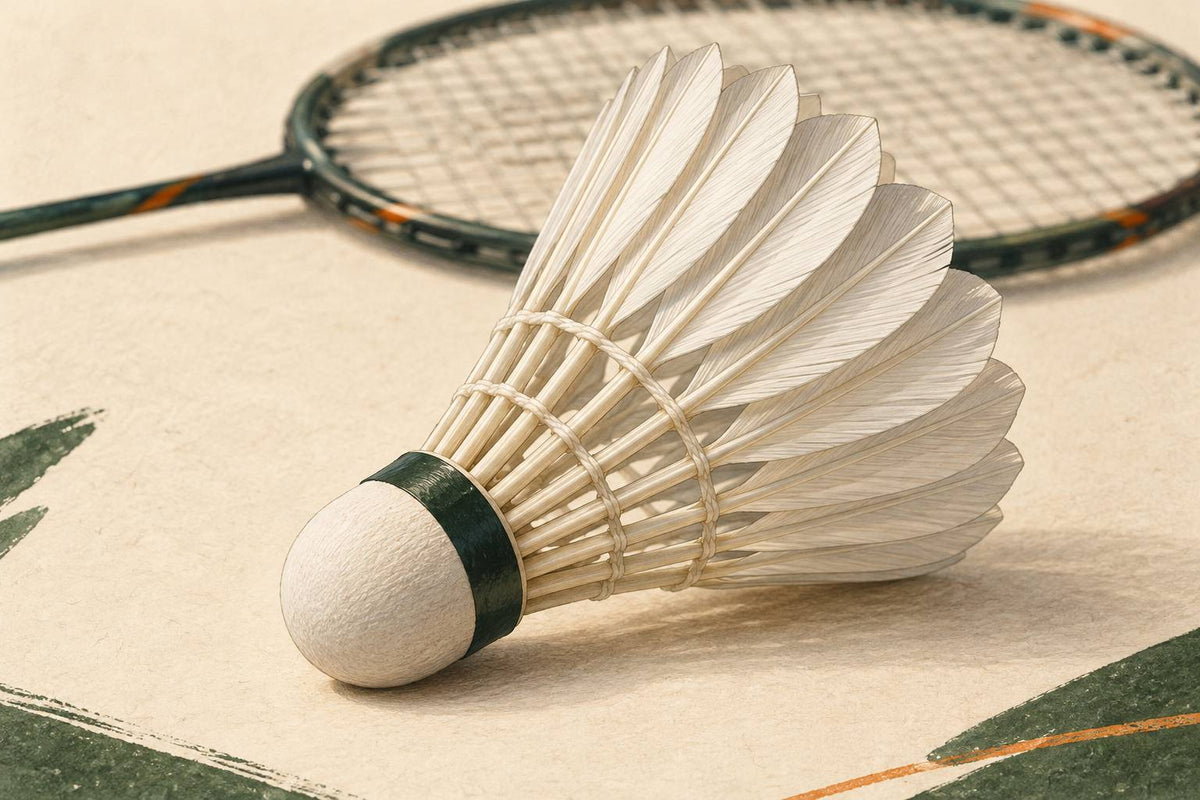
A shuttlecock combines a rounded, concentrated base with an open feather or synthetic skirt. The base is the impact point and leading mass. The broad skirt creates drag and helps the shuttle turn cork-first and remain stable. The parts work as one aerodynamic system.
Base
Cork or equivalent nose: the dense end struck by the strings.
Skirt
Sixteen feathers in a feathered shuttle, or a synthetic feather simulation.
Reference
A feathered shuttle weighs 4.74–5.50 g and has a 25–28 mm base.
A shuttlecock is not a ball with decorations attached. Its unusual flight comes from a deliberate mismatch: a small, heavy nose leads while a wide, light skirt trails behind and interacts strongly with the air. That is why a hard clear can leave the racket quickly, slow sharply and descend cork-first.
The Laws of Badminton allow natural or synthetic materials, provided the general flight characteristics resemble those of a natural feathered shuttle with a cork base. That legal similarity does not mean every model feels or lasts the same.
What does the cork base do?
The base is the rounded nose you aim to strike. In a traditional feathered shuttle, cork forms the base beneath a thin covering. It provides a concentrated impact region and places much of the shuttle’s mass ahead of the skirt.
An engineering analysis of shuttlecock behaviour describes the cork’s role in transferring racket energy while the feather structure supplies important aerodynamic behaviour. Neither part creates a shot by itself. String response, impact position, racket speed and the complete shuttle construction all influence the contact.
The BWF reference diameter for the rounded base of a feathered shuttle is 25–28 mm. That small target helps explain why clean contact matters, but the measurement is not a quality rating. Two legal shuttles can still differ in materials, consistency and playing feel.
Player cue: strike the rounded base, not the skirt. A framed contact that catches feathers is a contact error; it is not evidence that the shuttle’s anatomy is defective.
How do feathers and synthetic skirts differ?
A feathered shuttle has 16 feathers fixed into the base and tied into an open cone. A non-feathered shuttle replaces natural feathers with a synthetic skirt or another feather simulation. Both designs place a broad aerodynamic structure behind the base, but their exact materials and geometry are not identical.
The BWF shuttlecock overview applies the same general framework while allowing dimensional variation for non-feathered construction because synthetic materials behave differently. That allowance is not proof that every synthetic shuttle has the same speed, durability or flight as every feather shuttle.
The skirt presents far more area to the airflow than the base. It creates drag, which is why a shuttle loses speed more rapidly than a compact ball. The open gaps are not missing material: the shape, slots and spacing are functional parts of the aerodynamic design.
| Feature | Feathered shuttle | Non-feathered shuttle |
|---|---|---|
| Skirt material | Sixteen natural feathers | Synthetic skirt or feather simulation |
| Legal principle | Defines the natural reference shape | General flight should resemble the natural reference |
| Buying question | Exact grade, speed and consistency | Exact model, skirt construction, speed and intended use |
Compare specific models for the session you are running. Our synthetic feather shuttlecock guide looks more closely at that material category without pretending it is a single design.
What are the standard shuttlecock dimensions?
For a feathered shuttle, the Laws and BWF overview provide a compact reference envelope. The feathers in a given shuttle have a uniform length within the 62–70 mm range, their tips form a defined circle and the total shuttle remains very light.
| Part | BWF reference | What it describes |
|---|---|---|
| Feathers | 16 | The elements forming the open skirt |
| Feather length | 62–70 mm | Distance from tip to top of the base |
| Tip circle | 58–68 mm diameter | The outer opening formed by feather tips |
| Base | 25–28 mm diameter | The rounded nose and impact region |
| Total mass | 4.74–5.50 g | The reference mass range for the complete shuttle |
Those values define legal geometry; they do not tell you whether a particular speed is right for your hall. Temperature, altitude and the exact model still affect the practical choice. Use an on-court test instead of trying to infer flight from weight or skirt colour alone.

Why does a shuttle turn and stabilize cork-first?
A shuttle can leave the strings at an angle. The concentrated base leads while airflow acts strongly on the skirt behind it. If the skirt is displaced sideways from the direction of travel, aerodynamic forces create a correcting tendency that turns the shuttle toward a nose-first orientation.
A wind-tunnel study of feather shuttles just after impact found passive pitch stability and connected the result to gaps between skirt slots and feathers. The open structure is therefore part of the stabilizing system, not merely a way to reduce weight.
This does not mean every shuttle flips at exactly the same rate. Skirt geometry, material, model, speed and damage can affect the observed response. The study explains a mechanism in tested feather shuttles; it is not a guarantee for every synthetic or worn shuttle.
For a deeper flight explanation, see why shuttlecocks fly cork-first and spin.
How should you inspect a used shuttle?
Inspect shape and flight together. Appearance can identify obvious damage, but it cannot quantify how much the trajectory has changed. Compare the shuttle with an intact one of the same model and speed.
- Base: look for cracking, severe flattening, looseness or a covering that has separated.
- Skirt circle: sight down the opening and check whether one feather or section sits far outside the cone.
- Feather shafts or synthetic ribs: identify breaks, splits and loose attachments rather than smoothing them out by force.
- Bindings and joins: check whether the structure remains secure around the skirt.
- Controlled flight: if the session permits, compare a normal clear or shuttle-speed test with an intact reference.
Retire an inconsistent shuttle from match play before it becomes an argument. A worn shuttle may still serve a low-demand feeding drill if its base and structure are secure, but label or separate it so it is not returned to the match tube. Do not attempt repairs that leave loose parts or unpredictable flight.
To choose the right speed, continue with our nylon shuttle speed-colour guide or the BWF-style on-court shuttle speed test.
The anatomy in one sentence
The base supplies the impact point and leading mass; the feather or synthetic skirt supplies drag and passive stability. Legal dimensions define the reference shape, while the exact model, hall and condition decide how the shuttle plays.

Leave a comment
This site is protected by hCaptcha and the hCaptcha Privacy Policy and Terms of Service apply.