
Last updated: July 2026 · Written by the team at Badminton House
Quick Answer: Attack-to-Defense Rotation
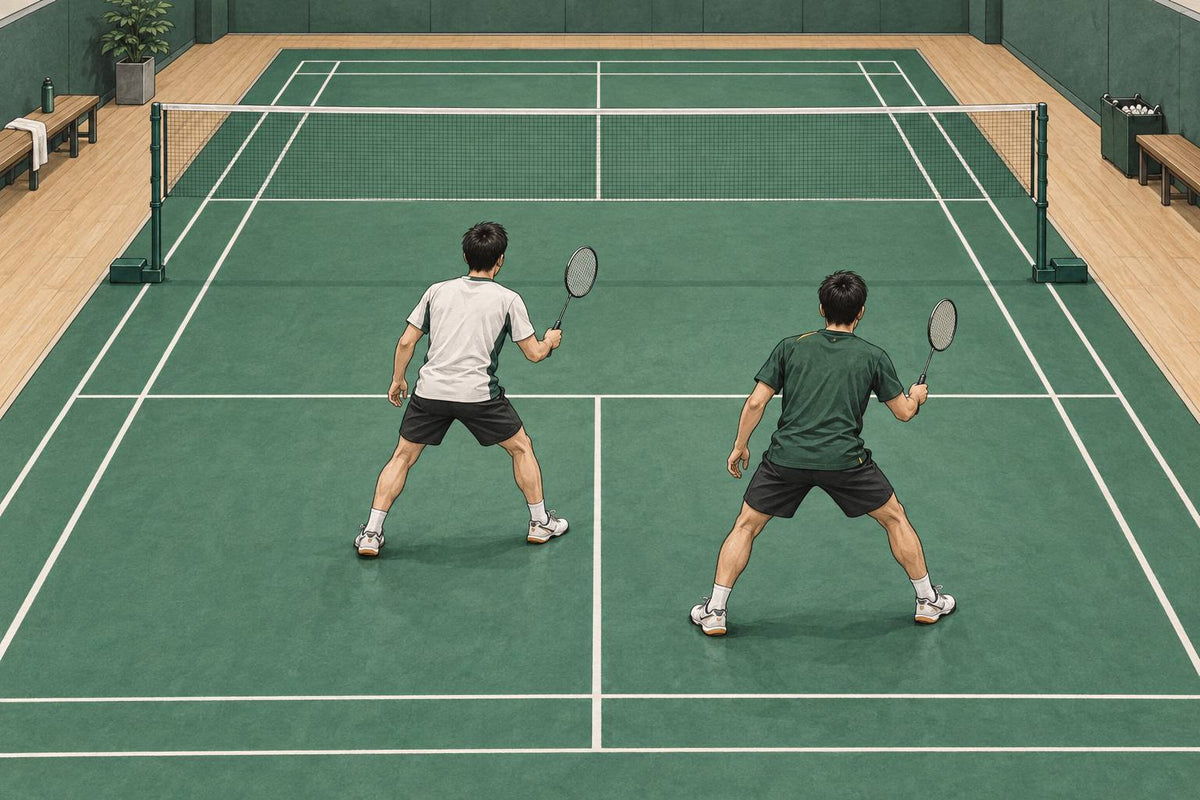
Use the lift as the trigger, not a clockwise rule. The front player retreats along their half while the rear player balances the open half. Both shade toward the lifted corner and finish side-by-side, settled with rackets raised, before the opponent contacts the shuttle.
Any Lift
Default rule: front retreats while rear balances into side-by-side.
Straight Lift
Recover quickly because the attacker is usually already set.
Cross-Court Lift
Recover slightly shorter while the partner covers straight attack and middle drop.
Your pair usually loses the rally in the moment after the lift, not during the smash. If one player lifts and both of you hesitate, the attack has already changed hands while your feet are still arranged for front-and-back pressure. The fix is not a memorized clockwise rotation; it is a shared trigger: lift, release the net, split to defend, and be balanced before the opponent contacts the shuttle.
For broader formation basics, see our doubles positioning and rotation guide.
In This Guide
The Lift Is the Trigger, Not a Clockwise Pattern
In badminton doubles attack-to-defense rotation, the change starts the instant your pair lifts. Until then, you are trying to keep downward pressure; once you are forced to send the shuttle up, that pressure belongs to the opponents and both players must move into a defensive base.
This is not a slow clockwise exchange where one player waits for the other to finish moving. The lifter and partner should react together: slide, retreat, and split before the opponent strikes. If you lift and stay front-back, the front player is left too close to the smash path with poor reaction angles, and even a brief open-court gap is enough for strong opponents to punish.
Front Player Retreats, Rear Player Balances
After the lift, do not think “clockwise rotation.” Think current positions. The front player often starts the move because they cannot safely look back to check where their partner is. If the front player has just lifted from the forecourt, they normally retreat straight backward into that defensive half. If the lift comes from the middle, the lifter usually recovers to the side they started on rather than drifting across and stealing their partner’s lane.
The rear player’s job is to balance what they can see. If the front player retreats left, the rear player fills right; if the front player retreats right, the rear player fills left. The worst outcome is staying front-back after lifting: the front player is left near the net facing a smash with almost no reaction angle. Use short calls early — “back,” “mine,” “yours,” or “middle” — so both players do not chase the same mid-court zone while the other half opens up.

Straight vs Cross-Court Lift: Set a Staggered Base
Do not defend from a permanent left/right assignment. The corner you lift to becomes the cue: both players shade toward that side because the straight attacking reply is usually the fastest line back at you.
- Straight lift: the attacker has less court to move before continuing downward pressure, so the lifter must recover quickly into the lifted-side defensive base.
- Cross-court lift: the attacker has to travel across court, which can shorten the lifter’s recovery distance, but your pair still shifts toward the lifted corner.
- Avoid lifting to the middle: prefer a corner when you can do so safely. A middle lift can let the attackers set up a strong central smash and reduce your counter-attacking angles.
Against a likely cross-court attack, stagger the base: the straight-across defender stands nearer the tramline, while the crosscourt defender shades slightly closer to centre and one step nearer the net to cover the slower cross smash or drop.
Drill It: Lift, Split, Be Set Before Contact
Train this instant away from match play. The rally is usually too fast to fix the transition, so isolate the lift, the retreat, and the split until both players move without discussion.
- No shuttle: start in front-back attack shape. One player calls “lift.” The front player retreats on the correct lane, the rear player balances across, and both finish side-by-side before an imaginary opponent would hit.
- Feed version: feeder gives a loose net shuttle or mid-court pickup. The pair lifts to a corner, calls “mine” or “yours” if needed, then freezes in defensive ready position before the feeder next contacts the same shuttle.
Score only the timing: one point if both players split and settle before contact, zero if either player is still drifting. After the defensive block or drive, your next formation depends on the quality of that reply, not on wanting to attack again.
Why Did the Transition Fail?
Use the first smash as feedback. Its landing lane tells you which part of the transition broke, so correct one movement instead of changing the whole rotation.
| What happened | Likely fault | One correction |
|---|---|---|
| Front player is still near the T at contact | The pair waited to see the opponent's shot before releasing the attack shape. | Start the retreat when the lift leaves your strings, not when the opponent begins the swing. |
| Both players arrive in the same half | The front player crossed the partner's sightline, or the rear player failed to balance the visible retreat. | Front player keeps the starting-side lane; rear player fills the opposite half. |
| Both players are split but still moving | The first step was late or too large, so neither defender can split-step for the smash. | Shorten the retreat and rehearse freezing before the feeder's next contact. |
The check is binary: at opponent contact, each player owns a half and is balanced enough to move again.
Get 10% off your first order
Join the Badminton House list and we’ll email you a 10% welcome code — plus training guides, technique advice, and badminton updates.
By subscribing, you agree to receive Badminton House emails and can unsubscribe anytime.
Good doubles defence is a shared habit: lift, split, and arrive balanced before the smash is hit.
Need quicker handling for defensive blocks and drives?
Explore Badminton RacketsCompare racket options for speed, control, and doubles defence.

Leave a comment
This site is protected by hCaptcha and the hCaptcha Privacy Policy and Terms of Service apply.