
Last updated: July 2026 · Written by the team at Badminton House
Quick Answer: Badminton Doubles Positioning
Aim to keep the attack in front-back formation when your pair can hit downward, switch to side-by-side defence after a lift, and rotate by following the shuttle.
Attack
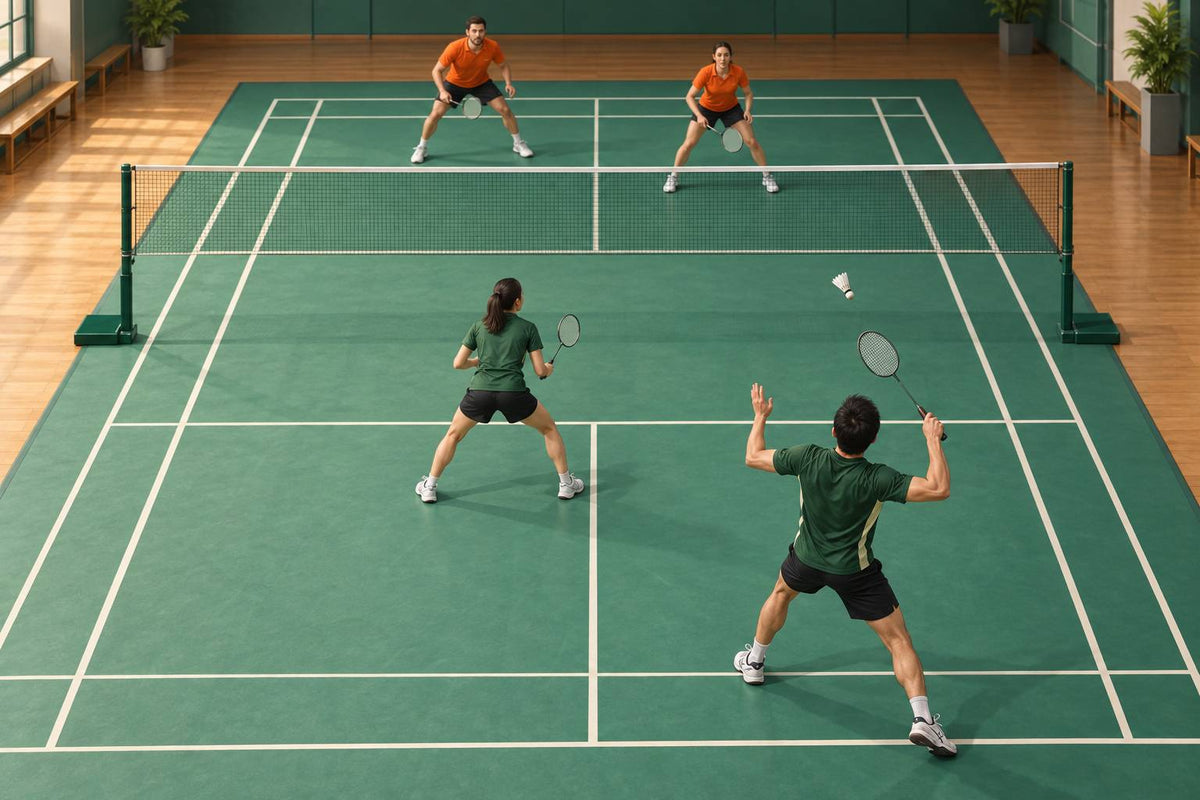
Best choice: use front-back positioning when your team is hitting down with a smash, drop, or offensive drive, with one player pressuring the net and one covering the rear court.
Defend
Move into side-by-side defence when your team lifts or gives opponents a clear attacking chance, so both players can cover fast smashes, drives, and angles.
Rotate
Rotate when someone is pulled forward: if the rear player is drawn into midcourt and plays a drop or soft block, they continue in to the net while the partner rotates behind to cover the back.
If your doubles games feel chaotic, the problem usually is not effort. It is positioning. One player smashes and stays planted, the net player drifts into the same lane, or both partners hesitate because nobody knows who should take the next shuttle.
Badminton doubles positioning becomes much easier once you understand the two main shapes: front-back attack and side-by-side defence. The pair hitting downward has the initiative; the pair that lifts usually has to defend. From there, rotation is less about memorizing a fixed spot and more about moving with the shuttle so one player attacks the next shot while the other covers the open space.
This guide breaks down doubles rotation in plain language for Canadian club nights, leagues, lessons, and drop-in play: when to attack, when to defend, how to follow the shuttle, and what simple communication cues keep both partners from ending up in the same zone.
Dial in your doubles setup. If your role is changing between rear-court attack and fast defensive exchanges, browse our badminton rackets collection while you use this guide to understand what your game actually needs.
In This Guide
- What are the two doubles formations?
- How does front-back attacking positioning work?
- When should you switch into side-by-side defence?
- What is the core rotation rule? Follow the shuttle
- How do you turn defence back into attack?
- Communication cues and common rotation mistakes
- Gear notes for doubles roles in Canada
- Badminton doubles positioning: which formation should you choose?
What are the two doubles formations? Front-back attack and side-by-side defence

Most badminton doubles positioning comes back to two shapes: front-back when your pair is attacking, and side-by-side when your pair is defending. If you can recognize which shape the rally needs, rotation becomes much less random.
The simplest way to read it is this: the pair hitting downward has the initiative; the pair that lifts is on defence. A smash, attacking drop, or offensive drive usually lets your team stay in a front-and-back attacking shape. A lift or clear usually gives the opponents the chance to hit down, so your team should prepare to defend side by side.
| Formation | Use it when | What each player covers |
|---|---|---|
| Front-back attack | Your side is hitting downward or applying pressure. | One player controls the net area while the other pressures from the rear court. |
| Side-by-side defence | Your side has lifted or the opponents are in position to attack. | Both players split the court width so they can cover fast smashes, drives, and cross-court pressure. |
Quick positioning check
- Did your team force a lift? Move into or maintain front-back attack.
- Did your team lift? Recover into side-by-side defence.
- Are you unsure? Ask: who can hit downward next? That usually tells you which pair has the initiative.
If you want the broader difference between singles court coverage and doubles court coverage, read Badminton Singles vs Doubles: Strategy & Gear in Canada. This guide stays focused on doubles positioning and how the two-player shape changes during a rally.
How does front-back attacking positioning work?
Front-back is the attacking shape in badminton doubles positioning: one player controls the net area while the other attacks from the rear court. Your pair normally moves into this setup when your side hits a downward shot — a smash, drop, or offensive drive — that makes the opponents lift or play upward.
The idea is simple: the back player keeps applying pressure from behind, and the front player waits to intercept the weak reply before the opponents can reset the rally.
The attacking clue: if your side is hitting down, you usually want front-back. If your side lifts, you have usually given up the attack and need to prepare to defend.
Where the two players should stand
- Back player: covers the rear court and keeps attacking with smashes, drops, or offensive drives when the shuttle is high enough.
- Front player: stands slightly behind the service line, ready to intercept the next shot at the net.
- Front player’s side bias: shift toward the attacker’s side. If your partner attacks from the right, shade to the right; if your partner attacks from the left, shade to the left.
That small side shift matters because most fast replies come back near the direction of the attack. The front player should not stand frozen in the centre as if guarding both halves equally; they support the back player’s angle and close the most dangerous gap first.
The smash rule: hitter stays back, partner takes the net
After a smash, do not automatically rotate. The hitter stays at the back and the partner covers the net, so your pair remains in front-back attack. This keeps the smasher available for the next lift and keeps the front player in position to finish blocks, loose net replies, or short defensive shots.
| Your shot | Best positioning response | Why it works |
|---|---|---|
| Smash from the back | Smasher stays back; partner stays slightly behind the service line | You keep the attack and are ready for either another lift or a short block. |
| Drop shot from the back | Back player may follow the shuttle forward; partner rotates behind if needed | Following the shuttle closes the net space and keeps pressure on the opponents. |
| Offensive drive | Maintain attacking pressure and adjust together toward the shuttle side | A flat, attacking drive can still force a lift or rushed reply. |
If the rear-court role is a big part of your game, a power-oriented racket can help, while the front player often benefits from faster handling for quick exchanges. For more on that gear tradeoff, see our head-heavy vs head-light racket guide or browse current badminton rackets.
When should you switch into side-by-side defence?
The cleanest trigger is simple: after your team hits a clear, switch into side-by-side defence. In doubles, the pair hitting downward has the initiative; the pair that lifts or clears has usually given up the attack. Once your shuttle travels high and deep, expect the opponents to hit down with a smash, drop, or attacking drive.
That means both players should stop thinking “front player/back player” and reset into a left-right defensive shape. One player protects one half of the court, the other protects the other half, so you are not asking one person to cover the full width of a doubles court while the shuttle is coming back faster.
Quick rule
If your shot gives the opponents a chance to attack downward, recover side-by-side first. You can rebuild the attack on the next low block, drive, or net shot.
| Trigger | What it means | Your positioning response |
|---|---|---|
| Your team clears | You have given up the front-back attack and the opponents may hit downward. | Both players recover into side-by-side defence and share the court width. |
| Opponents are ready to attack from the sides | A front-back shape can leave a wide channel exposed. | Shift into side-by-side coverage so neither sideline is abandoned. |
| Cross-court threat appears | If one opponent is poised to hit cross-court while your partner is still near the net, the far side can open up quickly. | Recover beside your partner instead of staying stacked front-back. |
The big mistake is staying in attack formation after the rally has changed. If your partner clears and you remain tight to the net, your team may have two players covering the front/back channel while the opponents attack into the wider spaces. If you clear and stand still at the back, your partner has to guess whether to retreat or hold the net. In both cases, the problem is the same: the team has not moved after the shot.
Side-by-side defence is not passive. It is a temporary safety shape that buys you coverage until you can turn the rally again. A good low block or tight net reply can force the opponents to lift or net, which lets your pair rotate back toward the front-back attack covered in the next part of this guide.
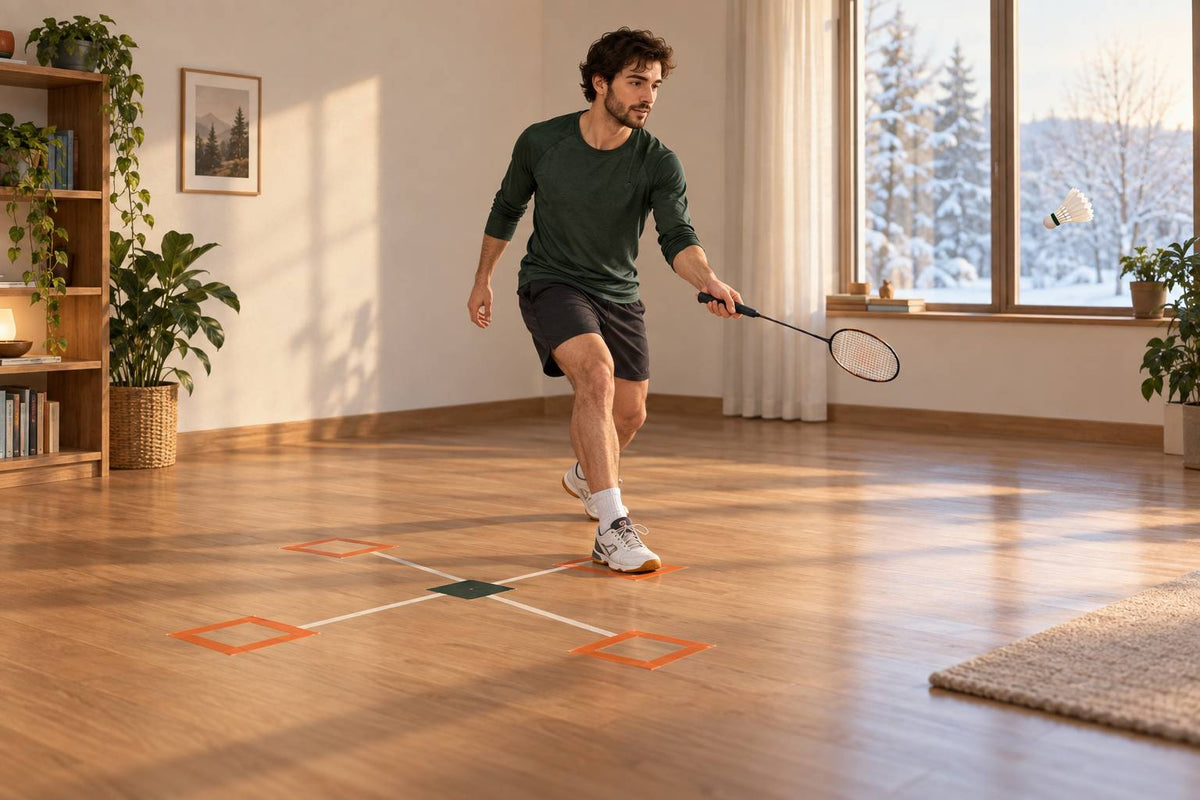
For players working on this at Canadian club nights or drop-ins, the key is the first recovery step after your own shot. If your footwork is late, the formation will be late too. Build that habit with badminton footwork basics and sharper change-of-direction work from our agility ladder and cone drills.
What is the core rotation rule in doubles? Follow the shuttle

The simplest rule for badminton doubles positioning is this: follow the shuttle when your shot changes the shape of the rally. In doubles, many beginners hit a shot and stand still. That leaves gaps. After every shot, ask: did we keep the attack, give up the attack, or create a chance to rotate?
The clearest example is the soft shot you play while being drawn forward. If you are the back player and you are pulled into midcourt to play a drop or block, continue forward with it and become the front player. Your partner rotates behind you to cover the back court. After a fast drop hit from deep in the rear court, stay back instead and let your front player hunt the reply. That keeps pressure at the net while still protecting the rear court if the opponents lift.
Beginner cue: Do not admire your shot. In doubles, the shot is only half the job; the recovery and rotation decide whether your partner has a court to cover.
The drop-shot rotation, step by step
- You are at the back. Your partner is in front, ready to intercept.
- You are drawn forward and play a drop. Because you are already moving in and the shuttle is short, you continue forward behind it.
- You take the front-court role. Your job is now to threaten the net and the next loose reply.
- Your partner rotates behind you. They cover the rear court in case the opponents lift or drive the shuttle past you.
This is why the rule is called “follow the shuttle.” The player who is already moving forward with their soft shot follows it in. The partner does not stay glued to the net; they read the rotation and fill the open zone behind.
| Back player’s shot | Rotation | Why it works |
|---|---|---|
| Drop shot | Hitter drawn forward continues in; partner rotates behind. After a deep fast drop, the hitter stays back. | Keeps net pressure while covering the back if the opponents lift. |
| Smash | Hitter stays at the back; partner covers the net. | The team stays in front-back attack because the shot is downward. |
| Clear | Both players move into side-by-side defence. | Your team has given up the attack, so both players need to defend the wider court. |
Think in pairs, not as two singles players
Good doubles rotation is not two players chasing the same shuttle. One player moves toward the likely next shot, and the other covers the open zone. That matters because a doubles court is 6.1 m wide versus 5.18 m for singles, and reaction time is shorter; one player cannot reliably cover that width alone.
A helpful mental model is: shuttle forward, one player forward; space behind, partner covers behind. If both players drift into the same zone, the opposite space opens. If both players wait because they are unsure, the next shot usually feels faster than it should.
A simple practice pattern
Try this with a partner at club night:
- Start in front-back attack.
- Rear player is drawn forward, plays a midcourt drop, and continues in immediately.
- Front player calls “switch” or “mine” and rotates behind.
- If the next reply is lifted, the new back player attacks and the new front player holds the net.
- If a clear is played, both players reset side-by-side to defend.
If the movement feels late, work on the footwork first. The basics in Badminton Footwork Basics and the touch details in Badminton Drop Shot Technique pair well with this rotation pattern.
How do you turn defence back into attack?
Good doubles defence is not only about surviving smashes. The real goal is to play one shot that stops the opponents hitting down, then rotate back into the front-back attacking shape.

The simplest way to do that is a soft block or tight net shot from your side-by-side defensive position. If you keep the shuttle low and close to the net, the opponent is often forced to lift or play another net shot. A lift gives your pair the chance to attack; a weak net reply gives your front player a chance to take control.
Key idea: defence becomes attack when your shot makes the opponents hit upward. Once they lift, your pair should move out of side-by-side defence and rebuild the front-back attacking formation.
The defence-to-attack sequence
| Your defensive shot | Likely opponent reply | Your rotation |
|---|---|---|
| Soft block to the net | Lift or another net shot | The player who moves forward pressures the net; the partner starts covering behind. |
| Tight net shot after defending a drop | Lift, tumble net reply, or loose push | Step in to threaten the next net shot; your partner prepares to attack any lift. |
| Defensive clear | Opponent keeps the attack | Stay side-by-side and defend again; you have not regained the initiative yet. |
Who moves forward?
Use the same “follow the shuttle” logic from attacking rotation. If you are the defender who plays the block or tight net shot, you are usually the player moving forward to apply pressure. Your partner should read that movement and rotate behind you, ready for the lift.
That rotation only works if you move immediately after contact. Do not pause in the middle and watch whether your block was pretty. Recover toward the shuttle, show your partner where you are going, and make the next court coverage decision early.
- If the opponent lifts: your partner can take the rear-court attack while you hold the front.
- If the opponent nets back: the forward player stays engaged and looks to take the shuttle early.
- If the opponent drives past you: communicate quickly and reset coverage so both players do not end up in the same zone.
For the shot skill itself, spend time on a reliable soft touch: a low block, a controlled net shot, and a drop-shot recovery pattern. These pair well with the technique work in our badminton net shot guide and drop shot technique guide.
Shop Babolat Shadow Tour Shoes
Fast lateral pushes matter in doubles defence · Free Canadian shipping · 14-day returns
Communication cues and common rotation mistakes
Good doubles rotation feels fast, but it should not feel silent. Short, early calls help your partner know whether you are holding the net, preparing for a flick serve, covering a cross-court reply, or leaving the shuttle for them.
Simple calls to use with your partner
- Before serve: “I’m taking net” tells your partner you are ready to step forward and control the front court after a low serve or attacking return.
- Before serve: “Watch the flick” reminds the rear player to be ready if the serve or return goes over the front player.
- During rallies: “Yours!” is for shuttles between both players, especially when hesitation would leave the shuttle dropping in the middle.
- During attack: “Cross” warns your partner that the opponents may reply cross-court, so the front player and rear player can shift with the shuttle instead of freezing in place.
- Between points: use quick check-ins like “I’ll cover the flick,” “stay a step wider on defence,” or “I’ll follow the next drop” so the adjustment happens before the rally starts.
Keep the calls short. In doubles, the court is wider and reaction time is reduced, so the goal is not a conversation during the rally — it is one clear cue that helps both players cover the next zone.
Mistake 1: both players end up in the same zone
This is the classic doubles breakdown: both players chase the same shuttle, both drift to the same side, or both move forward after a soft shot. The result is an open space somewhere else on the court.
- What it looks like: two players shoulder-to-shoulder in the mid-court, while the opposite rear corner or front corner is empty.
- Why it happens: both players react to the shuttle without checking the partner’s position.
- Fix: if your partner moves toward the shuttle, you cover the open zone behind or beside them. Think “one hits, one protects the gap.”
Mistake 2: rotating at the wrong time
Rotation should follow the rally situation, not a pre-planned pattern. If your team hits down, you can usually stay in or move toward attack. If your team lifts or clears, you have given up the attack and should recover into side-by-side defence.
- After a smash: the hitter normally stays at the back and the partner covers the net, so the pair stays in front-back attack.
- After a clear: both players should recover into side-by-side defence because the opponents can attack downward.
- After being drawn into midcourt for a soft drop: the hitter can follow the shuttle forward, while the partner rotates behind to cover the back.
Practice cue: after every shot, ask “did we hit down or lift?” If you hit down, organize for attack. If you lifted, split side-by-side and defend first. For the footwork base behind those movements, see our badminton footwork basics guide.
Gear notes for doubles roles in Canada

Your doubles positioning should guide your gear choices, but it does not need to make them complicated. Think of the racket as supporting the role you play most often in rallies: rear-court pressure, front-court interception, or fast side-by-side defence.
| Doubles role | Helpful racket direction | Why it fits the positioning |
|---|---|---|
| Rear-court attacker | Head-heavy, often 3U or 4U depending on strength and speed preference | Can suit players who prefer more head weight for repeated rear-court attacking shots. |
| Front-court interceptor | Head-light or lighter 4U-style setup | Feels quicker for net kills, blocks, pushes, and fast racket preparation when your partner is attacking behind you. |
| Defensive driver | Head-light, even-balance, or lighter 4U-style setup | Helps with quick reactions, flat exchanges, counter-drives, and getting the racket out in front during side-by-side defence. |
If you are still deciding, start with the role you want your racket to help most. Players who create most of their value from the back court usually prefer more head weight for attacking power. Players who win points through defence, drives, and front-court pressure often benefit from something quicker through the air.
Need a doubles racket shortlist? Browse current options in badminton rackets, then compare role-based picks in our Best Badminton Rackets for Doubles in Canada guide.
Do not ignore shoes in doubles rotation
Doubles positioning is footwork-heavy: you are constantly splitting, pushing laterally, recovering from defence, and changing direction after the shuttle moves. That makes indoor court shoes more important than many players realize, especially if you are used to playing in running shoes.
Babolat Shadow Tour Men’s Badminton Shoes – Orange
A practical footwear pick for doubles players who need support for fast lateral pushes and quick direction changes during defence, rotation, and drive exchanges.
Shop Babolat Shadow TourBadminton doubles positioning: which formation should you choose?
Choose your formation from the shuttle situation, not from a fixed left-player/right-player job. If your pair is hitting downward, use front-back attack. If your pair has lifted, cleared, or the opponents are set to attack, recover into side-by-side defence.
| Rally situation | Choose | What both players do | Why it works |
|---|---|---|---|
| Your side hits a downward shot, such as a smash, drop, or offensive drive, and forces a lift | Front-back attack | One player attacks from the rear court while the partner controls the front court, slightly behind the service line and shifted toward the hitter’s side. | The pair hitting downward has the initiative, and the front player is ready to intercept weak replies. |
| The rear player smashes | Stay front-back | The smash hitter stays at the back. The partner stays forward and covers the net. | This keeps your attacking shape intact after a shot that maintains pressure. |
| The rear player is drawn forward and plays a drop or soft block from midcourt | Rotate with the shuttle | The hitter continues forward to become the front player. The partner rotates behind to cover the rear court. | Following the shuttle closes the front-court gap and keeps pressure on the opponents. |
| Your side clears or lifts | Side-by-side defence | Both players move back into a left-right defensive shape. | A clear or lift gives up the attack, so both players need to cover the wider court against faster attacking angles. |
| The opponents are set to attack from the sides or threaten a cross-court shot while your partner is at the net | Switch to side-by-side | Slide out to cover the left and right channels instead of leaving one player stranded forward. | Side-by-side coverage helps protect the court when the opponents are ready to attack wide or cross-court. |
| You defend a drop and can play a tight block or net shot | Look to regain attack | Keep the shuttle low and near the net. If the reply lifts, move back into the attacking front-back shape. | A good block or net shot can force a lift and turn defence back into attack. |
| You hit a shot and feel unsure where to go next | Move, then communicate | Move after the shot, avoid standing in the same zone as your partner, and use short calls like “Yours” or “Cross” when needed. | Doubles reaction time is shorter, and one player cannot cover the full court alone. |
Gear should support the positioning choice, not replace it. If your doubles defence is limited by slipping or slow lateral recovery, the Babolat Shadow Tour Men’s Badminton Shoes – Orange are the relevant Badminton House footwear option for fast lateral pushes and quick direction changes. Badminton House ships across Canada.
Get 10% off your first order
Join the Badminton House list and we’ll email you a 10% welcome code — plus subscriber-only restock alerts, giveaways, and honest gear advice from players.
By subscribing, you agree to receive Badminton House emails and can unsubscribe anytime.
Doubles rotation gets easier when you treat every shot as a positioning cue: hit down, press forward; lift or clear, defend together; block well, move in and take the attack back. We play badminton ourselves, so if you are trying to match your racket, shoes, or string setup to your doubles role, contact us and we will help you choose gear that fits your game.
Build a doubles setup that fits your role
Browse badminton rackets for rear-court power, front-court speed, and all-around Canadian club doubles play.
Shop Badminton RacketsFree shipping in Canada · 14-day returns · Canadian badminton specialty shop

Leave a comment
This site is protected by hCaptcha and the hCaptcha Privacy Policy and Terms of Service apply.