

Last checked: August 2026 · Written by the player-led team at Badminton House
Quick answer
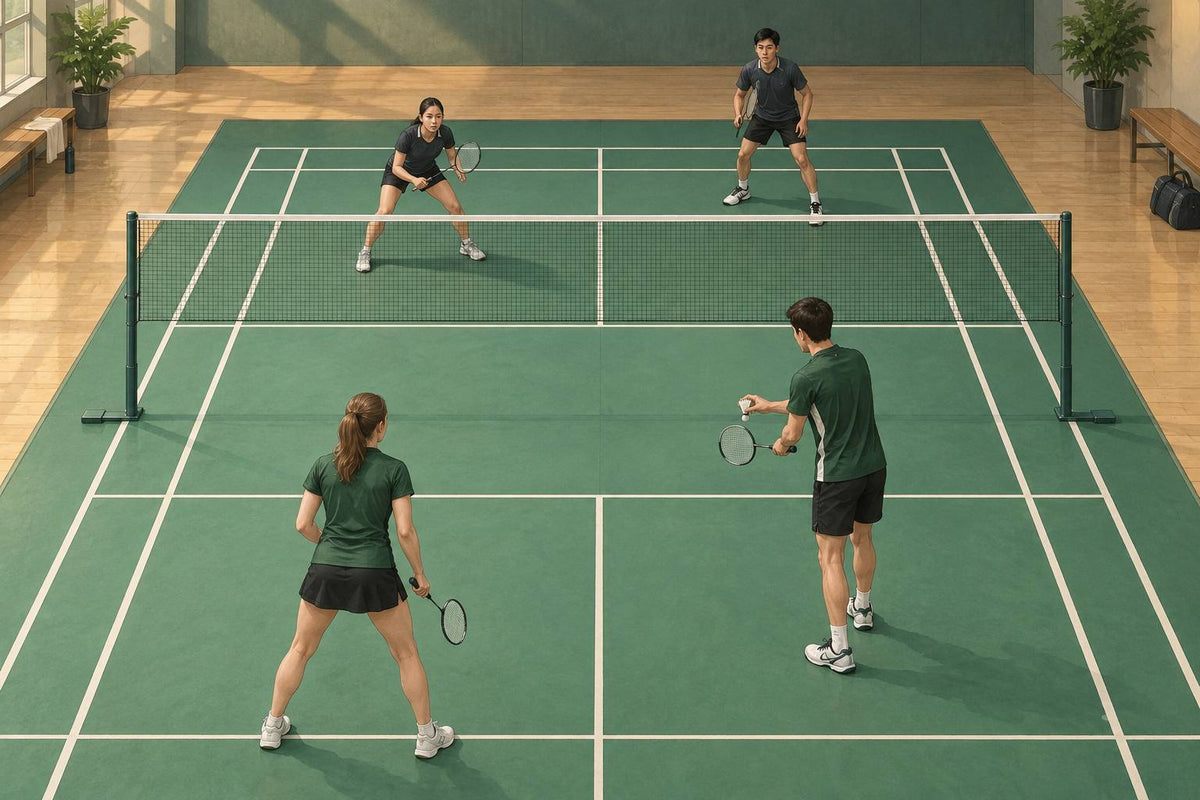
At service, the designated server and receiver use their correct diagonal service courts, while partners may take positions within their respective courts provided they do not unsight the opposing server or receiver. After the return, either player may hit; an ability-based court split is a partnership agreement, not a BWF rule.
Start with The Laws allow service positions but not ability-based zones
Use a simple temporary court plan when partners have different current levels, but do not turn it into a rule that one player owns a fixed zone. At service, preserve the designated server and receiver positions; after the return, either partner may take the shuttle.
- Before the game, agree one initial hand-off for a common situation, such as who calls a central lift or who takes a high return.
- Use a short between-point call when the pair wants to reset the plan, rather than trying to solve it during a rally.
- After the service return, let either partner take the shuttle; do not force a fixed ability-based zone.
- Review the hand-off after a few rallies and change it if it creates confusion, rather than treating a temporary example as a coverage law.
Related reading: How Elite Doubles Pairs Build Silent On-Court Communication — for making a local hand-off work with a partner.
The Laws allow service positions but not ability-based zones
During service, the server and receiver must stand in diagonally opposite service courts. Their partners may take positions within their respective courts provided they do not unsight the opposing server or receiver. The Laws do not create a stronger-player or weaker-player coverage zone. BWF Laws of Badminton

The Law comes before the plan: service positions must not be used to unsight opponents, and after the return either partner may hit. The BWF Vocabulary also includes the service call “You blocked the receiver’s view of the shuttle during service.” BWF Vocabulary
After the return, both partners may take the shuttle
After service is returned, either player on either side may hit the shuttle from any position on that player’s side of the net. That lets a pair respond to the live shuttle rather than obeying a permanent ability-based court map. BWF Laws of Badminton

A local plan works best when it is small. Agree one initial hand-off, one between-point reset phrase, and one review point. This is an editorial communication choice, not a BWF-prescribed formation. The pair can then see whether the agreement reduces confusion without claiming that it is the correct formation for every mismatch.
Agree a local hand-off plan without calling it a rule
A temporary hand-off agreement can reduce confusion for one recurring rally picture without assigning either partner a permanent territory. Keep it separate from the service-position rules, name the cue in neutral terms, and revise it between points if it stops helping.

Use one neutral hand-off
- Choose one recurring picture, such as a central lift or high return.
- Agree who calls it and what the other player does; keep the call short enough for a between-point reset.
- After the return, either player may still take the live shuttle. Review the agreement after a game and simplify it if it causes hesitation.
This is a local communication aid, not a BWF formation rule or a permanent assessment of either partner.
Questions the cited sources do not settle
- That the stronger player should always cover extra width, take the middle, or own a fixed court box.
- A universal communication script or handoff rule that prevents confusion.

Leave a comment
This site is protected by hCaptcha and the hCaptcha Privacy Policy and Terms of Service apply.