
Last checked: August 2026 · Written by the player-led team at Badminton House
Quick answer
Rules assign the serving side to the right court on an even score and the left court on an odd score; after the return, either partner may hit from any position. They do not assign a permanent tactical left or right side.
Start with Service court follows the serving side’s score
Separate the score-based service court from a pair’s tactical preference. The rules put the server on the right court at an even score and left at an odd score; after the return, either partner may hit from any position, so a permanent left-or-right role is not a Law.
- Before a game, agree whether the pair wants a temporary left or right preference for a specific return or rotation.
- At every serve, use the score to put the server in the correct service court.
- After the return, let either partner take the shuttle according to the live court picture rather than a fixed service-side label.
- Review the preference between games and keep or change it as a local pairing choice, not a rule violation or a permanent tactical assignment.
Related reading: Badminton Doubles Positioning & Rotation Guide — for doubles movement after the score sets the serving side.
Service court follows the serving side’s score
In doubles, the serving side serves from the right service court on an even score and the left service court on an odd score. When the serving side wins a rally, its server changes to the alternate service court; the receiving pair does not rotate at that moment. BWF Laws of Badminton

The service position has an exact answer: even score means right court for the server, and odd score means left court. BWF Vocabulary uses the same terms: “Right service court” and “Left service court.” BWF Vocabulary For example, if the serving side wins a rally from an even score, the same server then serves from the left court while the receiving pair stays in its respective service courts.
After the return, either player may play
After the return of service, either doubles player may hit the shuttle from any position on that side of the net. The score-based service court does not fix a player to a tactical left or right side once the rally is live. BWF Laws of Badminton

Choose a preferred side as a local pair choice
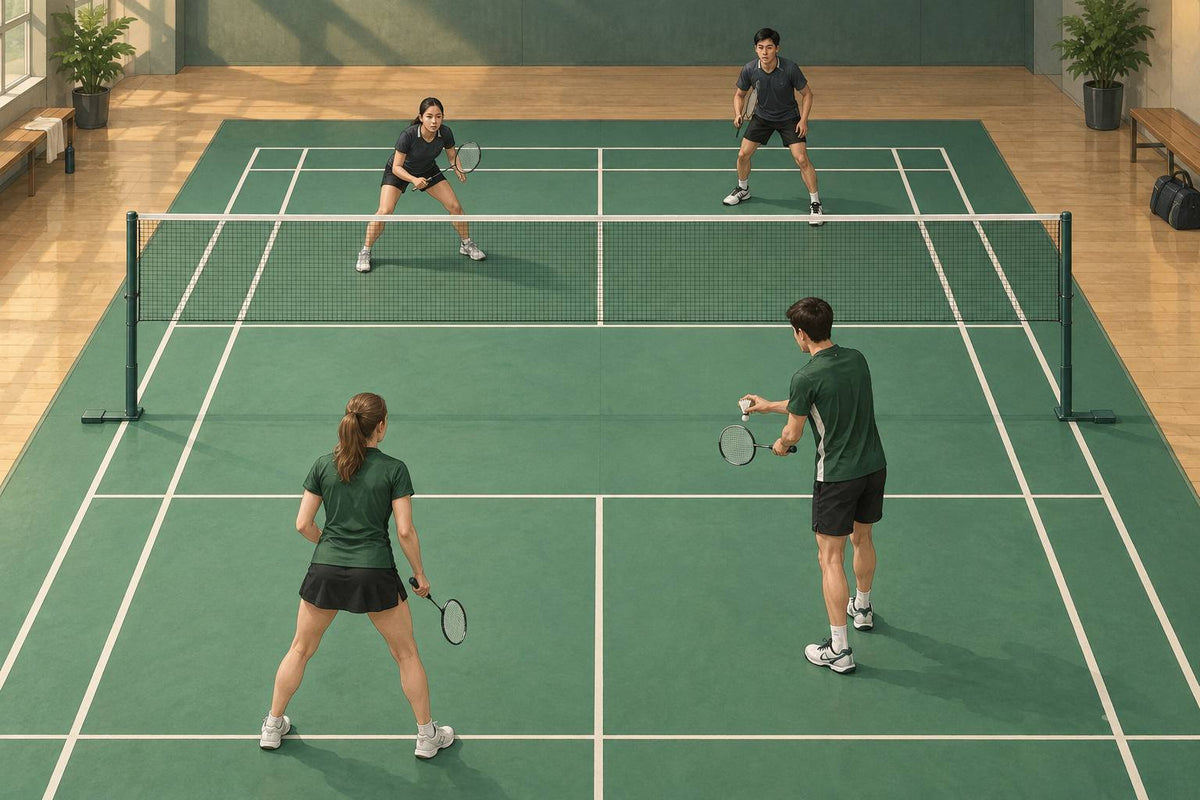
During service, the server and receiver occupy diagonal service courts. Their partners may stand anywhere within their respective courts provided they do not unsight the opposing server or receiver. A preferred left or right starting shape is therefore a pair choice, not an umpire instruction. BWF Laws of Badminton

Use a three-moment doubles court card
- For the pre-service moment, write the serving side’s score state and identify the corresponding service court. Put the server and receiver on the sketch first, then place the partners so the service picture remains legal and visible.
- For the service moment, use a separate line for where each partner chooses to stand. This line describes a legal starting position and sightline; it is not a permanent left- or right-side assignment and it does not decide who owns the next shuttle.
- For the post-return moment, draw the live court picture with both partners able to respond. Add any preferred starting shape as a reversible pair agreement beneath the rule lines, so a tactic cannot be mistaken for a score-based requirement.
- After a point, ask which moment created the uncertainty: score, service position, or rally choice. Only then revise the relevant line. This avoids correcting a local preference as though it were a Law error or treating a service court as permanent territory.
Questions the cited sources do not settle
- A permanent left- or right-side assignment based on handedness, reach, or a skill self-test.
- A claim that service-court position defines an in-rally tactical role.



Leave a comment
This site is protected by hCaptcha and the hCaptcha Privacy Policy and Terms of Service apply.