
Last checked: August 2026 · Written by the player-led team at Badminton House
Quick answer: touching the net in badminton
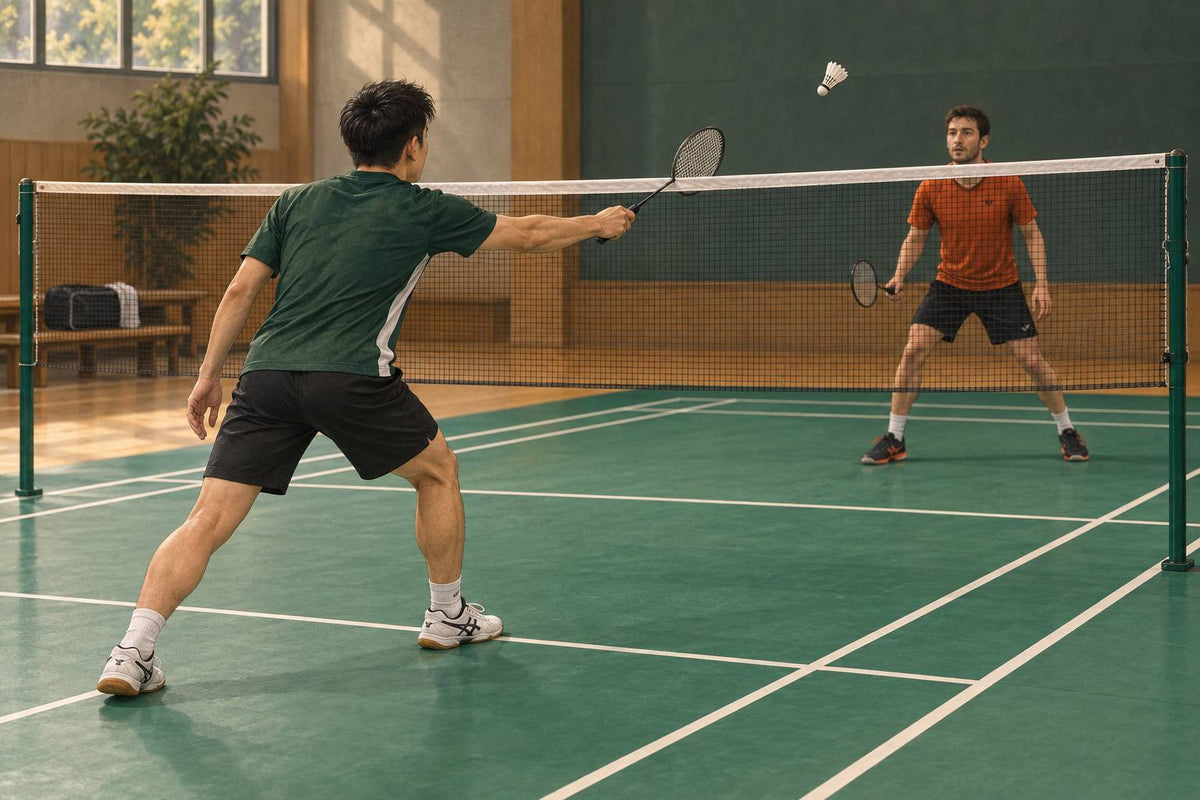
If the shuttle is still in play, a touch by your racket, body, or clothing on the net or its supports is a fault. A foot or racket under the net becomes a fault when it obstructs or distracts an opponent.
Net / post
Fault: do not touch the mesh, tape, cord, post, or support while the rally is live.
Under net
Judge interference, not merely whether a foot crossed the centre line.
After point
Once the shuttle has hit the court or a fault has occurred, the shuttle is not in play.
The useful rule is simpler than most net disputes: first decide whether the rally was still live, then decide what was touched. The Laws make net contact a fault only in play. That timing matters when a player lands after a net kill or brushes the tape after the shuttle has already hit the floor.
What counts as touching the net?
The Law covers both the net and its supports. So it is a fault if, during a live rally, your racket catches the tape, your sleeve brushes the mesh, or your body contacts a post. It is not a racket-only rule. BWF Law 13.4.1 covers a player touching the net or its supports with racket, person, or dress.
In practical terms, treat the whole assembly as off limits: mesh, white tape, top cord, posts, and their supports. Do not try to decide whether a tiny brush was “only clothing.” Clothing is explicitly included, and an honest self-call keeps an unumpired game moving.
Club-play habit: if you feel your racket, shirt, or body catch the net while the shuttle is live, call it immediately. Your opponent may not have seen the contact.
When does contact stop being a net fault?
Net contact is only a Law 13.4.1 fault while the shuttle is in play. The shuttle is not in play after it hits the court, or after a fault or let has occurred. That means a follow-through that brushes the net after a winning shuttle has landed is not an additional net fault. Law 15 is the timing rule behind that answer.
Do not use that timing point to take a risky lunge. A player can still be off balance, and the net posts are hard equipment. The rule answer and the safe movement choice are separate: finish the point, then regain control before turning away.
What if your foot or racket goes under the net?
Going under the net is not automatically a fault just because part of you crosses the centre line. The question is whether your racket or body under the net obstructs or distracts the opponent. BWF Law 13.4.3 makes that interference the test.
| Situation | Call | Reason |
|---|---|---|
| Racket clips the tape during a live net exchange | Fault | Direct net contact while in play. |
| A lunge slides a foot slightly under the net, clear of the opponent | Play on | No obstruction or distraction is shown. |
| A leg or racket under the net stops the opponent moving to the shuttle | Fault | Under-net invasion obstructs the opponent. |
| Player touches the tape after the shuttle has landed | No net fault | The rally has already ended. |
Keep the separate net rules separate
Net contact, reaching over, and obstruction often happen in the same rally, but they are different questions. BWF Law 13.4.2 allows a legal follow-through over the net after initial contact on the striker's side, but the player would still fault by hitting the tape. Equally, a player can stay clear of the net yet obstruct an opponent's legal stroke.

- Did anything touch the net or its supports? If yes, it is a fault while the shuttle is in play.
- Did someone invade under the net? Decide whether that action obstructed or distracted the opponent.
- Did a racket travel over the net after contact? That is the separate follow-through question covered in our racket-over-the-net rule guide.
For friendly games, agree to call clear self-faults and replay only when neither side can reasonably know what happened. That preserves both the rule and the spirit of close net play.
Build sharper front-court control
Good technique gives you more margin around the tape. Start with our badminton net-shot technique guide, then practise controlled movement rather than reaching for every shuttle.


Leave a comment
This site is protected by hCaptcha and the hCaptcha Privacy Policy and Terms of Service apply.