
Last checked: August 2026 · Written by the player-led team at Badminton House
This self-test battery covers seven checkpoints (mobility, power, change of direction, speed, endurance, upper-body strength and lower-body strength) using nothing more than a tape measure, a stopwatch and floor markers. Score yourself once for a baseline, repeat the same seven tests after 8 to 12 weeks, and judge progress against your own numbers instead of guessing whether training is working.
How this self-test battery works
Run all seven tests in one session on a day you are not fatigued, in the same shoes and on a similar floor each time you retest, because surface, footwear and fatigue change your numbers more than real fitness does between sessions.
These seven checkpoints are Badminton House's own way of organizing a self-test battery, not an official test from a federation or a national squad. They line up with how badminton fitness testing is actually structured in practice: Topend Sports' badminton testing guide groups the sport's physical demands into anthropometry, flexibility, strength and power, speed, agility and aerobic fitness, and notes that strength, speed, agility and endurance each contribute differently to a strong badminton player. We have simply split strength into upper- and lower-body checkpoints so the battery gives you two separate numbers to retest, since a player can improve one without the other.
Before you start, write down four things next to your results: the court or floor surface, the shoes you wore, the time of day, and how long you rested between each test. A 5-minute warm-up of light footwork and dynamic stretching comes first. Skip the whole session if you played a hard match or a heavy gym session in the last 24 hours; a fatigued score will look like a decline even when nothing has actually gotten worse.
Checkpoint 1 and 2: mobility and power
Test mobility with a floor sit-and-reach and power with a standing broad jump: both use only a tape measure, take under five minutes together, and give you a hip/hamstring range number and a leg-power number that most club players never track at all.
Sit-and-reach (mobility). Sit on the floor, shoes off, legs straight out in front of you and knees pressed flat. Place a tape measure on the floor between your feet, zeroed at your heels. Stack your hands, reach forward along the tape as far as you can after two practice reaches, and hold the final position for one to two seconds while a partner reads the distance to the nearest centimetre. This adapts the standard test protocol to a floor-and-tape version, since most players will not have a flex-box at home.
Standing broad jump (power). Stand behind a line with feet slightly apart. Swing your arms and bend your knees, then jump forward off both feet and land on both feet without stepping or falling backward. Take three attempts and record the longest distance, measured from the takeoff line to the back of your heels on landing. A result that sits well below your own baseline, especially combined with a short reach on the mobility test, usually shows up on court as a shot you should reach dying just short instead of arriving in balance.
Checkpoint 3 and 4: change of direction and speed
Change of direction and straight-line speed are separate qualities in badminton, so test them separately: a shuttle-run course scores how fast you brake and redirect, while a short sprint scores raw acceleration, and a big gap between the two tells you which one to train first.
Badminton researchers make the same distinction. A 2026 study of elite badminton players notes that on-court success "hinges more on an athlete's ability to change direction efficiently within limited space" than on linear speed, since rallies are full of abrupt stops and re-orientations that load the body differently than running in one direction.
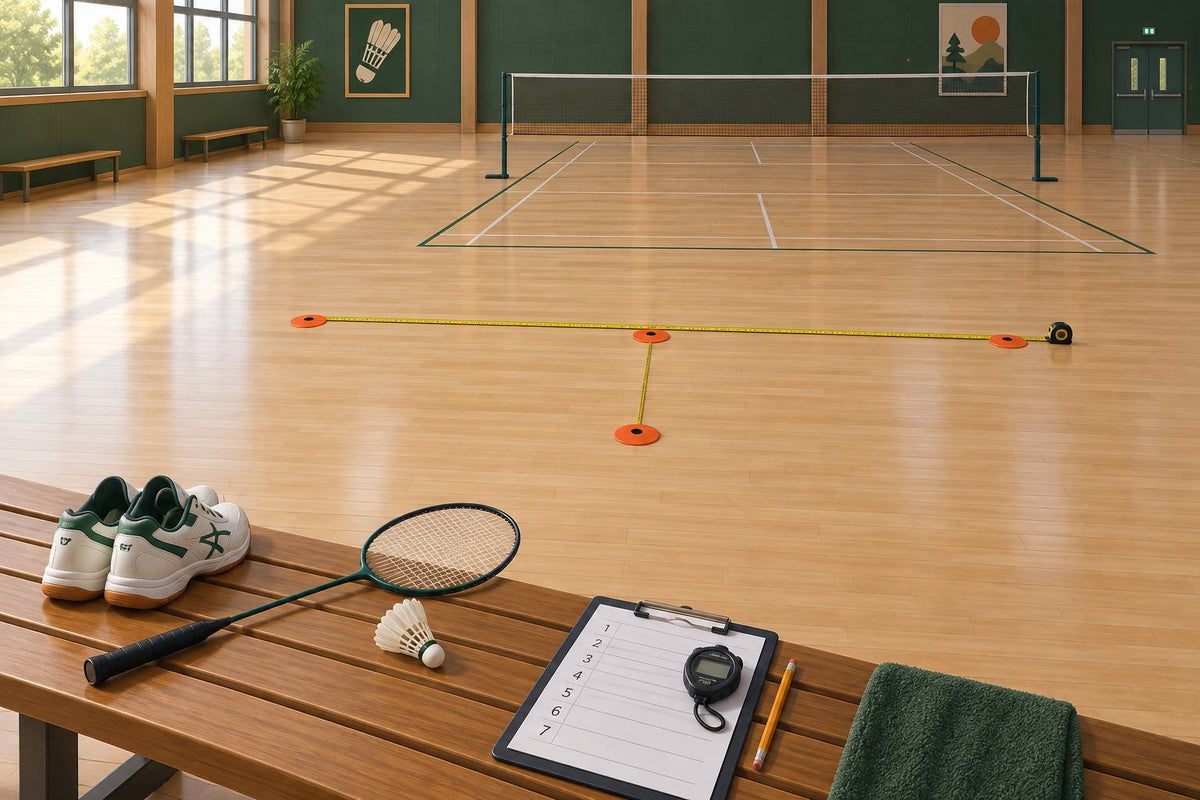
Shuttle-run change of direction. Set four floor markers in a T: one start marker, one 9.14 m straight ahead, and two more 4.57 m to each side of that one. Sprint to the far marker and touch it, shuffle sideways to touch each side marker and return to the centre without crossing your feet, then run backward through the start line. Take the best of three trials, timed to the nearest tenth of a second with a stopwatch. A trial does not count if your feet cross while shuffling or you miss a marker.
Short sprint (speed). Mark out 20 metres. From a standing start, sprint through the line as fast as you can and time the full distance; if you have a second person to help, split-time the first 5 m and 10 m too, since a slow start over the first steps points to a different fix than a slow finish. Take the best of two runs with full recovery between them.

Checkpoint 5, 6 and 7: endurance, upper body and lower body
Finish with three tests that need no equipment beyond a stopwatch and a wall: a continuous shuttle run for aerobic endurance, push-ups to failure for upper-body strength, and a single-leg wall sit for lower-body strength, run in that order so the endurance test does not fatigue the two strength tests that follow it.
Continuous shuttle run (endurance). The standard version is the 20 m beep test: run between two lines 20 m apart in time with a recorded pacer that speeds up roughly every minute. You get one warning for missing a beep and are stopped on the second. Score is the level and shuttle number you reach. If you do not have the audio, a simple substitute is running continuous 20 m shuttles at a hard, steady pace for as long as you can hold form, timed with a stopwatch instead of paced by beeps; note in your log which version you used so future retests stay comparable.
Push-ups to failure (upper body). Hands and toes on the floor, body in a straight line, hands at shoulder width. Lower until your elbows reach roughly 90 degrees with your upper arms parallel to the floor, then press back to full extension. Count every rep done with full range at your own pace until you cannot complete another one with correct form. This is a to-failure adaptation of the standard test-form description, not a metronome-paced version, so record it as your own protocol.
Single-leg wall sit (lower body). Stand with your back against a smooth wall, feet shoulder-width apart, and slide down until both your knees and hips sit at roughly 90 degrees. Lift one foot off the floor and start the stopwatch; stop it when you can no longer hold the position and the foot returns to the ground. Rest fully, then repeat on the other leg. A gap of several seconds between your two legs is worth tracking on its own, since it can point to a one-sided weakness a two-leg test would hide.
Recording your baseline and when to retest
Log every score the day you take it, then leave the battery alone for at least 8 weeks before you run it again, because meaningful physical adaptation takes time to show and testing too soon just adds noise instead of a real signal.
A 2025 review of resistance training studies in competitive badminton players found that programmes longer than 8 weeks produced more consistent gains than shorter ones, and that many of the studies it reviewed were themselves too short to show a real training effect. The same logic applies to retesting yourself: an 8-to-12-week gap gives training time to actually change your numbers, while still being short enough that you can act on what the retest tells you.
| Checkpoint | What you record | Baseline | Retest |
|---|---|---|---|
| Mobility | Sit-and-reach distance (cm) | ||
| Power | Broad jump distance (cm) | ||
| Change of direction | Shuttle-run best time (s) | ||
| Speed | 20 m sprint time (s) | ||
| Endurance | Beep test level/shuttle reached | ||
| Upper-body strength | Push-ups to failure (reps) | ||
| Lower-body strength | Wall sit, left/right (s) |
This battery measures physical qualities, not court coverage. Moving well between all four corners under match pressure is a separate skill worth testing on its own, so treat a strong physical score here as raw material rather than proof that your footwork patterns are already sharp.
Run your baseline this week
- Pick a rest day and warm up for 5 minutes before testing.
- Work through all seven checkpoints in the order above and log every score.
- Note your surface, shoes and rest gaps so the retest stays comparable.
- Set a calendar reminder 8 to 12 weeks out and repeat the exact same battery.


Leave a comment
This site is protected by hCaptcha and the hCaptcha Privacy Policy and Terms of Service apply.