
Last checked: August 2026 · Written by the player-led team at Badminton House
There is no rulebook answer for how a self-officiated player should stand, only optics and BWF's own officiating convention: to judge a line accurately, get your eyes roughly level with it and looking along its length, not across the court at an angle. Singles and doubles use different sidelines, and in doubles the long service line only limits the serve, not the rest of the rally. When a call comes from someone who was not aligned with the line, check their position before you argue about their honesty.
Related reading: Calling Your Own Lines in Badminton: In, Out and Doubt covers the honour-system baseline, the standard signal, and scripts for the three most common disputes. This guide picks up where that one stops, on the judging itself.
Why Your Angle Fools You on a Close Line
Standing off to the side of a line distorts where a fast, low shuttle appears to land, because your eye and the true landing point are not aligned with the boundary. The fix is positioning yourself so your sightline runs along the line itself, not across it, before you call anything close.
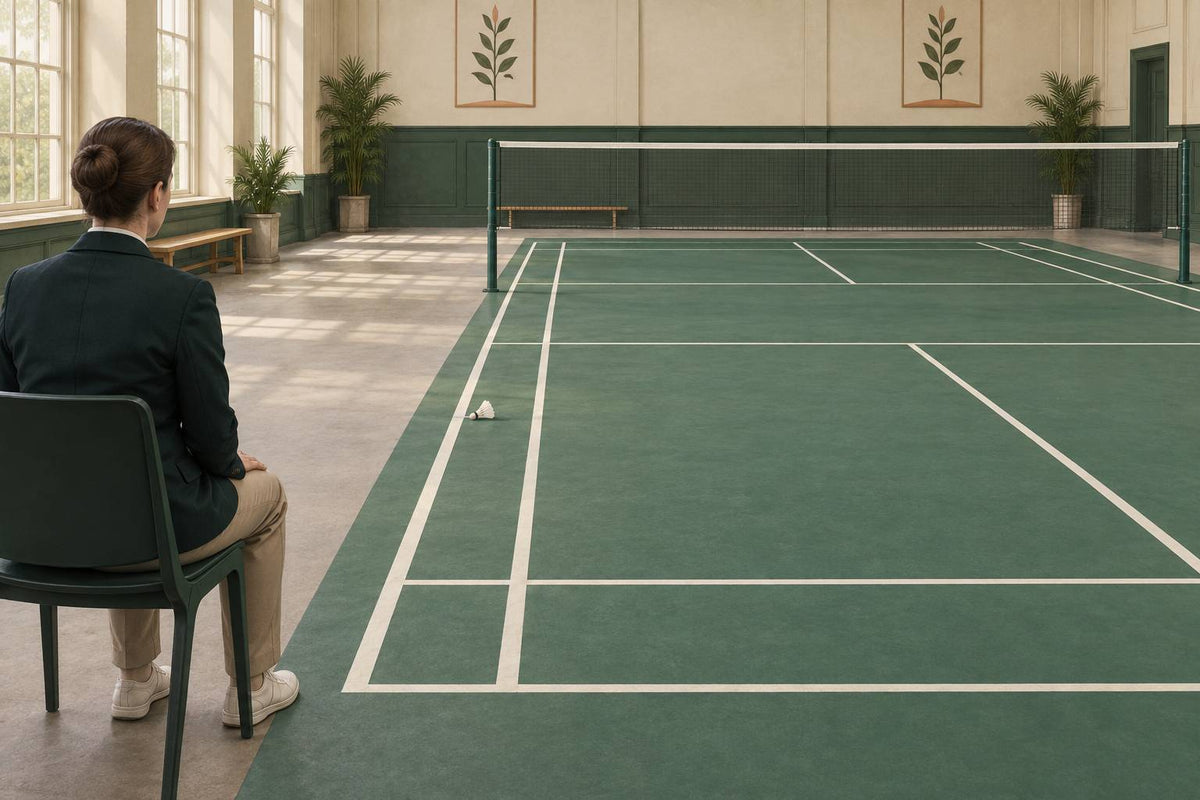
Badminton's own line judges are trained around exactly this problem. Where practical, officials sit outside the boundary but directly in line with the line they are watching, never off to one side, and are taught to imagine that line extended all the way to their own chair, per BWF's Line Judges' Manual. On the doubles long service line specifically, officials lean in their chair to sight as directly as possible down its length while keeping their eyes level rather than tilted.
You cannot bring a chair onto a club court mid-rally, but the principle travels. Before you call a shot near a sideline or the back boundary, take the extra half-step so your eyes are roughly level with the line and looking along it, not glancing across the court at an angle. Viewed obliquely from mid-court, an in shuttle can look like it clipped the outside of the line, and an out shuttle can look like it caught the inside. The error runs both ways, which is exactly why position beats confidence.
Picture a flat cross-court drive that clips the sideline mid-court while you are still recovering toward the centre. From that angle, six or seven metres away and slightly behind the line's true plane, the shuttle can look a racket's width outside when it actually caught the paint. The player standing near the service line on that same side, closer to square with the mark, has the better call even though you hit the previous shot and feel like the point is yours to decide.
The margin for error is often smaller than it looks. A singles sideline sits only 0.46 m inside the doubles sideline, shorter than a full-size racket (up to 680 mm under the Laws), so from mid-court that gap is close to impossible to judge on an angled glance. Move toward the end of the line before you call it, the same habit BWF trains into every official who sits with a boundary extended toward their own feet.
Which Lines Are Even in Play? Singles, Doubles, and the Serve
Which boundary counts changes with the format and the moment: singles and doubles use different sidelines, and doubles even uses two different back limits depending on whether the shuttle is still on the serve or already in the rally. Knowing which line is live prevents a wrong call before you make one.
The net posts always sit on the wider doubles sidelines, whatever format is being played, so that outer strip of court physically exists on every setup. In singles, that strip is dead: only the inner sideline counts, and anything landing between the two sidelines is out. In doubles, the same strip is live, and a shot that would be out in singles is perfectly in. Our guide to badminton court dimensions and lines has the full breakdown if you are marking a court from scratch.
Doubles adds a second trap. A correct serve has to land in the receiver's service court, which is bounded at the back by the long service line for doubles, sitting just 0.76 m in from the true back boundary. That line governs the serve and nothing else. Once the return is struck, the BWF Laws of Badminton judge every later shot in the rally against the full boundary of the court, not the service court, so a return landing 50 cm past the long service line, well inside that 0.76 m gap, is legal mid-rally even though the identical spot would have faulted as a serve.
Take the identical landing spot in two different moments: a shuttle that dies 40 cm beyond the long service line but well short of the back boundary. On a doubles serve, that spot is out; the shuttle never reached a live line. In the rally that follows the serve, or in singles at any point, the identical spot is comfortably in, because the boundary that matters has moved back to the true back line. Same shuttle, same patch of floor, two different calls depending on what happened before it landed.
Back corners create a third trap. A shuttle can be in relative to the sideline and out relative to the back boundary at the same time, or the reverse, and it only takes one of those two lines to be out for the whole shot to be out. Official line judges are drilled on exactly this case and can legitimately give opposite signals on the same shuttle, because each is reading a different line. In doubles, check the sideline and the back boundary independently on anything landing near a corner; a good look at one line does not cover the other.

Calling It: Timing, Volume, and Who Has Priority
A correct call is worth nothing if it arrives late or too quiet to hear, and a confident voice from the wrong position can drown out the player who actually had the line. Call the instant the shuttle lands, loud enough for everyone on court, and give priority to whoever was aligned with that boundary.
Wait until the shuttle actually touches the floor before you call or move toward it. BWF's guidance to officials warns that signalling early can hand an unfair advantage to one side and puts the caller's own credibility in doubt, and the same logic holds with no umpire watching to catch it. Our guide to calling your own lines in badminton covers the honour-system baseline, the standard signal, and scripts for the three most common disputes; this article assumes that context and stays with the judgement itself.
When partners disagree in doubles, settle it by sightline rather than seniority or volume. Three rules keep it quick:
- Whoever was aligned with the boundary when the shuttle landed, looking along it rather than across it, has priority.
- A call made before the shuttle actually landed loses priority, even if it came first.
- If both partners were genuinely out of position, treat it as unsighted rather than disputed, and replay the point.
This is not about rank or trust. A partner with three more years of experience than you still loses the call if they were watching the shuttle from an angle across the court while you were standing square to the sideline when it landed. Badminton's own line judges work the same way: a rookie assigned to one line outranks a veteran assigned to a different one, because the assignment, not the resume, decides who is right.
When Someone Calls From the Wrong Angle
Some disputes are not about honesty at all: they happen because someone called a line from across the net or from deep in the rally, at an angle nobody trusts. One short question separates a genuine bad angle from a real disagreement, and it keeps the rally moving instead of turning into an argument.
Ask instead of accusing. If a call comes from someone who plainly was not aligned with the line, whether an opponent shouting from the far baseline on a sideline shot or a partner glancing sideways mid-swing, say: "You were looking across the court; I had the line straight on. Can we go with what I saw?" Framing it as a position check rather than a challenge to their honesty keeps the exchange short and specific.
If you were both genuinely out of position, the shot is unsighted rather than disputed, and the honour system's usual fallback applies: replay it. Treat that as the rare case, not the default. Most close calls resolve in seconds once everyone commits to checking position before volume, which is really the whole skill this guide teaches: read the line you are actually aligned with, not the one you wish you could see.

Leave a comment
This site is protected by hCaptcha and the hCaptcha Privacy Policy and Terms of Service apply.