

Last checked: August 2026 · Written by the Badminton House player-led team.
Quick answer: start with short court bursts and twice as much recovery
- Use 6–12 seconds of hard badminton movement as a starting work interval.
- Begin near a 1:2 work-to-rest ratio, then change one variable only when movement stays controlled.
- Keep a lower-intensity court block because match play also depends on recovery across the whole session.
The most useful badminton interval training session is built around the sport’s short rallies and incomplete recovery, not a generic running timer. Start with 6–12 seconds of hard court movement, recover for roughly twice that time, then add a longer aerobic block so the session trains both repeated efforts and the ability to keep moving.
Start with the broader goal: our badminton stamina and fitness guide explains how court conditioning fits beside strength and ordinary play.
What does rally data say about badminton interval training?
Competitive badminton alternates a short, demanding exchange with a reset rather than repeating one identical effort continuously. A useful timer therefore practises hard movement, controlled braking, and recovery in a repeating rhythm. The observed numbers are starting points for session design, not rules that every player or rally must match.
One competitive analysis observed average performance intervals of 6.4 seconds and rest periods of 12.9 seconds between exchanges. The study report came from 11 international players and 14 match samples, so treat it as a reference point rather than a promise that your rallies will last exactly 6.4 seconds.
A later review gives a similar practical picture: a typical rally of about seven seconds, followed by about 15 seconds of rest, with effective playing time around 31 percent. That review of badminton’s physical demands also describes a broad estimate of 60–70 percent aerobic contribution and approximately 30 percent anaerobic contribution. Those percentages depend on how effort is measured, so use them to justify a mixed session, not to calculate a personal energy-system score.
| Observed pattern | Training translation |
|---|---|
| Hard exchange: roughly 6–12 seconds | Use short court-movement bursts rather than making every repetition last 30–60 seconds. |
| Rest: roughly twice the work duration | Begin with a 1:2 work-to-rest ratio and adjust only after movement quality is stable. |
| Effective play: about one-third of total match time | Include resets, walking, and easy movement; the recovery is part of the training target. |
The practical lesson is simple: do not fill every minute with continuous hard running. Badminton conditioning needs enough work to challenge movement and breathing, plus enough recovery to reproduce a useful court pattern on the next effort.
Which three badminton interval sessions can you run with a timer?
These three sessions need only a court and a timer. The first practises short rally-length movement, the second groups those efforts into match-like clusters, and the third develops the aerobic support used between harder efforts. Keep every route recognisably badminton-shaped: split, move, brake, recover toward base, and reset.
1. Short-rally movement set
Set the timer for eight seconds of hard movement followed by 16 seconds of easy recovery. That is an 8:16 ratio, or 1:2. During the work interval, move through two or three court corners at a controlled attacking pace, then return toward base. During recovery, walk, breathe, and prepare rather than collapsing at the back of the court.
Complete eight repetitions, rest for two minutes, then complete a second set of eight. The arithmetic is 8 repetitions × 24 seconds = 192 seconds, or 3 minutes 12 seconds, per set. The longer set break lets you begin again with enough quality to notice whether braking and recovery change.
2. Match-cluster set
Use the same eight-second work and 16-second recovery, but organise the repetitions into three clusters of four. Four repetitions take 4 × 24 seconds = 96 seconds, or 1 minute 36 seconds. Rest for 60 seconds between clusters. The full block is 3 × 96 seconds plus 2 × 60 seconds, or 6 minutes 48 seconds.
Choose a fixed route within each cluster, such as base to forehand front, back to base, then backhand rear and back. You can change the route between clusters, but do not make every repetition a surprise. The purpose is to expose repeatable movement to incomplete recovery.
3. Aerobic court base
Move continuously for 20 minutes at an easy-to-moderate pace. Use two minutes of relaxed court movement followed by two minutes of moderate footwork, repeating the cycle without sprinting. Five four-minute cycles make 20 minutes. Finish able to speak in short sentences and keep the footwork quiet enough to remain technically useful.
This lower-intensity block is support around the short efforts, not another maximum interval test. If you have no partner, use fixed routes and a repeating timer. If a partner feeds, keep the pace controlled; the session earns its place when the final repetition still looks like badminton.
On the next cycle, reverse a fixed route so both forehand and backhand corners receive equal practice.

Why is a steady run not enough for badminton conditioning?
A 20-minute steady run can support general aerobic fitness, but it does not rehearse badminton’s repeated transitions: accelerating for a short exchange, braking on court, recovering while breathing hard, and producing another controlled movement soon afterward. Keep running if you enjoy it; pair it with court-specific intervals when court performance is the goal.
The limitation is not that steady running is useless. Its rhythm is simply different. Rally-based work asks you to change direction, lower your centre of mass, recover to a useful base, and restart after a brief pause. It also gives you a visible quality check: did you reach the next corner under control, or did fatigue turn the route into reaching and falling?
Research on high-performance badminton drills found that 10-second intervals most closely represented average match loads in that protocol, while longer 30- and 50-second intervals increased anaerobic demand. The authors cautioned that extending intervals beyond 30 seconds might impair external training load and skill performance. Read the interval-duration study. That does not make 30 seconds forbidden; it means longer work should have a specific purpose rather than being the default.
Doubles players can begin with a modest adjustment: six seconds of hard work and 12 seconds of reset, using a compact route and a sharper return to base. A 2026 analysis of 124 junior championship matches reported higher shot frequency, shorter rallies, and more concentrated activity in doubles than singles. It does not create a universal adult-club prescription, so restore the 8:16 version if shorter cycles make movement or communication deteriorate.
How do you fit badminton intervals into one hour?
A one-hour court session can include all three elements without becoming a maximal test. Warm up first, place the short work early enough for good movement, use the aerobic block as support, and leave time to cool down and record what changed. The aim is a session you can repeat, not one heroic result.
- 0–6 minutes: walk, mobilise, and rehearse split steps and easy corner movements.
- 6–14:24 minutes: complete the two eight-repetition short-rally sets, including the two-minute break.
- 14:24–21:12 minutes: complete the three match clusters, including the 60-second pauses.
- 21:12–29 minutes: walk, drink, and let breathing settle before the aerobic block.
- 29–49 minutes: complete the 20-minute aerobic court base.
- 49–55 minutes: walk and perform relaxed mobility rather than adding extra sprints.
- 55–60 minutes: record the session while the details are fresh.
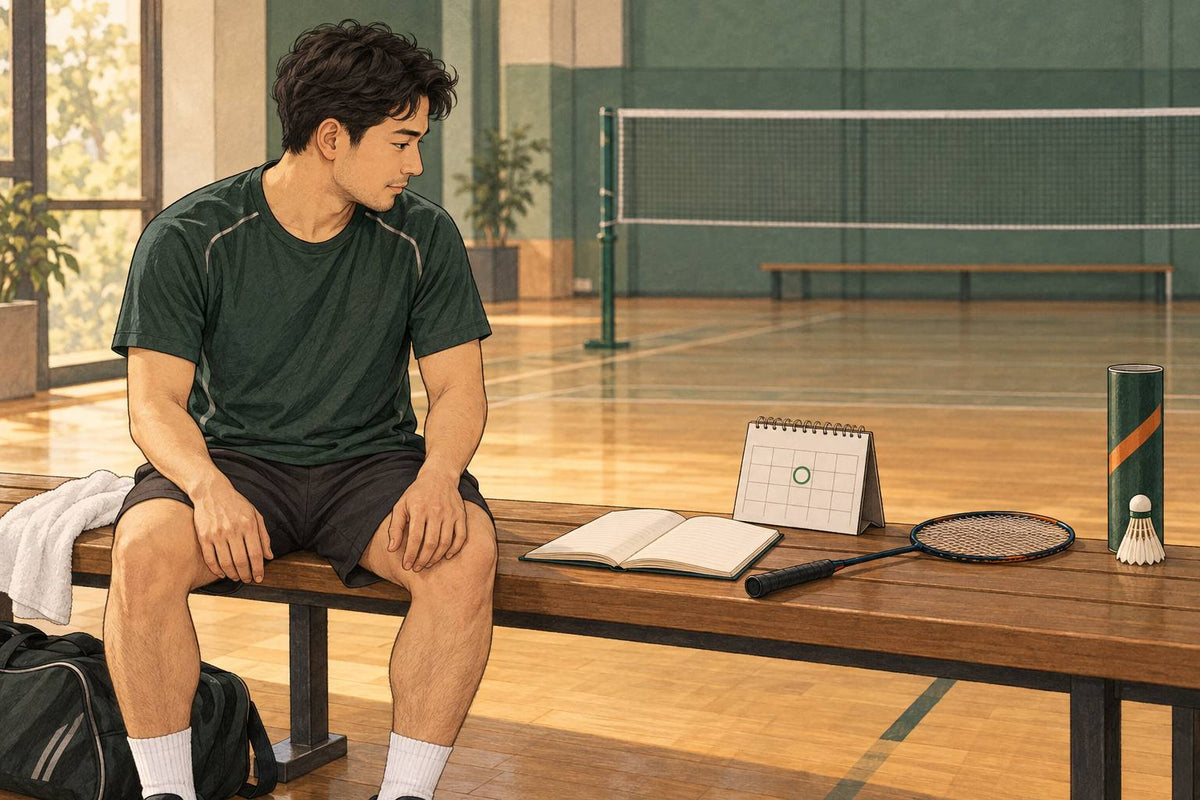
Log the work-to-rest setting, completed repetitions, first technical error, and how the last repetition compared with the first. If the final round remains controlled for two similar sessions, change one variable: add one repetition, slightly increase movement speed, or reduce a reset by a few seconds. Do not change all three at once.
For progression beyond this session, see our badminton repeated-sprint training guide. If you use a watch, heart rate can add context but should not replace movement notes; our badminton heart-rate guide explains that boundary.
Stop if pain, dizziness, unusual breathlessness, or unstable movement appears. Otherwise, keep the first week deliberately repeatable. Rally-length intervals work best when the timer helps you reproduce a clean court action, recover, and do it again.
Your next badminton interval session
- Set a timer for eight seconds of work and 16 seconds of recovery.
- Complete one short-rally set before adding a harder option.
- Write down the first movement error, then use that note to choose one progression.

Leave a comment
This site is protected by hCaptcha and the hCaptcha Privacy Policy and Terms of Service apply.