
Last updated: June 2026 · Written by the team at Badminton House
Quick Answer: Badminton Fitness Training
Build stamina with short, badminton-specific intervals first, then support them with footwork, strength, balance, and mobility work.
Default
Best choice: use rally-style HIIT built around hard efforts of up to 30 seconds, because badminton rallies are short and explosive and HIIT improves aerobic capacity in badminton players.
No court
Do shadow footwork at home: 30 seconds of movement, 30 seconds of rest, repeated 5–6 times to build movement patterns, recovery rhythm, split-step timing, and on-court fitness.
Support
Add core training, lower-limb resistance work, balance drills, and mobility so your lungs, legs, and movement control improve together instead of just getting tired faster.
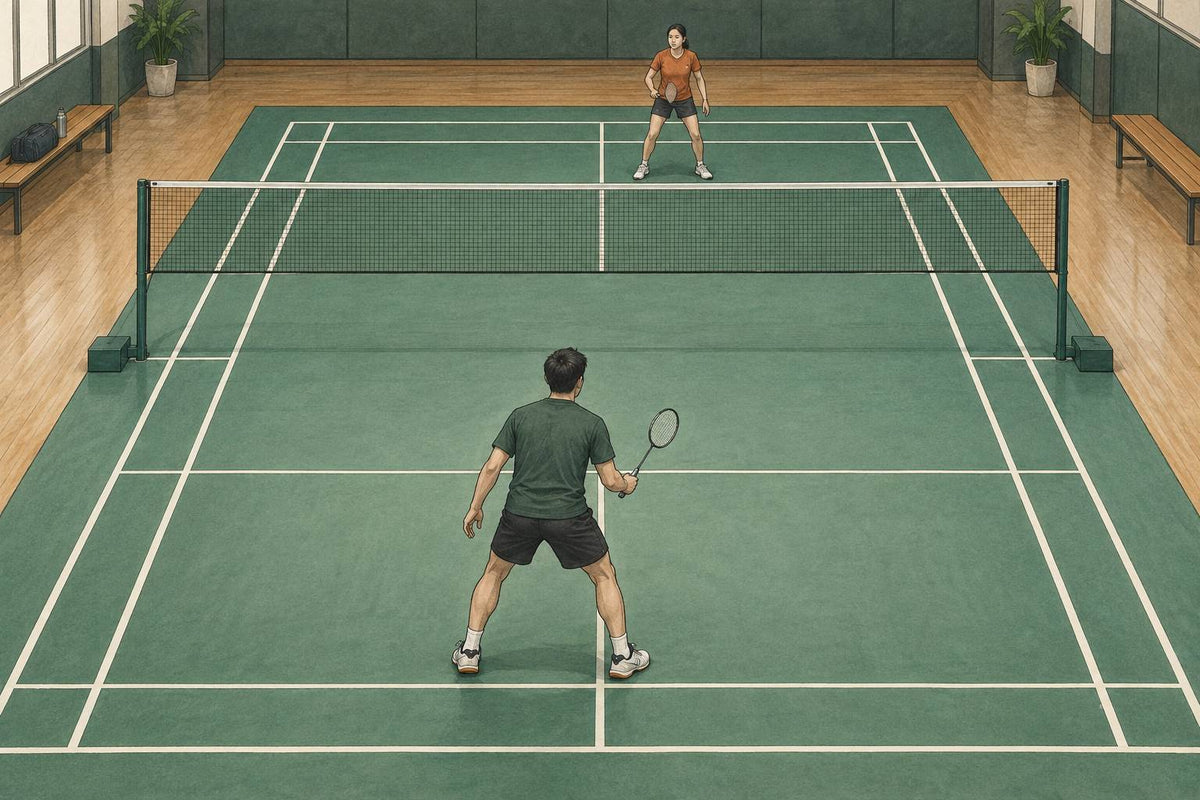
Badminton combines short rallies with pauses between points. Build conditioning around repeated acceleration, braking and recovery; match demands vary with the players, event and length of rallies.
Train your footwork in proper court shoes. If you are adding shuffles, lunges, jumps, or agility drills, start with indoor badminton footwear from our footwear collection. Badminton House ships across Canada.
In This Guide
- Why Badminton Fitness Training Matters
- Build Stamina With Badminton-Specific Intervals
- Condition Your Footwork Without Wasting Court Time
- Add Core, Lower-Body Strength, and Balance Work
- Recover With Mobility and Better Warm-Ups
- Use the Right Shoes for Footwork Conditioning
- Which Badminton Fitness Training Plan Should You Choose?
Why Badminton Fitness Training Matters

In a 2007 study of 12 internationally ranked players, simulated singles matches averaged 73.3% of peak oxygen uptake and 89.0% of peak heart rate. These are results from a small, specific study, not heart-rate targets for every club player.
The simple takeaway: if you want to stop fading late in games, train the repeat-effort pattern of badminton — not just general endurance. Pair this section with our badminton footwork basics guide if your movement breaks down before your fitness does.
The same study analysed 630 rallies, averaging 5.5 seconds of play, 11.4 seconds of rest and 5.1 shots per rally. This illustrates badminton’s repeated-effort pattern; it does not mean every drill should use those exact work and rest times.
This is also why singles and doubles can feel different but still demand real conditioning. Singles places a heavier heart-rate load, with mean heart rate reported at 89% of maximum compared with 79% in doubles. Doubles gives you slightly more shared court coverage, but it still sits within a range that develops and maintains cardiorespiratory fitness. If you play fast front-back rotations, mixed doubles, or aggressive flat exchanges, you still need repeat-sprint stamina.
For Canadian players, this matters even more in typical club conditions: you may get limited court time, crowded drop-ins, cold winter warm-ups, or long waits between games. Good badminton fitness training helps you make each court session count, stay sharp through a full club night, and reduce the sloppy late-game footwork that often leads to mistimed lunges and poor recovery steps. If you are newer to the sport, start with controlled intervals and basic movement patterns before pushing intensity; our adult beginner badminton guide for Canada covers the broader first-step path.
Build Stamina With Badminton-Specific Intervals
Key idea: train short, fast efforts with enough rest to keep movement quality high. For technique to pair with conditioning, see our badminton footwork basics.
Why HIIT works for badminton stamina
HIIT has been shown to improve aerobic capacity in badminton players, including VO₂max, while also enhancing selected match performance indicators. Across racket sports, HIIT has also been associated with improvements in VO₂max, running and repeated sprint performance, jumping performance, and hitting speed during play.
Intervals should let you repeat quick starts, controlled stops and accurate strokes as fatigue builds. Monitor three qualities:
- Aerobic recovery: the ability to bring your breathing and heart rate down between rallies.
- Anaerobic repeatability: the ability to explode through repeated lunges, jumps, and direction changes.
- Skill under fatigue: the ability to keep footwork timing and hitting speed when legs are tired.
A four-week block of badminton HIIT performed three times per week for 30 minutes reduced body fat and produced superior anaerobic ability compared with moderate continuous training. For aerobic development, however, longer blocks are better: HIIT interventions lasting more than six weeks have shown stronger aerobic benefits.
Use rally-length intervals, not random burnout sets
The biggest mistake is making every interval too long. A 30-second high-intensity drill can be useful as an upper limit because rallies can sometimes stretch toward that range, and 30 seconds is a common practical structure for hard badminton conditioning. But it should not be treated as a normal rally length. Most rallies are much shorter, with the average around 5.5 seconds and 86.7% under 9 seconds.
Going beyond 30 seconds is not automatically more badminton-specific. Longer intervals can reduce running velocity, which means the drill may drift away from the fast accelerations and recoveries you actually need on court.
| Interval type | Work / rest | Best use |
|---|---|---|
| Rally repeat | 6–10 seconds hard, then 12–20 seconds easy | Closest to the short rally profile: fast split step, two to four corners, recover, repeat. |
| 30 / 30 shadow block | 30 seconds shadowing, 30 seconds rest, repeat 5–6 times | A simple no-court option for home, condo gym, or pre-season work when court time is limited. |
| Multi-rally set | 4–6 short rallies, then a longer rest | Useful for club players who want to simulate the fatigue of several points without turning the drill into slow running. |
| Upper-limit effort | Up to 30 seconds hard, then full-quality recovery | Use sparingly for stamina stress. If speed drops sharply, end the rep instead of stretching it longer. |
A practical weekly structure
For most Canadian club players, two focused interval sessions per week is a realistic starting point alongside regular play. If you already play hard singles or competitive doubles several nights per week, treat match play as one of your high-intensity days and keep extra conditioning short.
| Block | Focus | How to progress |
|---|---|---|
| Weeks 1–2 | Clean movement and repeatable pace | Start with short rally repeats. Stop before footwork becomes sloppy. |
| Weeks 3–4 | Anaerobic repeatability | Add one 30 / 30 shadow block or one multi-rally set after your main drill. |
| Weeks 5–6+ | Aerobic improvement plus match stamina | Keep interval quality high and extend the training block beyond six weeks for stronger aerobic gains. |
Keep the stopwatch honest, but do not let it override movement quality. If your last reps look like slow shuffling instead of badminton footwork, take more rest or finish the set. The goal is to repeat fast badminton actions, not prove you can suffer through a long interval.
Gear note for interval days
If your intervals include lateral lunges, split steps, and court shuffles, use indoor court shoes rather than running shoes. The Babolat Shadow Tour Men’s Badminton Shoes – Orange is a non-marking indoor court shoe with lateral midfoot support. You can also browse badminton footwear; Badminton House ships across Canada.
Condition Your Footwork Without Wasting Court Time

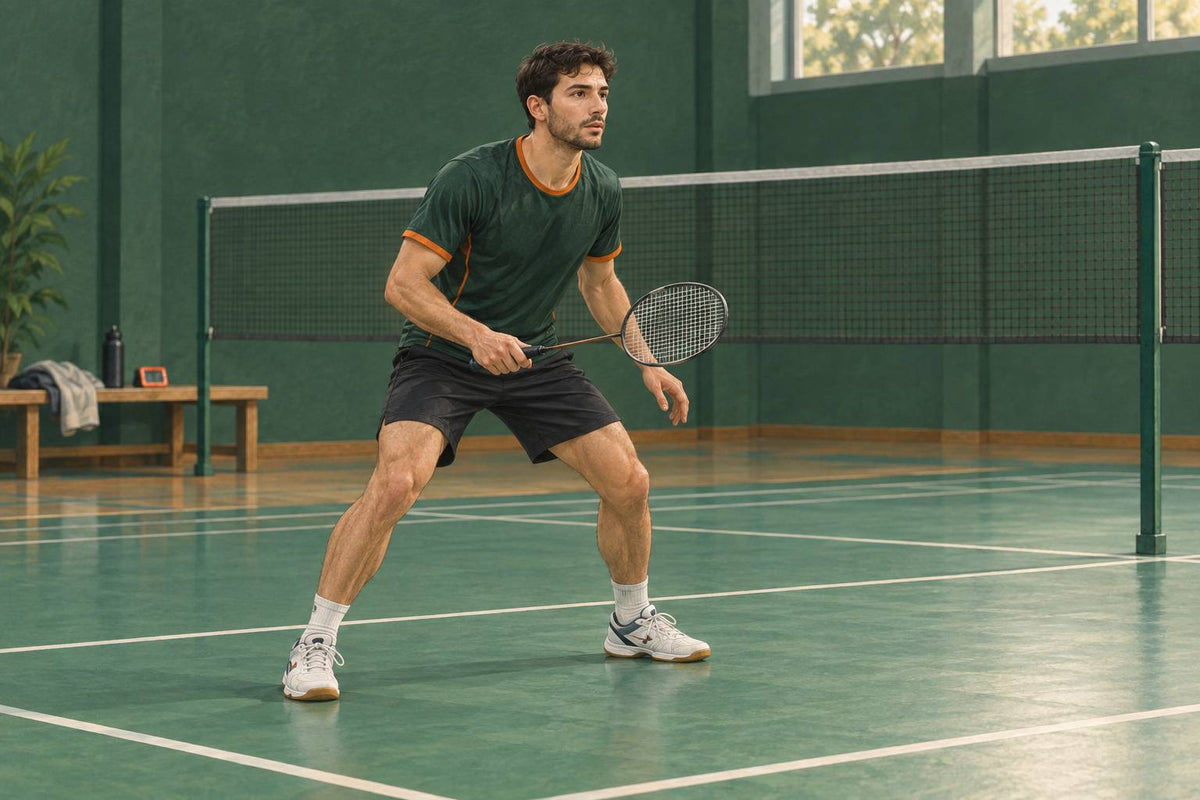
Court time is precious, especially if you are booking busy evening slots in a Canadian gym. Shadow footwork lets you train the movement side of badminton without needing a net, a partner, or a full court. You are rehearsing the same patterns you need in games: split step, first push, lunge or jump, recovery, and reset.
The goal is not to “run around” randomly. Good shadow work should feel like an invisible rally: you split as if your opponent is hitting, move to the shuttle, play the stroke shape, recover toward base, then split again. That rhythm builds movement patterns, recovery timing, split-step timing, and badminton-specific fitness at the same time.
Simple shadow-footwork block
- Pick 4–6 corners or zones: front forehand, front backhand, rear forehand, rear backhand, and optional mid-court defence positions.
- Use a quality-first interval: work for 30 seconds, rest for 30 seconds, and keep it to 5–6 rounds before your form gets sloppy.
- Reset every rep: finish the imaginary shot, recover toward base, then split step before the next movement.
- Stay low and quiet: the best reps usually look controlled, balanced, and repeatable — not frantic.
If you are new to the movement patterns, learn the technical pieces first so you are not conditioning bad habits. Start with our badminton footwork basics guide, then come back to this interval format once your split step, chasse, lunge, and recovery steps feel more natural.
How to make shadow footwork feel more like a rally
Badminton is an interval-style sport: rallies are short, explosive, and broken up by brief rests. That is why shadow footwork works best when you keep the work periods sharp instead of turning them into long, slow cardio. Move with intent for the work block, breathe during the rest block, then start the next round with a clean split step.
| Focus | What to do | Why it helps |
|---|---|---|
| Split-step timing | Add a small split before every movement, even when you already know the next corner. | Trains the habit of reacting from a balanced, springy base instead of standing flat-footed. |
| Recovery rhythm | After each imaginary shot, recover toward base before starting the next rep. | Builds the habit that keeps you ready for the next shuttle instead of admiring the shot. |
| Stroke shape | Include the racket motion: net lift, net shot, clear, drop, smash, or defensive block. | Connects footwork to actual badminton timing instead of turning the drill into generic agility work. |
| Breathing control | Use the rest period to stand tall, breathe, and reset your posture. | Helps the next round stay fast and clean instead of getting slower every set. |
Protect your movement quality
Shadow footwork is only useful if your positions still look like badminton. If your knees collapse inward, your lunges get heavy, or you stop recovering to base, end the set and rest. Five clean rounds teach more than ten sloppy ones.
Do this on a safe, non-slippery surface with enough space around you. If you are using a gym floor or doing footwork conditioning before court time, proper court shoes matter because lateral support and grip are part of moving safely. Badminton House carries badminton footwear, including the Babolat Shadow Tour Men’s Badminton Shoes – Orange, a non-marking option with lateral midfoot support.
Add Core, Lower-Body Strength, and Balance Work
Badminton fitness training is not just cardio. If your legs collapse late in the session, your lunge feels unstable, or your recovery step gets slower after long rallies, the missing piece may be strength and balance rather than more running.
Badminton asks you to brake, push, rotate, jump, land, and recover in every direction. Agility has been shown to improve after plyometric and core stability training, while dynamic balance is strongly connected with injury prevention. Core training and lower-limb resistance training help power; balance training, Pilates, and balance-focused exercises contribute to better balance; and core training can enhance smash performance.
"If your legs collapse late in the session, the missing piece may be strength and balance rather than more running."
What to train off court
Think of strength work as support for better movement quality, not bodybuilding. You want hips that can load a lunge, ankles that can control a landing, glutes and quads that can push you back to base, and a trunk that stays stable while your arm accelerates through a clear, drive, or smash.
| Training area | Why it matters for badminton | Good exercise choices |
|---|---|---|
| Core stability | Helps you stay balanced when reaching, rotating, and hitting under pressure. Core training also supports smash performance. | Dead bugs, side planks, bird dogs, Pallof presses, slow mountain climbers. |
| Lower-body strength | Builds the push-off and braking strength needed for lunges, split steps, jumps, and recovery steps. | Split squats, reverse lunges, calf raises, hip hinges, step-downs, wall sits. |
| Balance | Improves control when you land, stretch wide, or recover from an off-balance shot. Dynamic balance is strongly tied to injury prevention. | Single-leg holds, single-leg reaches, controlled lunges, balance taps, Pilates-style control work. |
| Plyometrics | Supports quick, explosive changes of direction when performed with clean landings and good control. | Small pogo hops, lateral bounds, split-step jumps, squat jumps, low box step-offs. |
A simple badminton strength circuit
Use this kind of circuit on non-match days or after a lighter technical session. Keep the movements controlled. The goal is to finish feeling sharper, not so sore that your next court session suffers.
- Split squat or reverse lunge: build the leg strength you need for repeated front-court lunges.
- Side plank or Pallof press: train the trunk to resist twisting when you hit from stretched positions.
- Single-leg balance reach: improve control through the ankle, knee, and hip while your centre of gravity shifts.
- Calf raise with a slow lower: support repeated split steps, pushes, and landings.
- Small lateral hops: add a light plyometric element, but only if you can land quietly and stay aligned.
For beginners, bodyweight is enough. For club and league players, resistance bands, dumbbells, or a controlled gym program can help, but load should never come at the expense of landing quality or knee alignment. If your knee caves inward, your foot rolls, or you cannot control the landing, reduce the difficulty.
Player tip
Treat every off-court rep like a badminton movement: quiet feet, stable knee, tall posture, and a quick return to balance. Sloppy strength work does not transfer well to clean footwork.
Connect strength work back to your strokes
Core and lower-body work should make your badminton feel easier, not separate from the sport. After strength training, pay attention to whether you can hold your shape on deep lunges, recover faster from the rear court, and stay balanced after overhead shots. If you are working on a stronger smash, pair this section with technique work from our badminton smash guide.
If injuries or recurring soreness are limiting your training, strength and balance work should be paired with smarter load management, warm-ups, and recovery. For more on common problem areas, see our guides to badminton injury prevention and knee pain in badminton.
Recover With Mobility and Better Warm-Ups
Recovery is part of badminton fitness training, not the thing you do only when something feels tight. If your hips, ankles, shoulders, or upper back are stiff, your footwork gets choppier: lunges shorten, split steps feel heavy, and late recoveries become more common.
A simple target is 10–15 minutes of mobility work a few times per week. Done consistently, that small block can improve how smoothly you move on court, especially if you play in colder Canadian gyms where your first few rallies can feel stiff.
Simple Mobility Menu
- Hip openers: use before deep lunges, rear-court recoveries, and wide defensive steps.
- Spinal rotations: help your torso turn more freely for clears, smashes, and cross-court recovery.
- Deep lunges: build comfort in the low positions you use at the front court.
- Shoulder circles: loosen the overhead hitting chain before clears, drops, and smashes.
- Ankle mobility: supports smoother split steps, landings, and push-offs in multi-directional movement.
Use mobility work in two ways: lightly before play to prepare your range of motion, and more calmly after training or on off-days to restore movement quality. Before a match or club night, avoid turning it into a long stretching session that leaves you feeling flat. You want to feel warm, springy, and ready to change direction.
For a complete pre-court sequence, follow our badminton warm-up exercises guide. It pairs well with the interval and footwork work in this stamina plan because it prepares the joints and movement patterns you are about to train.
Practical rule: if your first game always feels like your warm-up, your warm-up is too short. Add 10 minutes of dynamic movement before hard rallies and save longer mobility work for after training or non-court days.
Use the Right Shoes for Footwork Conditioning

Badminton fitness training puts a lot of stress through your feet before you even hit a shuttle. Shadow footwork, split-step repeats, defensive side-to-side movement, and lunge recovery drills all depend on stopping, pushing, and changing direction cleanly.
That is where proper court shoes matter. For conditioning work, look for two things first: lateral support so your foot does not spill over the edge during side lunges, and reliable grip so you can push off without sliding. Running shoes are built mainly for forward motion; badminton footwork asks for repeated sideways braking, fast pivots, and low recovery steps.
Training more footwork this month? Browse Canadian court-shoe options in our badminton footwear collection, including the Babolat Shadow Tour Men's Badminton Shoes – Orange, a non-marking shoe with lateral midfoot support. Badminton House ships across Canada.
Shoe check before conditioning drills
| What to check | Why it matters for badminton fitness |
|---|---|
| Side support | Helps you stay controlled during lateral shuffles, defensive recoveries, and repeated lunge patterns. |
| Grip | Lets you push off confidently during split-step and change-of-direction drills without turning every rep into a slide. |
| Indoor court feel | A stable court shoe makes it easier to train precise foot placement instead of compensating for unstable footwear. |
If you are building stamina with off-court intervals, save your hardest lateral drills for a clean indoor surface and badminton-appropriate shoes. For more detail on why court shoes are different, see our guide to badminton shoes vs running shoes.
Which Badminton Fitness Training Plan Should You Choose?
Pick the plan that matches how you actually play this month. Singles, doubles, limited court access, and return-to-training weeks all need different stamina work.
| Choose this if... | Best focus | Why it fits badminton | Simple starting point |
|---|---|---|---|
| You play mostly singles | HIIT plus recovery | Singles has been measured at a higher mean heart-rate load than doubles: 89% of maximum heart rate for singles versus 79% for doubles. | Use short, hard intervals rather than long slow running. Badminton rallies are short and explosive, and longer intervals beyond 30 seconds can reduce running velocity. |
| You play mostly doubles | Agility, repeat sprints, and core stability | Doubles still falls within the range used for developing and maintaining cardiorespiratory fitness, but the movement demand is often fast, reactive, and explosive. | Pair short court-style intervals with core training. Core training, strength and resistance training, Pilates, and balance work have all been linked with agility improvements in badminton players. |
| You cannot get court time | Shadow footwork at home | Shadow footwork builds movement patterns, recovery rhythm, split-step timing, and on-court fitness without needing a booked court. | Try 30 seconds of shadowing, 30 seconds rest, repeated 5–6 times. Even 15–30 minutes of focused home work can help maintain and build fitness. |
| You feel stiff, slow, or beat up | Mobility and warm-up consistency | Badminton demands fast lunges, jumps, and recovery steps, so movement quality matters as much as conditioning volume. | Add 10–15 minutes of mobility a few times per week: hip openers, spinal rotations, deep lunges, shoulder circles, and ankle mobility. For a court-day routine, see our badminton warm-up exercises. |
| You are new to structured training | Footwork basics before volume | Badminton rallies average only a few seconds, so clean split steps, lunges, and recovery steps are more useful than simply adding more running. | Start with technique-focused movement, then add intervals. If you need the movement patterns first, use our badminton footwork basics guide. |
One gear note: if your conditioning includes lateral shuffles, lunges, or shadow footwork, use proper indoor court footwear rather than running shoes. The Babolat Shadow Tour Men’s Badminton Shoes – Orange is a non-marking court-shoe option at Badminton House; the shoe section below explains when footwear should become part of your training plan.
Get 10% off your first order
Join the Badminton House list and we’ll email you a 10% welcome code — plus subscriber-only restock alerts, giveaways, and honest gear advice from players.
By subscribing, you agree to receive Badminton House emails and can unsubscribe anytime.
Train like the sport actually feels: short explosive rallies, quick recoveries, strong legs, stable core, and clean movement habits. We play badminton ourselves, so if you are unsure which court shoes or training gear fit your level, playing style, or local gym conditions, contact us for advice and we will help you choose confidently.
10% off first order · Ships across Canada · 14-day returns · Canadian badminton specialty shop

Leave a comment
This site is protected by hCaptcha and the hCaptcha Privacy Policy and Terms of Service apply.