Last updated: June 2026 · Written by the team at Badminton House
Quick Answer: Badminton Court Dimensions
For Canadian clubs, schools, and community centres, use the same BWF regulation court measurements used worldwide: 44 ft long, with doubles at 20 ft wide and singles at 17 ft wide.
Full court
Default layout: 13.40 m x 6.10 m, or 44 ft x 20 ft, for doubles and full-court marking; the same court can be used for both singles and doubles.
Singles
Singles keeps the same 13.40 m / 44 ft length but narrows the playable width to 5.18 m / 17 ft by using the inner singles sidelines.
Net
Set the top of the net at 1.524 m at centre court and 1.55 m over the doubles sidelines; the net spans the full 6.1 m / 20 ft court width.
Trying to confirm badminton court dimensions before you tape a gym floor, check a community-centre court, or explain which lines count in singles versus doubles? The confusing part is that one badminton court carries multiple boundaries: the full doubles footprint, narrower singles sidelines, short service lines, long service limits, and a centre line for serving.
In Canada, there is no separate Canadian court size. Regulation badminton courts use the same BWF standard worldwide, so the measurements used at clubs, schools, and community centres here match the international layout. This guide will keep the numbers practical: metric and imperial dimensions, which lines are in play, net height, service boxes, and the setup details that make a court feel safe and playable.
Playing the full 44 ft court? Correct lines help the rules make sense, but proper indoor footwear helps you move safely on them. Browse badminton footwear in CAD, with free Canadian shipping on orders over $200.
In This Guide
Regulation Badminton Court Dimensions
A regulation badminton court is 13.40 m long and, for doubles, 6.1 m wide — the familiar 44 ft × 20 ft footprint. Singles uses the same full 13.40 m / 44 ft court length, but narrows the playable width to 5.18 m / 17 ft.
These badminton court dimensions are universal. Canadian clubs, schools, and community centres use the same BWF-standard measurements as regulation courts worldwide, so the lines you learn on at a local gym match the layout used internationally.
Gear note for full-court movement. A 44 ft court means repeated lunges, split steps, and recovery steps. The in-stock Babolat Shadow Tour Men’s Badminton Shoes are $119.99 CAD, regular $139.99 CAD, with non-marking grip for indoor badminton courts. Badminton House ships across Canada, with free Canadian shipping on orders over $200.
| Court format | Length | Width | Total playing area |
|---|---|---|---|
| Doubles | 13.40 m / 44 ft | 6.1 m / 20 ft | 81.74 m² / 880 ft² |
| Singles | 13.40 m / 44 ft | 5.18 m / 17 ft | 69.41 m² / 747 ft² |
The key point: singles and doubles share the same court length. What changes is the side boundary. Doubles uses the outer sidelines, while singles uses the inner sidelines, reducing the width by 0.92 m — about 3 ft — compared with doubles.
For facility setup, one helpful check is the full-court diagonal: the official BWF court diagram lists the diagonal length as 14.723 m, and the same court layout can be used for both singles and doubles. If you are marking a court, matching diagonals helps confirm the rectangle is square rather than skewed.
This section covers the footprint only. For how rallies are scored and how serve rotation works once you are standing on the correct court, see our badminton rules and scoring guide.
Singles vs Doubles Lines: What Changes?

For singles and doubles, the badminton court length does not change: both use the same 13.40 m / 44 ft full court length. The only boundary change is the width.
In doubles, the outer sideline is used, giving the full court width of 6.10 m / 20 ft. In singles, the inner sideline is used. That singles sideline sits 0.46 m in from the doubles sideline on each side, so the total width difference between singles and doubles is 0.92 m.
| Format | Length | Width used | Sideline to watch |
|---|---|---|---|
| Singles | 13.40 m / 44 ft | 5.18 m / 17 ft | Inner sideline |
| Doubles | 13.40 m / 44 ft | 6.10 m / 20 ft | Outer sideline |
Easy way to remember it: singles is long and narrow; doubles is the same length but wider. If you are playing in a Canadian club, school gym, or community centre, the regulation markings follow the same international dimensions.
One detail matters when calling lines: all court lines are 40 mm wide, and the line counts as part of the area it defines. So if the shuttle touches any part of the correct boundary line, it is in.
If you are switching between formats, the boundary change is only part of the adjustment. Doubles also changes positioning, serve receive pressure, and rotation patterns; for that side of the game, see our singles vs doubles strategy guide or the badminton rules and scoring guide.
Service Courts and Service Lines
The service markings are the easiest part of badminton court dimensions to misread because singles and doubles use different rear limits for the serve. Canadian clubs, schools, and community centres use the same regulation layout as international courts, so once you learn these lines, the court reads the same anywhere you play.
| Line or area | What it means | Key measurement |
|---|---|---|
| Short service line | The front boundary of every legal service court. A serve must travel beyond this line to land in the correct service area. | 1.98 m / 6.5 ft from the net |
| Doubles long service line | The back service boundary in doubles. It sits inside the rear baseline, so a doubles serve can be long even if it lands inside the full doubles rally court. | 2 ft 6 in from the back boundary |
| Singles long service limit | Singles does not use the inner doubles long service line for serve depth. The rear baseline is the long service limit. | Rear baseline |
| Centre line | The lengthwise line that splits each half of the court into left and right service zones. | Creates the left and right service courts |
The four service courts
A regulation badminton court has four service courts: left and right service courts on one side of the net, and left and right service courts on the other side. The centre line creates the left/right split, while the short service line and the correct long service limit define the front and back of the service area.
Each service court measures 3.88 m / 12.72 ft long by 2.53 m / 8.3 ft wide. In practical terms, that means a legal serve is not aimed at the whole half-court; it is aimed into one specific diagonal service box.
This section is only about the markings. If you want the mechanics of who serves, which side to stand on, and how scoring changes the service side, read our badminton rules and scoring guide.
Playing on a full 44 ft court? Court lines only help if your feet can stop and recover safely. The in-stock Babolat Shadow Tour Men's Badminton Shoes are $119.99 CAD and use non-marking grip for indoor badminton movement. Badminton House ships across Canada, with free Canadian shipping on orders over $200.
Badminton Net Height and Net Specs

For a regulation badminton court in Canada, use the same BWF net measurements used internationally: the top of the net is 1.524 m at the centre of the court and 1.55 m over the doubles sidelines. In practical terms, the top tape sits slightly lower in the middle than at the sides.
Quick Net Height Check
Centre
1.524 m: measure from the court surface to the top of the net at mid-court.
Sidelines
1.55 m: measure over the doubles sidelines, not the singles sidelines.
The net spans the full doubles court width: 6.1 m, or 20 ft. That is the same full-court width used for doubles play, even when the court is being used for singles.
| Net item | Regulation spec | Why it matters |
|---|---|---|
| Height at centre | 1.524 m | Sets the correct clearance for net shots, drives, serves, and tight tumbling shots. |
| Height over doubles sidelines | 1.55 m | Gives the correct side height across the full doubles width. |
| Width | At least 6.1 m / 20 ft | The net must cover the full regulation court width. |
| Depth | 760 mm | Creates the correct vertical coverage below the top tape. |
| Mesh | Dark fine cord, even thickness; 15–20 mm mesh | Keeps the net visible while preventing the shuttle from passing through the mesh. |
| Top tape | 75 mm white tape doubled over a cord or cable | Defines the top edge clearly and supports consistent net tension. |
If you are comparing badminton to pickleball court setups, the court footprint can look familiar: a doubles badminton court is 44 ft by 20 ft. The net is the big difference: badminton uses the higher 1.524 m centre height and 1.55 m side height.
For play, the net dimensions are only one part of a safe court setup. Players should also use non-marking indoor court footwear for badminton movement on the full court; see our non-marking badminton shoes guide if you are setting up for regular club, school, or community-centre play.
Need the serving and rally rules that go with these lines and net measurements? Read our badminton rules and scoring guide for the 21-point format, serve rotation, and basic match flow.
How to Read the Court Diagram and Check Measurements
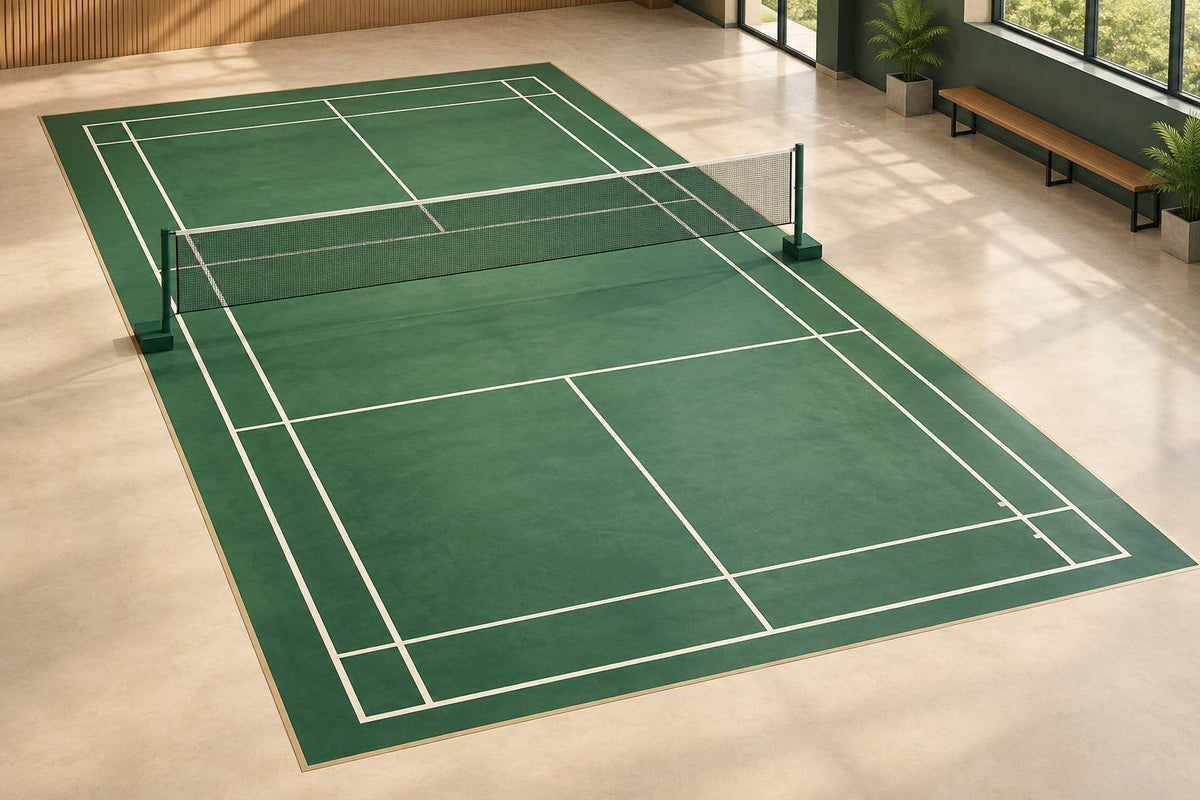
Read a badminton court diagram from the outside in. The outer rectangle is the doubles court, the inner long sidelines are the singles sidelines, and the service markings sit inside the same full-court footprint. Canadian clubs, schools, and community centres use the same BWF court layout as international play, so there is no Canada-specific variation to memorize.
Top-down court diagram labels
Use this as a planning checklist for a diagram or a quick facility audit.
Orange outside border = doubles sidelines and back boundaries. Grey inner vertical lines = singles sidelines. Blue horizontal and vertical lines = service-court markings. The centre black line = the net.
The official BWF court diagram lists the full-court diagonal as 14.723 m and notes that the same court layout can be used for both singles and doubles. That diagonal is also the installer’s squaring check: measure both corner-to-corner diagonals and confirm they match, so the court is a true rectangle rather than a skewed rhombus.
| Diagram label | What to check |
|---|---|
| Overall court | The full 13.40 m by 6.10 m rectangle forms the doubles court and the base layout for the entire diagram. |
| Singles sidelines | These sit inside the doubles sidelines and define the narrower singles playing width. |
| Service lines | Label the short service lines on both sides of the net and the doubles long-service lines near each back boundary. |
| Centre line | This divides each side into left and right service courts, which matters for diagonal serving. |
| Net line | The net crosses the full width at the exact middle of the court length, separating the two halves. |
| Full-court diagonal | Use this as the final squaring check after the outside rectangle is marked. |
One line-marking detail is worth keeping consistent during measurement: badminton court lines are 40 mm wide, and the line belongs to the area it marks, so measure from the same edge of the line each time instead of switching between inside and outside edges.
Serving still feels confusing? Once the boxes make sense visually, read our badminton rules and scoring guide for the serve-rotation and scoring mechanics.
If you are testing movement across the full 44 ft court, use non-marking indoor court shoes. The Babolat Shadow Tour Men's Badminton Shoes (Orange) are in stock at $119.99 CAD. Badminton House ships across Canada, with free Canadian shipping on orders over $200.
Facility Setup: Floor, Ceiling, Lighting, and Footwear
Once the lines and net are correct, the playing environment matters just as much. Canadian courts in clubs, schools, and community centres use the same universal badminton court dimensions as regulation courts worldwide, but comfort and safety depend on the ceiling, floor surface, lighting, and shoes.
Ceiling height: no fixed law, but clears need room
The Laws of Badminton do not specify a minimum ceiling height. In practice, the ceiling should be high enough that clears and high serves are not restricted. If shuttles regularly hit rafters, basketball equipment, or low fixtures, the court may still be marked correctly but it will not play like a proper badminton court.
Floor surface: choose grip and shock absorption
Hardwood and sprung wood floors are common for badminton because they offer appropriate grip and shock absorption. Avoid carpet and overly slick surfaces: badminton footwork involves lunges, split steps, fast side-to-side recovery, and sudden stops across the full 44 ft court length.
Footwear matters on a full-size court. Browse badminton footwear, including the in-stock Babolat Shadow Tour Men's Badminton Shoes at $119.99 CAD, built with non-marking grip for badminton movement.
Lighting: keep it to the sides
Lighting should be positioned along the sides of the court rather than directly overhead. Overhead lights can blind players when they look up to track clears, lifts, and high serves, especially in doubles where players are often looking upward under pressure.
| Setup item | Practical check |
|---|---|
| Ceiling | No minimum is written into the laws, but clears and high serves should fly without hitting the ceiling or fixtures. |
| Floor | Hardwood or sprung wood is common; avoid carpet and overly slick surfaces. |
| Lighting | Place lights along the sides, not directly above the court, to reduce glare when players look up. |
| Footwear | Use non-marking court shoes with reliable grip for lunges, recoveries, and side-to-side movement. |
Badminton House does not currently carry badminton nets, posts, or court-marking equipment. For those setup items, check Canadian badminton specialty retailers or your local club's pro shop.
Which Court Setup Should You Choose?
Use the intended play format first, then check the room, net, lines, and footwear around it. In Canada, there is no separate regional court size: clubs, schools, and community centres use the same regulation BWF dimensions used internationally.
| Situation | Choose this | Why it fits | Watch for |
|---|---|---|---|
| Marking one regulation court | Use the full doubles footprint: 44 ft long by 20 ft wide, with the singles sidelines marked inside. | The official court layout can be used for both singles and doubles, and the full court length is the same for both formats. | Before making lines permanent, square the rectangle with the diagonal check and use a clearly contrasting line colour. |
| Singles-only training | Play inside the singles sidelines: 44 ft long by 17 ft wide. | Singles uses 747 sq ft of playing area. The narrower width keeps rallies from becoming too lateral for one player. | The singles sideline sits 0.46 m in from the doubles sideline, so do not use the outer sideline for singles rallies. |
| Doubles league or school play | Use the full width: 44 ft long by 20 ft wide. | Doubles uses 880 sq ft of playing area and includes the outer sidelines. | For doubles service, the long service line sits 2 ft 6 in from the back boundary; singles service uses the rear baseline as the long service limit. |
| Shared pickleball and badminton space | The 44 ft by 20 ft footprint can work for doubles badminton, but set the net for the sport being played. | A pickleball court and doubles badminton court share the same footprint, but the nets are different. | Pickleball uses 36 in at the ends and 34 in in the middle; badminton is higher at 1.55 m over the doubles sidelines and 1.524 m at centre. |
| Buying net, post, or marking equipment | Check Canadian badminton specialty retailers or your local club’s pro shop. | Badminton House does not currently stock nets, posts, or court-marking equipment. | Confirm the net spans 6.1 m, uses dark fine cord mesh, and has the required white top tape. |
| Player footwear for a full court | Choose non-marking indoor badminton shoes. | Hardwood or sprung wood floors are common for badminton courts, and players need grip and shock absorption for repeated starts, stops, and lunges. | The in-stock Babolat Shadow Tour Men’s Badminton Shoes (Orange) are $119.99 CAD, regular $139.99 CAD, with non-marking grip for moving across the full 44 ft court. |
If your question is about what happens after the court is set up, see our badminton rules and scoring guide for serve rotation and 21-point scoring.
Get Canadian badminton gear advice + restock alerts
Join the Badminton House list for buying checklists, restock alerts, and practical gear advice for Canadian players.
By subscribing, you agree to receive Badminton House emails and can unsubscribe anytime.
That’s the practical court-dimensions checklist we use as players: confirm the 44 ft length, choose the right singles or doubles sideline, check the service lines, then make sure the net and playing surface suit real movement. If you’re unsure what gear makes sense for your court, club night, or school setup, contact Badminton House — we’re happy to help Canadian players choose with confidence.
Prices in CAD · Free Canadian shipping on $200+ · 14-day returns · Canadian badminton specialty shop


Leave a comment
This site is protected by hCaptcha and the hCaptcha Privacy Policy and Terms of Service apply.