
Last updated: July 2026 · Written by the team at Badminton House
Quick Answer: Badminton Net Approach Footwork
Choose the shortest pattern that lets your racket-side foot land before contact without an overreach.
Two step
Best default: from around mid-court, take a small non-racket-leg step, then lunge with the racket leg.
One step
Use this when you are already close to the net, such as near the front service line.
Run
Use a running approach only when you are too far away, then adjust so the racket foot lands at contact.
If you keep arriving late to tight net shots, the problem is usually not your hand. It is the approach: too many players force the same pattern every time, then overreach, jam the shot, or get stuck at the tape. Good badminton net approach footwork starts with reading distance and choosing the step pattern that lets your racket foot land before contact.
Build the movement before adding speed. Start slowly enough to land under control, then add pace only when the same approach still leaves you balanced for the recovery.
In This Guide
Badminton net approach footwork is distance-based, not fixed
Badminton net approach footwork is not a memorized “always two steps” rule. The useful pattern changes with your distance from the shuttle and your natural stride length. A taller player may cover the same space with fewer steps than a smaller player, so judge the pattern by the quality of the arrival rather than by a fixed count.
Use the smallest pattern that lets you reach without stretching or crashing through the net. If your racket-side foot can plant before contact and you can push back without an extra balance step, the distance choice was appropriate.
Set the start: ready stance and split step
Your one-step or two-step pattern only works if the first movement starts from a useful base. Set your feet about shoulder-width apart, with the racket-side foot slightly forward rather than square. Keep the knees softly bent, weight loaded on the balls of the feet, and the racket held up around chest height so your hand is already prepared for a fast net response.
From that position, the split step is the trigger. Make a small hop as the opponent hits the shuttle, land lightly, then push into your first step as you read the direction. The goal is not to jump high; it is to preload the legs like springs so the first movement is explosive instead of flat-footed. If your timing feels late, work through the dedicated badminton split step timing guide before worrying about exact step count.
How the one-step, two-step, and running approaches differ
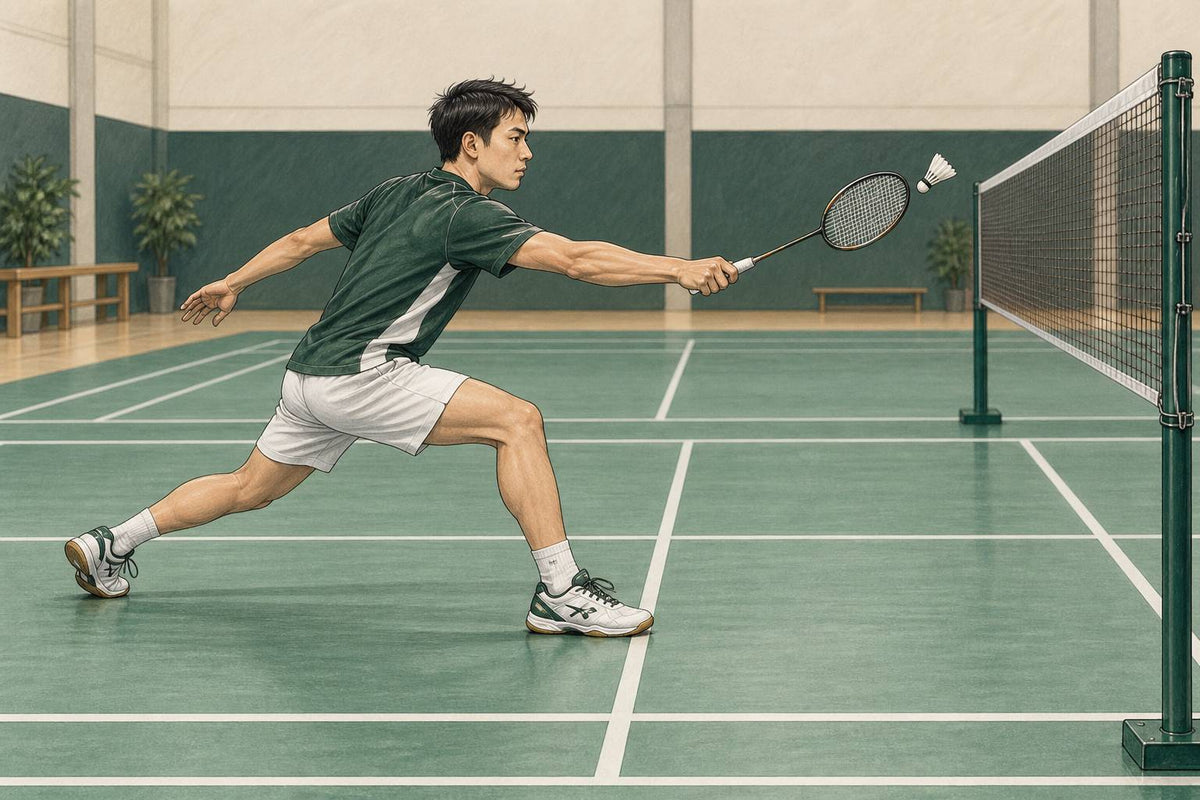
Think of the patterns as different ways to organize the same final lunge: arrive balanced, let the racket foot meet the floor, then play the shuttle with the racket already extending forward. One-step is the simplest: push off, drive the racket leg straight into the lunge, and reach.
In the two-step pattern, the first step is deliberately smaller. Use the non-racket leg to aim the body and create momentum, then let the racket leg cover the final distance. If the shuttle is farther from the front service line, the approach may become running or rush steps, or a shuffle-to-lunge. Running gets you into the forecourt fastest, but it is less stable; shuffle or chassé steps keep the body quieter and make the lunge easier to control.

Final lunge, recovery, and common mistakes
Whatever approach got you to the forecourt, the finish is the same: lunge on your racket-side leg. Land heel-first, rolling heel-to-toe, with the knee bent so you absorb force instead of jamming the joint. Keep your torso and head upright, brace through the core, point the toes toward the shuttle, and keep the knee tracking in line with the foot.
Aim to plant the front foot before racket contact. That timing lets you push back immediately after the shot, rather than falling through the net. If the non-racket leg slides closer after the lunge, treat it as balance support, not an extra approach step. Recovery usually reverses the approach, or uses a dominant-foot-first return pattern back toward ready position. Avoid lunging with the non-racket leg, crashing heavily onto the heel, letting the knee shoot past the toes, or under-aiming the lead leg when the shuttle angle gets wider.
Which net approach should you choose?
Use the shortest pattern that gets your racket leg to the shuttle without reaching. The table below is the practical distance guide; adjust by one step when your stride length or starting balance demands it.
| Court position | Choose | Why |
|---|---|---|
| Near the front service line | One step | Push off and lunge straight in with the racket leg. |
| Around mid-court | Two steps | A small non-racket-leg step points the body and builds momentum before the lunge. |
| Further from the net | Running approach | Sprint forward, then adjust so the racket foot lands as you hit. |
| Unstable or off-angle | Shuffle-to-lunge | Use it when balance matters more than maximum forward speed. |
Get 10% off your first order
Join the Badminton House list and we’ll email you a 10% welcome code — plus training guides, technique advice, and badminton updates.
By subscribing, you agree to receive Badminton House emails and can unsubscribe anytime.
Net approach footwork is one of those details we care about because we play the sport ourselves: the right answer is the one that gets you balanced, early, and able to recover. If you are unsure whether your movement issue is technique, shoes, or both, contact us and we will help you think it through.
Need shoes that support cleaner lunges?
Shop Badminton FootwearBrowse indoor court shoes built for non-slip grip, cushioning, and fast direction changes.


Leave a comment
This site is protected by hCaptcha and the hCaptcha Privacy Policy and Terms of Service apply.