
Last updated: July 2026 · Written by the team at Badminton House
Quick Answer: Badminton Non-Racket Arm
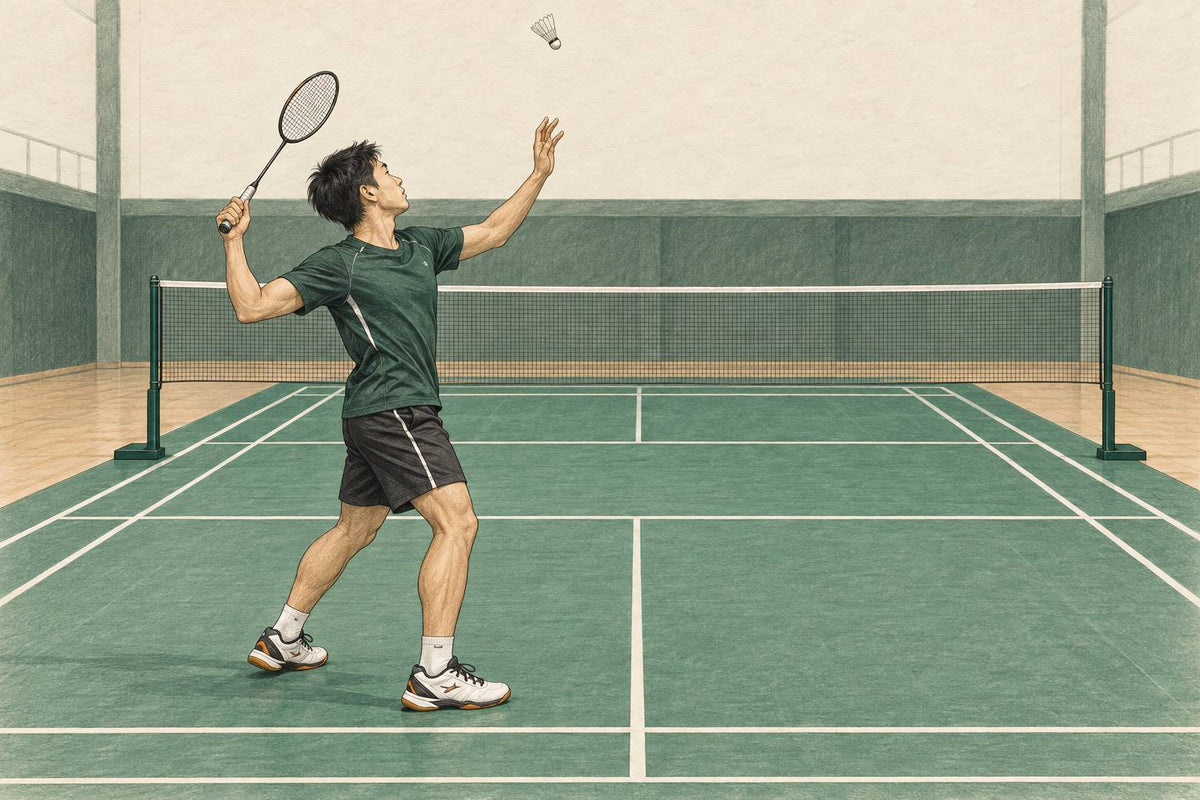
Use the lead arm as a relaxed counterbalance: raise it with the shuttle, keep it active through the load, then let it fold as the racket arm fires.
Drops
Best fix: keep it lifted longer so your racket-side swing does not pull you off balance.
Pulls early
Delay the fold so your shoulders do not open before contact.
Feels forced
Relax the wrist and reach naturally; the goal is balance, not a frozen pointing pose.
If your clears feel powerful in shadow swings but wobbly once the shuttle is above you, check the arm that is not holding the racket. In overheads, the badminton non-racket arm is not decoration: it helps counter the weight and force of the swinging racket arm, gives you a clearer side-on setup, and helps you judge where the shuttle is before contact.
The key is not to copy a frozen “pointing” pose. Good players raise and extend the lead arm naturally, then let it return as the racket side fires.
In This Guide
What the badminton non-racket arm does on overheads

The badminton non-racket arm is not a passive spare limb on clears, drops, and smashes. When it rises during preparation, it helps your body stay balanced while the racket arm loads behind you. It also gives the racket side something to work against, so the swing does not pull your whole upper body off line before contact.
Its second job is orientation. A raised or reaching lead arm helps you turn side-on, set the non-racket shoulder toward the shuttle, and create space for the hips and trunk to load before the racket accelerates. That fits the broader badminton kinetic chain: legs, hips, trunk, shoulder, arm, then hand. The exact look will vary. Coaching sources describe the arm as raised, pointing, or simply out for balance, so the useful target is natural counterbalance, spacing, and body alignment rather than forcing one fixed arm angle for every player.
Timing it through the overhead swing
Think of the badminton non-racket arm as a timing partner. In preparation, turn side-on and line the racket head and non-racket hand toward the shuttle. This gives your eyes, shoulders, and hitting arm the same target instead of chasing late with the racket alone.
In loading, raise or point the lead arm while the racket arm drops back. As the legs push and the hips and trunk begin to rotate, the lead arm stays up long enough to stop the chest opening too soon. Around contact, let the lead arm return down or in as the racket shoulder, arm, wrist, and hand accelerate through the shuttle. That counter-motion helps the swing fire without pulling your body off line.
On follow-through, allow the racket arm and trunk to travel across the body while the lead arm settles near your side. Finish balanced enough to begin your recovery step without an extra stumble.
Common non-racket arm faults that break balance
These faults show up in shuttle flight and recovery, not just in how the swing looks. If the non-racket arm hangs or sags, the racket-side swing force is no longer countered well, so the body wobbles and the shot often becomes a rushed arm swing.
- Pulling it back too early: the shoulders open before the hit, which can lower the contact point and leave the shuttle slightly behind the head.
- Tensing it: a stiff lead arm interrupts the smooth rotation you need for whole-body timing.
- Swinging it forward: instead of counterbalancing the racket arm, it throws your centre off and makes landing less stable.
- Losing it under fatigue: once the arm drops late in rallies, clears can go up but not deep, and the swing shifts toward pure arm power that tires fast and loses the whole-body coordination that makes overheads efficient.
Drills to train the lead arm without forcing a pose
Train the badminton non-racket arm as a rhythm and balance tool, not a frozen pointing shape. Use this short progression:
- Shadow swings: turn side-on, raise the lead arm naturally toward the shuttle line, then let it return as the racket arm accelerates.
- Mirror or video check: look for timing. If the lead arm drops early, your shoulders open too soon; if it stays locked up late, your follow-through gets stuck.
- Seated clears: hit or shadow from a chair to remove leg drive and feel upper-body rotation, contact height, and balance.
- High-feed straight clears: have a partner feed high shuttles; judge success by height, depth, and a quiet balanced landing.
- Overarm throws: without a racket, rehearse the side-on turn, opposite-arm lead, throw, and follow-through.
Balance matters even more on airborne overheads, where you cannot correct with your feet mid-swing. For the full stroke sequence, see How to Hit a Badminton Clear.
Which Non-Racket Arm Cue Should You Use?
Pick the cue that fixes your overhead problem first. The same arm can help balance, spacing, and shoulder rotation, but the emphasis changes by mistake.
| Choice | Choose this if... | Main cue |
|---|---|---|
| Default | Your overhead is generally inconsistent. | Raise the lead arm toward the shuttle, turn side-on, then let it return as the racket fires. |
| Wobble | Your body falls to the racket side after contact. | Keep the arm out as a counterweight until the swing commits. |
| Late contact | You hit behind your head and the shuttle rises without travelling deep. | Use the raised arm for spacing, then move earlier to meet the shuttle slightly in front. |
| Fatigue | Your form fades late in rallies. | Deliberately reset the lead arm during preparation so the kinetic chain can still work. |
Get 10% off your first order
Join the Badminton House list and we’ll email you a 10% welcome code — plus training guides, technique advice, and badminton updates.
By subscribing, you agree to receive Badminton House emails and can unsubscribe anytime.
We play badminton too, so our best advice is simple: make the non-racket arm useful, relaxed, and timed with the whole overhead—not decorative. If you are unsure whether your balance issue is technique, footwork, or racket setup, contact us and tell us what shot breaks down.
When you are ready to dial in your overhead setup, compare racket weight, balance, and flex.
Shop Badminton RacketsCompare racket weight, balance, and flex after your overhead timing feels repeatable.


Leave a comment
This site is protected by hCaptcha and the hCaptcha Privacy Policy and Terms of Service apply.