
Last updated: July 2026 · Written by the team at Badminton House
Quick Answer: Badminton Racket Swingweight
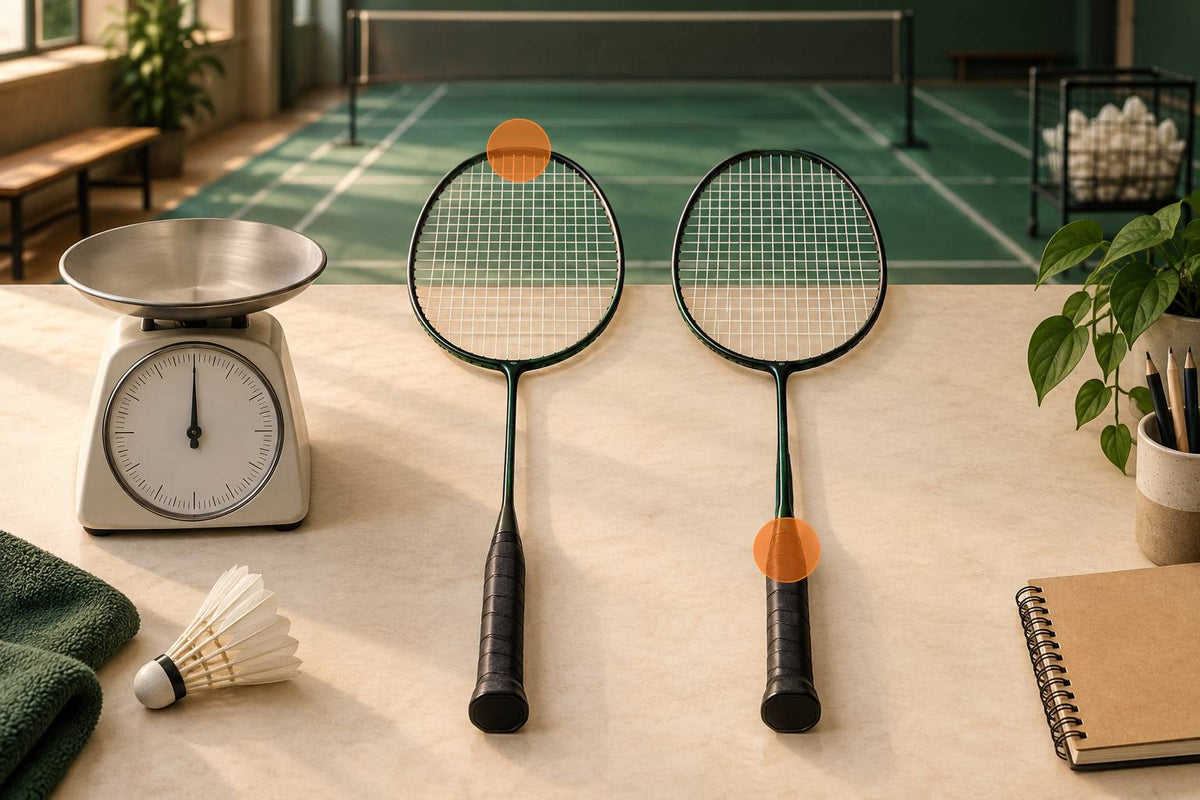
Swingweight is how heavy a badminton racket feels while it is swinging: its rotational inertia around your hand, typically 90–97 kg·cm² measured about an axis 9 cm from the butt end. If you are not sure what to choose, start with a moderate swingweight: quick enough for defence and doubles, but still stable enough for clears and smashes.
Default
Moderate swingweight: the safest starting point for most Canadian club players because swingweight has no universal best value; the right feel depends on your timing, strength, stroke style, and whether you play more singles or doubles.
Lower
Choose this if you value faster handling for drives, defence, interceptions, and net exchanges; it will usually feel easier to accelerate but less forceful through the shuttle.
Higher
Choose this if you want a more powerful, solid feel on clears and smashes and can accept slower manoeuvrability; studies show higher swingweight can reduce racket-head speed without necessarily reducing shuttle speed.
Ever picked up two badminton rackets with the same printed weight (say 4U) and wondered why one feels quick in defence while the other feels like it wants to hammer through the shuttle? That difference is often badminton racket swingweight: how heavy the racket feels while it is moving, not just how many grams it weighs on a scale.
Swingweight is the racket’s rotational inertia. In plain club-night language, it tells you how much the racket resists being accelerated around your hand. A higher swingweight can make the head feel more powerful through impact, but it can also feel slower on drives, blocks, and fast doubles exchanges. A lower swingweight usually feels easier to whip around, but may not carry the same punch on full swings.
The tricky part is that swingweight is not printed clearly on most badminton racket spec sheets in Canada. You’ll usually see weight class, balance, flex, grip size, and tension range (useful specs, but not the full story). This guide explains how swingweight works, why two same-weight rackets can feel completely different, and how to think about speed, power, and control before choosing your next frame.
Choosing a racket in Canada? Browse the live badminton rackets collection for current availability. Badminton House ships across Canada.
In This Guide
- What Does Swingweight Actually Mean?
- Weight vs Balance Point vs Swingweight
- Why Do Two Same-Weight Rackets Feel Different?
- Does Higher Swingweight Slow Down Your Smash?
- There Is No Universal Best Swingweight
- Can You Change a Racket’s Swingweight?
- How to Compare Two Supposedly-Identical Rackets
- Which Swingweight Should You Choose?
What Does Swingweight Actually Mean?

Swingweight is the physics term behind a very familiar feeling: how heavy a badminton racket feels while it is moving, not just how heavy it is on a scale.
Technically, badminton racket swingweight is a moment of inertia, also called rotational inertia. It describes how much the racket resists being rotated around an axis near the handle where you grip it, with that axis running parallel to the stringbed. In plain badminton language: it is how hard the racket is to start, stop, and redirect during a swing.
Quick definition. Swingweight is not the printed 3U or 4U weight. It is the racket’s resistance to rotation in your hand, which depends on both total mass and where that mass sits along the frame.
In badminton testing, swingweight is commonly measured around an axis 9 cm from the end of the handle. Typical badminton racket swingweight values sit around 90–97 kg·cm², with racket masses around 0.085–0.095 kg. That mass range lines up with the kind of weights Canadian players often see on racket listings, such as 4U around 83 g and 3U around 88 g, but swingweight explains why the same weight class can still feel fast, sluggish, powerful, or crisp.
| Term | What it means on court |
|---|---|
| Static weight | How much the racket weighs on a scale, such as a 3U or 4U weight class. |
| Balance point | Where the racket’s centre of gravity sits along the frame, usually felt as head-heavy, even, or head-light. |
| Swingweight | How much the racket resists rotation when you swing, block, drive, defend, or change direction. |
A useful way to picture it is this: extra mass near the handle does not change the swing feel nearly as much as extra mass toward the head, because mass farther from your hand has a much bigger effect on rotational inertia. That is why a racket can feel quick in the fingers even if it is not the absolute lightest model, and why another racket with the same printed weight can feel much heavier once rallies speed up.
When you compare badminton rackets in Canada, treat swingweight as the missing feel number behind the spec sheet. Weight tells you part of the story; balance tells you more; swingweight explains what your hand and forearm actually notice during the shot. For a broader starting point on printed weight classes, see our 3U vs 4U vs 5U badminton racket guide.
Weight vs Balance Point vs Swingweight

Three racket specs get mixed together all the time: total weight, balance point, and swingweight. They are related, but they are not the same thing.
Total weight is simply how much the racket weighs. In the Yonex weight-class system commonly used in Canada, a 4U racket averages about 83 g and a 3U racket averages about 88 g. That number matters, but it only tells you the mass of the whole racket, not where that mass sits.
Balance point is the racket’s centre of gravity, usually measured as a distance from the butt of the handle. If more mass sits toward the head, the balance point moves farther from your hand and the racket feels more head-heavy. If more mass sits toward the grip, the racket feels more head-light. For a deeper breakdown, see our head-heavy vs head-light racket balance guide.
Swingweight is the one players feel most during actual swings. In physics terms, it is rotational inertia: how strongly the racket resists angular acceleration when you try to start, stop, or redirect it. A racket with higher swingweight takes more effort to whip quickly, even if its printed weight looks normal.
| Spec | What it tells you | What it misses |
|---|---|---|
| Total weight | How heavy the whole racket is, such as 4U or 3U. | Where that weight is located along the racket. |
| Balance point | Where the centre of gravity sits, measured from the butt of the handle. | How hard the racket is to accelerate in a real swing. |
| Swingweight | How heavy the racket feels while rotating around your hand. | It is rarely printed on badminton racket spec sheets, so players usually infer it from feel, balance, and frame design. |
The hammer analogy
Think of holding a hammer two ways. Hold it normally, with the heavy metal head far from your hand, and it feels powerful but slower to change direction. Flip it around and hold the metal head, with the lighter handle sticking out, and it becomes much easier to waggle quickly.
The hammer did not change total weight. What changed was the distance between your hand and the mass. Badminton rackets behave the same way. More mass near the top of the frame makes the racket resist rotation more; more mass near the handle has a much smaller effect on swing feel.
Useful rule: grams near the head matter far more than grams near the handle because swingweight depends heavily on distance from the hand, not just total mass.
That distance effect is why small changes at the top of the racket can be obvious. Adding weight at the handle might change the scale reading, grip feel, or static balance, but it has a much lower impact on swingweight because it is close to the rotation point. Adding weight near the frame head changes the swing much more because the distance is larger, and in the underlying physics, that distance effect is squared.
A real shopping example
This is why printed weight classes are helpful but incomplete. For example, the Yonex Astrox 100 ZZ and Yonex Astrox 100VA Game have both been listed in 4U and 3U versions, with 4U averaging 83 g and 3U averaging 88 g. But the Astrox 100 ZZ is listed as head-heavy and extra stiff, while the Astrox 100VA Game pairs its head-heavy balance with a more forgiving medium flex. Same weight class, different shaft flex, different expected swing feel.
| Racket example | Listed weight options | Listed balance | Why it matters |
|---|---|---|---|
| Yonex Astrox 100 ZZ | 4U avg. 83 g / 3U avg. 88 g | Head heavy | A useful example of a power-oriented frame where mass distribution can make the racket feel heavier in motion. |
| Yonex Astrox 100VA Game | 4U avg. 83 g / 3U avg. 88 g | Head heavy (medium flex) | A useful contrast: the same weight classes and balance category can still feel different when the shaft flex changes how the racket loads. |
For Canadian shoppers, the practical takeaway is simple: use U weight classes as a starting point, then compare balance and expected swing feel. If you want the weight-class foundation first, read our 3U vs 4U vs 5U badminton racket guide.
You can also browse the live badminton rackets collection for current availability, but treat the spec sheet as the beginning of the decision — not the whole decision.
Why Do Two Same-Weight Rackets Feel Different?
Printed weight is only the starting point. Two rackets can both say 4U or 3U on the spec sheet, but if one carries more of that mass toward the head, it can feel much heavier during the swing.
A useful badminton study made this point very clearly: ten lightweight frames were customized into five equal-mass rackets with increasing swingweight by applying lead tape at specific points on the racket frame. In plain English, the rackets were made to weigh the same overall, but the mass was moved around so they resisted swinging by different amounts.
Same scale weight, different swing feel. That is the core reason swingweight matters: your hand feels the racket rotating, not just sitting still on a scale.
This is why a player can pick up two rackets with the same U-weight and immediately say one feels faster, one feels meatier, or one feels harder to whip through defence. The difference is not imaginary. It comes from rotational inertia: mass farther from your hand has a bigger effect on how hard the racket is to accelerate.
| Canadian-market example | Printed weight options | Listed balance | What the spec sheet does not fully show |
|---|---|---|---|
| Yonex Astrox 100 ZZ | 4U avg. 83 g / 3U avg. 88 g | Head heavy | More mass toward the head can make the racket feel more demanding to accelerate, even before you consider shaft flex or string setup. |
| Yonex Astrox 100VA Game | 4U avg. 83 g / 3U avg. 88 g | Head heavy | The same printed 4U and 3U weight classes and balance category can still feel easier to accelerate and time when the shaft is a more forgiving medium flex instead of extra stiff. |
If you are comparing rackets online in Canada, treat U-weight as the first filter, not the final answer. After that, look at balance, shaft flex, and the type of shots you rely on most. For a deeper weight-class breakdown, see our 3U vs 4U vs 5U badminton racket guide; for balance, see our head-heavy vs head-light racket guide.
Browse Badminton Rackets — Live Canadian Availability
Ships across Canada · Availability changes
Does Higher Swingweight Slow Down Your Smash?

Here is the counterintuitive part of badminton racket swingweight: a higher-swingweight racket can slow your racket head down without making the shuttle leave slower.
In a controlled badminton smash test, increasing swingweight reduced racket head speed by an average of 0.7 m·s⁻¹ for every 5 kg·cm² increase. But that reduction in swing speed did not lead to slower shuttlecock speeds.
Plain-English takeaway
A heavier-feeling swing is not automatically “worse” for power. It may move slower through the air, but it can carry more effective mass into the shuttle at impact.
Why the shuttle does not necessarily slow down
Two things explain the result.
- Higher effective mass at impact: for a given impact location, a higher-swingweight racket behaves as if there is more mass behind the shuttle. That can help preserve shuttle speed even when the racket head is moving slightly slower.
- More distal impact location: as swingweight increased, impact was associated with a more distal longitudinal location (in simple terms, contact occurred farther from the hand along the racket’s length). That impact-location change also helps explain why shuttle speed did not drop.
| As swingweight increases | What tends to happen | What it means on court |
|---|---|---|
| Racket head speed | Dropped by about 0.7 m·s⁻¹ per 5 kg·cm² increase | The racket can feel slower to accelerate, especially on fast exchanges. |
| Shuttlecock speed | Did not become slower in the group result | A slower-feeling swing can still produce a strong smash if you time it well. |
| Effective mass | Higher for the same impact location | More of the racket’s inertia is delivered into the shuttle. |
| Impact location | Associated with a more distal longitudinal contact point | Contact farther from the hand can help offset the lower racket head speed. |
What this means for choosing a racket
This is why “speed racket” and “power racket” are not just marketing labels. They describe a real trade-off: lower swingweight tends to feel quicker and easier to accelerate, while higher swingweight can feel more demanding but more solid through impact.
For a rear-court player who has enough timing and strength, higher swingweight can make sense for smash pressure. For a doubles player who lives on drives, blocks, interceptions, and fast defensive changes, too much swingweight can make the racket feel late even if the smash still has power.
Choosing for speed vs power? If your main complaint is “my racket feels late,” look for a quicker-feeling setup before chasing more smash weight. If your timing is good but your smash lacks punch, compare head-heavy or higher-swingweight options in the badminton rackets collection as availability changes.
If you are trying to connect racket feel to your actual stroke, pair this with the technique side: a powerful racket still needs clean timing, relaxed acceleration, and good contact. Our guide to improving your badminton smash and head-heavy vs head-light racket guide are good next reads.
There Is No Universal Best Swingweight
The mistake is treating badminton racket swingweight like a simple upgrade scale: low is beginner, high is advanced, and higher always means more power. Real play is messier. Individual players can perform better with a particular swingweight, and that “right” number depends on timing, strength, swing path, stroke preference, and how cleanly they contact the shuttle.
In controlled racket testing, the group result showed that higher swingweight reduced racket head speed but did not reduce shuttle speed overall. The individual results were more interesting: some players had racket head speeds up to 5 m·s⁻¹ different between rackets, and some even produced greater racket head speed with higher-swingweight rackets. That is why two club players can borrow the same head-heavy frame and come back with opposite opinions: one feels extra punch, the other feels late on every fast exchange.
A better way to think about “best”
The best swingweight is the one that lets you hit your most important shots on time, not the one that sounds most powerful on paper.
For example, a higher-swingweight racket may help a player who has a long, committed overhead swing and wants more stability through the smash. But that same racket can be a problem in defensive blocks, quick drive exchanges, counter-attacks, and attacking net shots, where manoeuvrability and fast racket head acceleration matter more than carrying mass through impact.
This is also why printed weight classes do not tell the whole story. Yonex’s common Canadian-market weight labels include 4U at about 83 g and 3U at about 88 g, but two rackets in the same 4U or 3U class can still swing very differently if their mass is distributed differently. Availability changes, so use the live badminton rackets collection rather than assuming a specific model is available.
If you are choosing a racket in Canada, start with your game first: do you win more points from full overhead attacks, fast doubles exchanges, defence-to-attack transitions, or tight net pressure? Then choose weight, balance, flex, and string setup around that pattern. For a broader step-by-step framework, use our badminton racket selection guide.
Canadian buying note. Badminton House ships rackets across Canada, so it is worth checking the live collection when comparing your next setup.
Can You Change a Racket’s Swingweight?
Yes — a racket’s swingweight can be modified by adding mass to the frame. In practical badminton terms, that usually means small amounts of lead tape or tungsten putty placed on the racket head or hoop.
The important part is where the mass goes. Adding weight near the handle has a much smaller effect on swingweight, while adding mass farther from your hand (especially around the hoop or head) increases the racket’s resistance to being accelerated through the swing. That is why a small change near the top of the frame can feel more dramatic than the same added mass near the grip.
Treat customization as fine-tuning, not a shortcut. If your racket already feels too slow in defense or flat exchanges, adding mass to the head will generally push it further in that direction.
This is also where swingweight separates itself from simple “weight class” thinking. A 4U racket can be made to feel more demanding if extra mass is placed high on the frame, while a heavier racket with mass concentrated closer to the hand may still feel easier to move than expected.
For most Canadian club players, the safer path is to first choose a racket with the right general weight, balance, and flex for your game, then use customization only if you know exactly what you are trying to change. If you want the dedicated step-by-step explanation, read our badminton racket lead tape balance guide.
How to Compare Two Supposedly-Identical Rackets
Two rackets of the same model and weight code are rarely exact twins. A U code is a weight band, not an exact gram figure, and the quoted weight is usually the bare, unstrung frame. String, grommets, grip, and overgrip all shift the finished racket you actually swing. To separate a genuine build difference from a setup difference, match one string, one tension, and one grip choice across both frames, then measure in stages:
- Bare frame: record total mass, balance point, and swingweight.
- Strung frame: repeat the three numbers after stringing.
- Finished racket: repeat again after the final grip setup.
Where the gap first appears tells you the cause: a difference in the bare measurements points to manufacturing tolerance or mass distribution; a gap that appears only after stringing points to the string or grommet setup; a gap after gripping points to handle build, wrap length, or overlap. Even matched numbers can still feel different (vibration and node location affect comfort at impact), so play-test the pair on court before chasing a perfect clone.
Which Swingweight Should You Choose?
There is no universal “best” badminton racket swingweight. The right choice is the one that lets you play your main strokes well without making your weakest situations worse. If you cannot measure swingweight directly, choose by on-court feel: how fast the racket accelerates, how stable it feels at impact, and whether it helps or hurts your defence, drives, net attacks, and full-power shots.
| Choose this feel | Best fit | What to expect | Main trade-off |
|---|---|---|---|
| Lower swingweight feel | Players who prioritize manoeuvrability, quick defensive reactions, attacking net strokes, and fast racket-head acceleration. | The racket should feel easier to start, stop, and redirect during quick exchanges. | A lower swingweight carries less force into the shuttle than a higher-swingweight racket at the same swing speed. |
| Moderate / familiar feel | Most players who are unsure, especially if they play both singles and doubles or want one racket for mixed situations. | This is the safest starting point because swingweight has an individual optimum: one player may perform better with a different swingweight than another player using the same printed weight class. | It may not maximize either extreme: pure quick handling or maximum mass through contact. |
| Higher swingweight feel | Players who like a more solid, powerful-feeling racket and can still time their full swings cleanly. | Higher swingweight typically lowers racket-head speed, but that does not automatically mean a slower shuttle. Greater effective mass at impact can help preserve shuttle speed. | It can hurt defensive strokes or attacking net strokes where fast acceleration and manoeuvrability matter most. |
| Customized feel | Players who already know what their current racket lacks and want small, deliberate changes. | Adding mass toward the hoop or head increases swingweight; mass near the handle has much less effect because distance from the swing axis matters so much. | Small changes can make a racket feel noticeably different. Test gradually and read our badminton racket lead tape balance guide before modifying a frame. |
Shopping tip: do not choose by 3U or 4U alone. Yonex’s listed weight classes put 4U at about 83 g and 3U at about 88 g, but swingweight also depends on where that mass sits along the frame. Check the live badminton rackets collection for current availability, then compare weight class together with balance and flex.
A practical rule: if you often feel late on defence, drives, or net kills, move toward a quicker-feeling setup. If your timing is clean but your full swings feel like they are not carrying through the shuttle, a higher-swingweight feel may suit you better. If both matter equally, stay closer to a familiar, controllable feel and refine from there.
Get 10% off your first order
Join the Badminton House list and we’ll email you a 10% welcome code — plus subscriber-only restock alerts, giveaways, and honest gear advice from players.
By subscribing, you agree to receive Badminton House emails and can unsubscribe anytime.
Swingweight is one of those racket details that makes more sense once you have felt a few frames side by side. If you are trying to choose between quicker handling, easier defence, or more power through the shuttle, contact us for advice. We play badminton ourselves and can help you narrow the choice based on your level, stroke style, and what your current racket feels like.
Find a badminton racket that actually fits your swing.
Shop Badminton RacketsShips across Canada · 14-day returns · Canadian badminton specialty shop

Leave a comment
This site is protected by hCaptcha and the hCaptcha Privacy Policy and Terms of Service apply.